
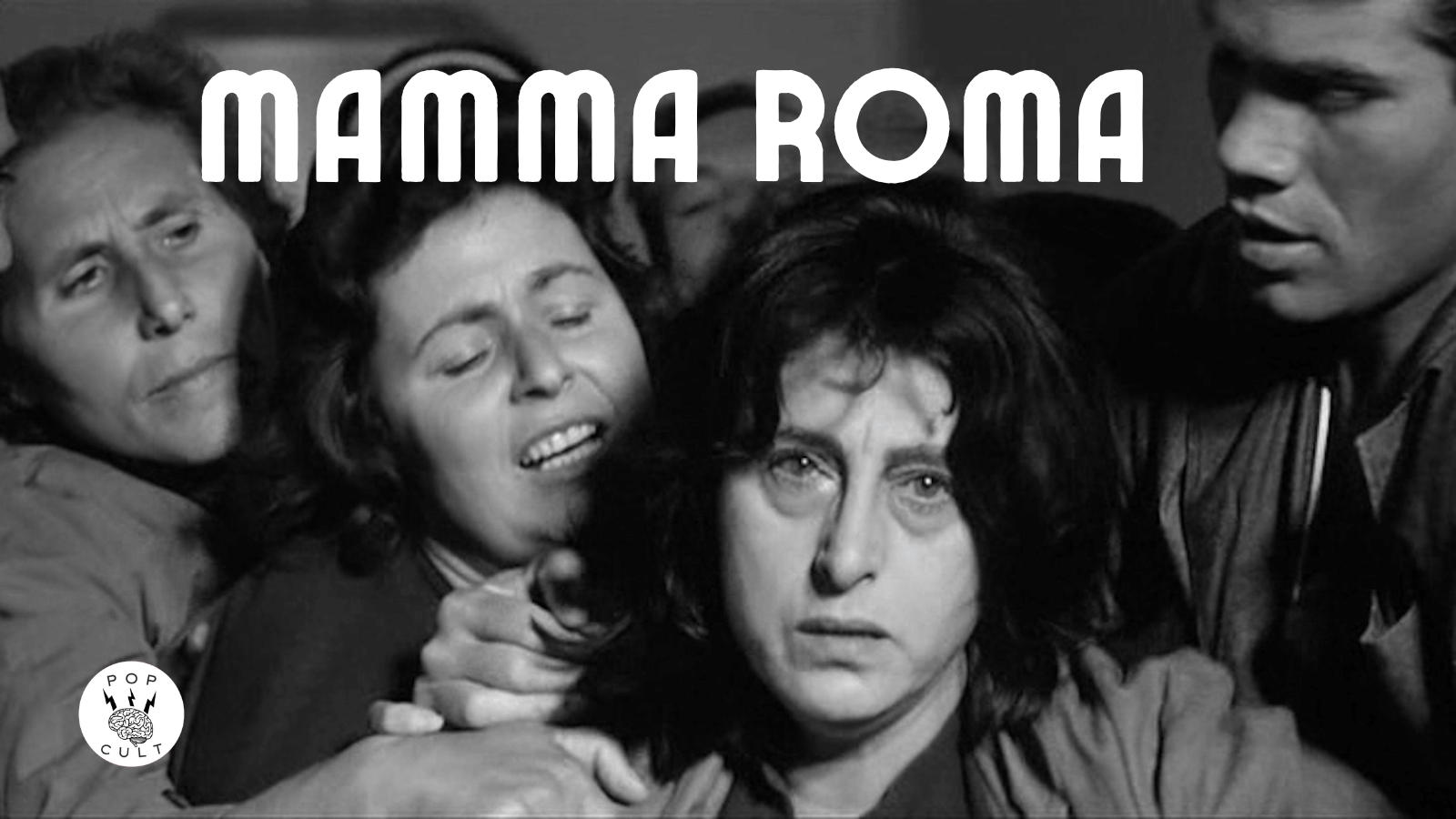
Mamma Roma (1962)
Written and directed by Pier Paolo Pasolini
Pasolini’s work stands out from his Italian peers of the era. He’s completely caught up in doing his own thing, making movies with a particular style nobody else brought to the table then. While his first few films, like this one and Accattone, are set contemporaneously, the filmmaker would quickly lose interest in that and dive deeper into the past through classic stories that shaped the world he was born into. Pasolini also held peasants in high regard, even though, as a gay man, he was often the subject of hate from them. That hate, of course, was stoked by the remnants of Italian fascism & generations of patriarchy that lie dormant until their more recent return to prominence (see Italy’s current fascist PM). Mamma Roma is a story of a peasant rising from her “lowly” beginnings to finally have a peaceful, more secure life, only to deal with challenge after challenge.
Mamma Roma (Anna Magnani) is finally free after years of working for Carmine, her pimp. He’s marrying and leaving the life of sex work behind, which means she is out from under his thumb. The most important thing for Mamma is reunification with her estranged sixteen-year-old son, Ettore. He’s surprised to see her when she shows up, offering a new, better life. Ettore remains skeptical because she hasn’t been there before for him. Mamma gets her boy a job as a waiter after blackmailing the restaurant’s owner. That’s not enough to keep Ettore from hanging out with young men she sees as dangerous and leading him down a dark path. He’s also getting cozy with Bruna, a sex worker in the neighborhood, and that scares Mamma the most. Then Carmine returns, wanting to coerce Mamma into making him more money. It seems that her dream is about to fall through her fingertips.
Like Accattone, this fits with the rest of the post-war Italian neorealism that had gained a foothold in the culture. While its setting is contemporary and its subjects are the underclass, Pasolini isn’t interested in gritty realism. He is adamant that the lives of the poor are as beautiful, if not more than the wealthy class. There is a truth to the peasant, often tragic but also quite full of joy, that most mainstream art ignores. There are moments here where the surroundings take on surreal qualities, and it feels like we’re floating through a dream with Mamma.
Where the neorealists seek grounded or muted emotions, Pasolini’s work overflows with them. Anna Magnani, a well-established Italian actor of the era, delivers her authentic performance in an operatic, over-the-top style. She has shaped a larger-than-life personality, most likely to hide the scars of an existence spent scrambling for crumbs and reluctantly selling her body. She’s so elated to be reunited with Ettore, to give him a mother he never had, and a chance at a better life. The juxtaposition of these themes and her performance elevated Mamma Roma into the realm of grand tragic operas.
Mamma is bringing her son into the world of the petit bourgeois. Rows of identical housing flats where she sells produce from a stand on the outskirts of Rome. Pasolini understands all of this is just a cheap reproduction of the luxury the wealthy class has. It’s a pretty painted-up knock-off reflecting how Mamma feels about herself in this environment. She’s posing as one of these people while acknowledging her peasant roots will forever define her. Mamma is a woman seeking redemption in a newly shaped system of automated consumption. As soon as she begins to experience some joy in this new place, it starts being taken away.
What’s happening on a greater scope here is that Mamma Roma represents post-war Rome. It’s never clearly defined who Ettore’s father is, if he has any, to begin with. Mamma is an amalgam of the Madonna and the Whore, which, from Pasolini’s perspective, is an excellent way to personify what was happening to Rome. Carmine makes mention of a hypothetical father, claiming he was an underage country boy who Mamma seduced and “left at the altar.” In this twisted scenario, the descriptions of her unseen lover come to resemble Ettore, who starts up a relationship with a sex worker of his own. Mamma sees her past repeating itself before her own eyes. Time is a flat circle, they say.
Mamma Roma was a controversial film, as so much of Pasolini’s work would be. He certainly loved the grand drama of it all, even getting into public spats in the press about how much he disliked Magnani’s performance. He blamed it on her; she said she didn’t like her performance either but blamed it squarely on the man directing her. At its Roman premiere, neo-fascists stormed the theater, and a minor riot broke out. These scandals and claims of public indecency would fuel Pasolini as a public figure. In my opinion, his work is never marred by these external goings on. It is always focused on the ideas of beauty found in places most people consider ugly.

 PopCult Reviews
2 thoughts on “Movie Review – Mamma Roma”