
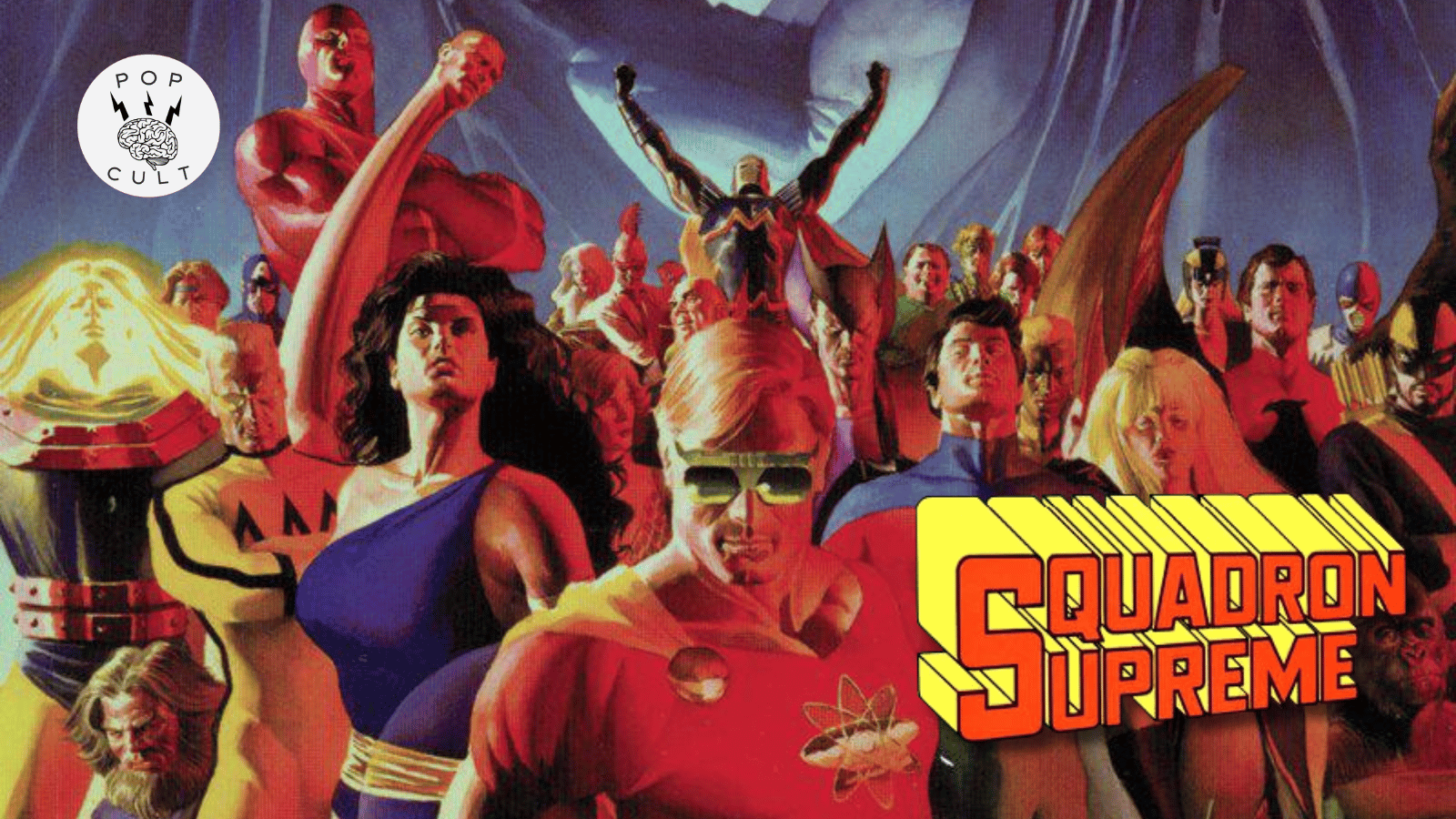
Squadron Supreme (2021)
Reprints Squadron Supreme #1-12 and Captain America #314
Written by Mark Gruenwald
Art by Bob Hall, Paul Ryan, John Buscema, and Paul Neary
In 1969, writer Roy Thomas and artist Sal Buscema pitted the Avengers against the Squadron Sinister, a team of slightly familiar villains created by the bigger baddie Grandmaster. The creators intended it to be a DC Comics’s Justice League pastiche. The characters and their counterparts were as follows: Hyperion/Superman, Nighthawk/Batman, Doctor Spectrum/Green Lantern, and The Whizzer/The Flash. The idea would stick around and be reworked by Mark Gruenwald with a retconned explanation that these villains were based on the Squadron Supreme, the premier hero team of another Earth in Marvel’s Multiverse. Nighthawk would eventually cross over to the main Marvel Earth and join the Defenders for a short time. In 1985, Gruenwald took the idea further and devoted a year-long mini-series to this team. It’s a story noted as a possible inspiration for Mark Waid & Alex Ross’s Kingdom Come.
Following events in the pages of The Defenders, Earth 712 – the home of the Squadron Supreme – was left in a post-apocalyptic state. Nighthawk had become president of the United States, and he and his team were under the control of a supervillain. With the world in such an awful state, the collected heroes agree they will use their powers and authority to transform the Earth into a utopia. This is done without consultation with the rest of the people and drives a wedge between Nighthawk and the team. Tom Thumb, the team’s resident inventor, creates a device that will allow them to forcibly modify the behavior of their foes, which is another red line for some members. The more the Squadron seizes power, the more they begin to look like the forces they hoped to drive out of the world.
Squadron Supreme had the unfortunate luck of being published around the same time as significant events like Crisis on Infinite Earths and more mature stories like Alan Moore’s Watchmen and Frank Miller’s The Dark Knight Returns. Marvel never went too far in the direction of those books in the 1980s, so Squadron is a strange inbetween book. It looks and reads like a typical Marvel comic with lots of exposition to fill readers in. However, the themes and fates of some of these characters are much darker & harrowing than you would expect from Marvel.
Nuke, the team’s answer to DC’s Firestorm, discovers his parents are both dying of radiation poisoning linked back to his powers. I know I immediately thought of Dr. Manhattan from Watchmen and the effect his similar aura of radioactivity had on his loved ones, having to remember this was before that comic was published. Moore handles Manhattan’s tragedy with more maturity, though; the lack of the stoic Doctor’s emotions clash with his former paramour’s doomed state. In Squadron Supreme, Nuke reacts the way you expect a young hothead in the Marvel Universe to do. That difference in style is one of the big things that reminds us why Squadron is well-regarded but will not be seen as a classic of the medium.
There’s also a reference to the Squadron Sinister Hyperion, who shows up to replace the heroic version for several issues. This relies on many references to other comics; when you’re met with so many walls of text, it can be a turn-off. An appearance by Nighthawk in the pages of Captain America during this series’ run (Gruenwald wrote that book, too) introduces some pretty vital characters. However, that reprint is put at the end of the book. So, as I was reading, there are suddenly three new characters interacting with Nighthawk, and the Squadron issue doesn’t provide much context other than an editor’s note to read the Cap issue.
The story is compelling, and something comics fans have debated for years. Questions like, “Why doesn’t Superman just destroy all the military weapons on Earth?” are answered here. The Squadron engages in a forced round-up of firearms and is met with plenty of resistance from people not too keen on giving them over, seeing as how these heroes recently were wreaking havoc on Earth, albeit mind-controlled. The ability to change someone’s behavior takes a darkly toxic turn when the Golden Archer uses it to make Lark love only him. The way it’s presented in the typical Marvel style makes this subplot come off even more disturbing. Gruenwald doesn’t linger too much because I think he’s not as comfortable in this territory as other writers, particularly the British transplants who were coming to prominence at the time.
I think Gruenwald puts forth a valiant effort here, pushing the story as much as he feels comfortable into commenting on the limits of power and how unchecked authority will lead to ruin. Kingdom Come is an extension of these themes, going even darker and with art of an exemplary quality. The art here is…well, typical Marvel. Paul Ryan is one of those pencilers I remember from when I was a kid in the 1990s and reading Fantastic Four and The Avengers. Even then, I felt it was very generic, the sort of thing you expect from Marvel Comics. Would I prefer Ryan’s work over the “superstars” of the 90s era like Leifeld and Silvestri? Yeah, I think I do. But I couldn’t help thinking about the art in books with similarly themed comics and how this was underwhelming.
The conclusion reached here is a strong endpoint for the Squadron. But because they are part of the Marvel Universe, they were brought back and reappeared every few years since. There was a brief Mature Readers series by J. Michael Straczynski that is exploitative trash. The main Marvel continuity version is clearly different from the one from this 1980s mini-series, but there’s such a gap in my knowledge of this element of comics I couldn’t articulate it all. I don’t know If I would recommend this comic. If you’ve heard about it and are curious, then by all means, but if you want this type of story written in a more mature style, you have far better choices.

 PopCult Reviews