
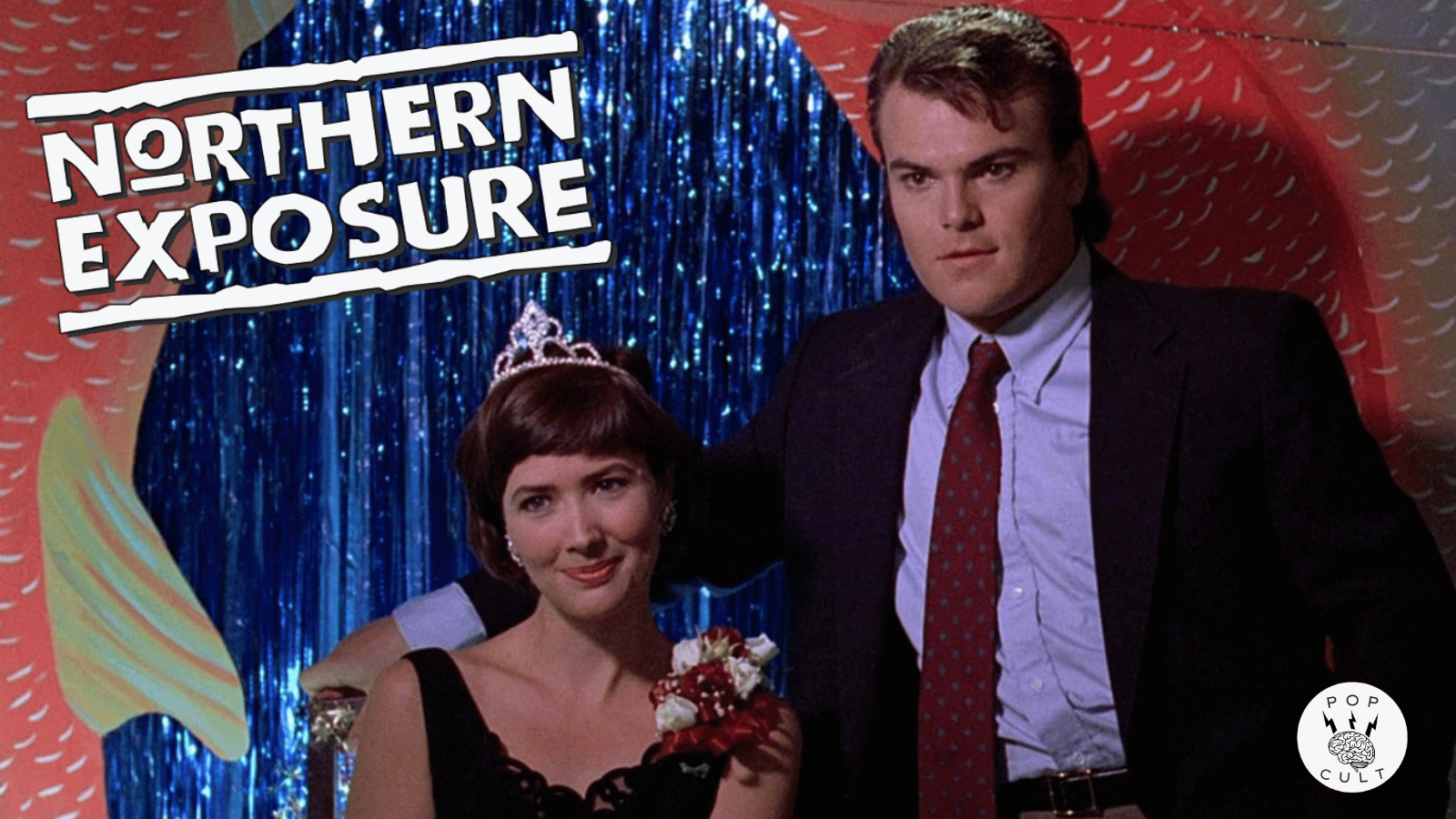
Northern Exposure Season Five (1993-94)
Written by Diane Frolov, Andrew Schneider, Rogers Turrentine, Mitchell Burgess, Robin Green, Jeff Melvoin, Barbara Hall, David Chase, and Jed Seidel
Directed by Daniel Attias, Michael Fresco, Jim Charleston, John David Coles, Nick Marck, Mark Horowitz, Michael Katleman, Michael Lange, Michael Vittes, Oz Scott, Bill D’Elia, Lorraine Senna, Tom Moore, and James Hayman
Joshua Brand and John Falsey, the co-creators and showrunners of Northern Exposure, were dealing with some stress by the end of season four. They had helped create shows like St. Elsewhere and I’ll Fly Away, but with this series, they finally found something they could cultivate and grow. The first problem came when writer Sandy Veith sued Universal, the production company behind NE, claiming they had stolen his idea and given him no credit or compensation. Universal may have cribbed some of Veith’s ideas and fed them to Brand & Falsey, who didn’t know where they had come from. Veith’s script was about an Italian-American doctor working in a small town in the U.S. South. Falsey was struggling with alcoholism and related sickness. He would be in that fight until his passing in 2019. It felt like it was time to leave. Who would they be replaced with? Cue David Chase.
Chase knew Brand and Falsey as he served as executive producer on I’ll Fly Away. With that show’s cancellation, he was available, and Universal assigned him to Northern Exposure. Brand would later say Chase ran the series into the ground. Chase admitted in interviews years after that he’d only taken the job for the money and disliked the entire premise of NE. By the time the show reached the end of its sixth season, so much had been changed that fans quickly turned their backs on it.
That isn’t immediately apparent when season five begins. I immediately noticed that episodes were being shot in a slightly different style. The lighting and camera angles/movements felt more cinematic. Chase must love an arc-shaped tracking shot because so many episodes have one – the camera starting at point A, curving as it moves along the track to stop at point B on the other side. The shift in the stories is subtle. The quirky comedy you expect from Northern Exposure is still there but feels a little more restrained. Instead, stories take on a slightly heavier, more dramatic tone. Ruth Anne feels a little bitchier, and Chris feels a little less philosophical. Maggie and Joel finally get together without much fanfare.
The Three Doctors, Heal Thyself – Ed in Season Five
The character subject to the biggest shift is Ed Chigliak. Up to this point, Ed had been several things in the show. He was the town’s resident cinephile, reflecting the writers’ tastes for classic films. Ed was also Ruth Anne’s stock boy and the gopher for Maurice. With season five, another aspect suddenly added to Ed’s character that I don’t think entirely worked. The season premiere, “The Three Doctors,” sees Graham Greene’s Leonard return. With Joel sick, Leonard steps in and treats Ed who is waking up in high places, having sleepwalked there. Leonard’s diagnosis from the things Ed shares is that the young man is meant to be a shaman.
Until now, Ed’s main ambition had been to become a film director in Hollywood. From a writing perspective, this creates an interesting tension. Ed is mixed; with his parentage split, so are his ambitions. One part wants to move to California and make movies; now, there’s a pull from his Indigenous side to stay and serve his community. This focus on personal dilemmas rather than strange situations colors the entire season. However, Chase isn’t against the strangeness, as you know if you’ve seen The Sopranos. He uses it more sparingly than viewers would have been used to in previous seasons.
In “First Snow,” the show tackles end-of-life planning as Joel struggles with a patient who chooses to die in a few days. There’s nothing medically wrong with her, and this causes a true psychological crisis for the doctor. His entire focus is the preservation of life, but now he sees how, for someone who has lived as long as this woman, death is not something feared but seen as a relief. It’s the natural end of a long life.
That kind of good but heavy episode is offset by something like “Mr. Sandman,” where the aurora borealis appears responsible for people getting their dreams mixed up. Ron, one half of the gay couple that runs the local Bed and Breakfast, starts having dreams about women’s shoes only to realize these are hidden desires of Maurice. Holling feels a sudden repulsion towards food, which is solved by Maggie, who discovers they have swapped dreams. All the while, Joel, a man of science, tries to argue that this can’t be possible.
Shelly’s pregnancy is a big part of the first half of this season. She’ll still singing when the season premieres, much to my disdain, but they jettison that quickly. The best episode with her has got to be “Hello, I Love You,” where Shelly heads off to the laundromat (a new set used quite a bit at the start of the season and then abandoned). While there, she meets a little girl named Miranda, whose mother has stepped out. Shelly’s motherly instincts seem to awaken, and she finds herself happy to ask the little girl questions about her life. Later, while returning to pick up the washed clothes, Shelly searches for Miranda but only finds a twelve-year-old girl. This girl also happens to be named Miranda. This continues until Shelly realizes she’s somehow seeing her baby and the person she’ll become.
But there are clear signs that the quality of episodes is going downhill. That is most obvious with “Grand Prix,” a late-season entry. Actor Barry Corbin (Maurice) had been absent for several episodes after breaking his foot. When Maurice shows up, the break is written into the episode and used to justify this premise. While doing PT, Maurice befriended several wheelchair users and decided to host an international race in Cicely. What makes it feel even more off is the absence of Joel. Rob Morrow was negotiating a new contract behind the scenes. Like Joel, he was dissatisfied with the lack of growth he was experiencing. For all his lessons learned, Joel still felt like a lazy sitcom character to Morrow, always defaulting back to his disdain for Cicely. With Joel gone, a guest star doctor on one racer’s team opposes Ed when a cure is debated for this racer’s sudden struggles.
“Lovers and Madmen” should have been the series finale. It ends with Joel telling Maggie he’s realized he’s a Cicilian now wholly integrated and accepting of this town’s strangeness. That’s spurred on by his discovery of a slowly melting wooly mammoth from a nearby glacier. The doctor attempts to get professionals into town so he can show off and take credit for his finding. Yet, when they do show up, the mammoth is nowhere to be found. Walt has butchered it to prepare the meat for cooking and serving. I can’t imagine it would be safe to eat mammoth, but this is a fantasy world, so I’ll let it slide. By the end of these, there’s a definite feeling that something has shifted. As we go into season six, it will only get worse.

 PopCult Reviews
One thought on “TV Review – Northern Exposure Season Five”