
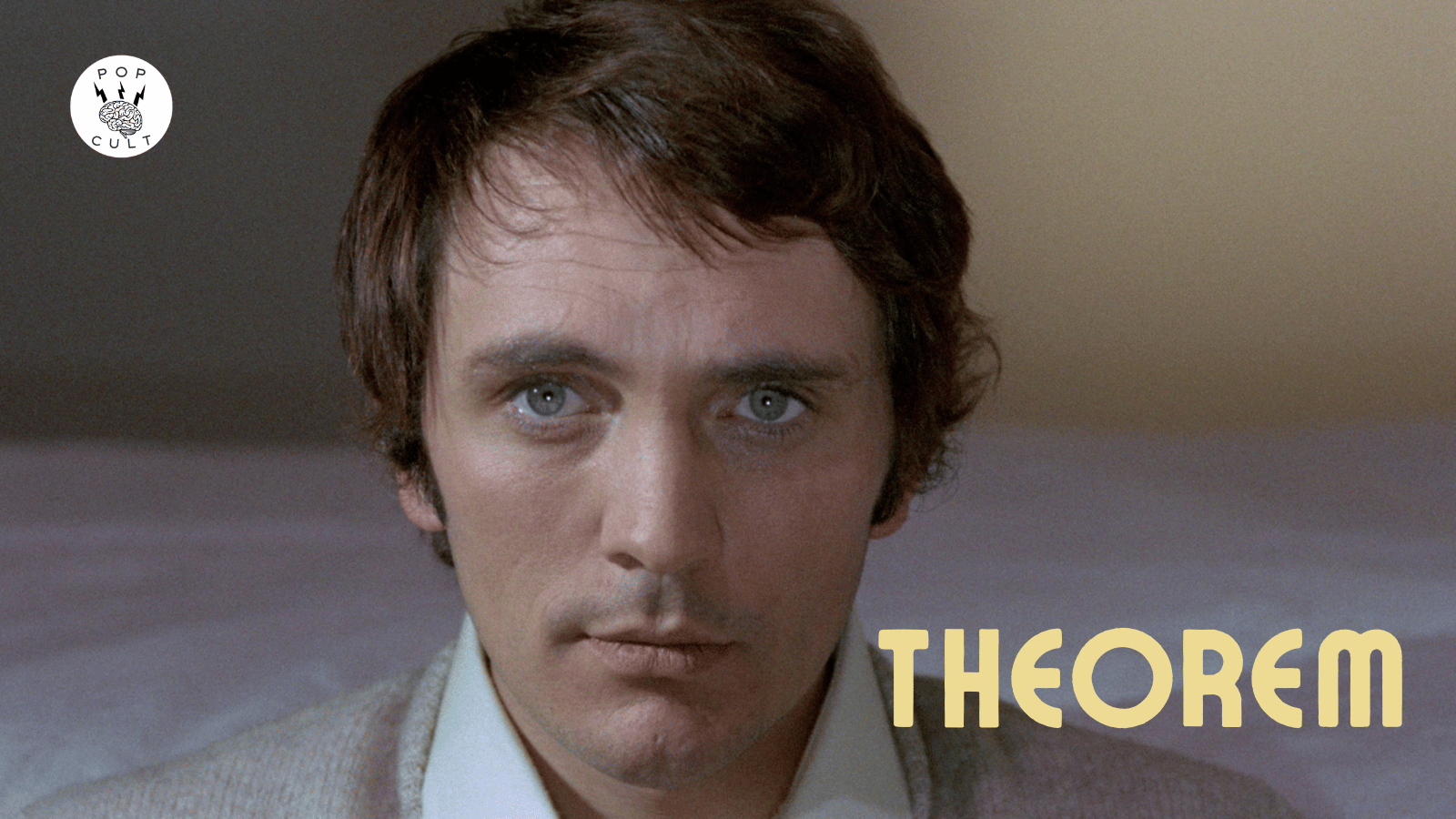
Theorem (1968)
Written and directed by Pier Paolo Pasolini
Stop me if you’ve heard this one. A visitor (Terence Stamp) appears in the lives of a bourgeois Italian family. This stranger goes about having sexual relationships with every member of the household. That’s the shy daughter, the repressed mother, the deeply disturbed father, the sensitive son, and the devoutly religious maid. The stranger barely speaks a word but seems to provide each person with the type of care & attention they are in desperate need of.
At one point, he saves the maid from a suicide attempt. This visitor’s arrival was marked by the appearance of an overexcited mailman. When that mailman returns, the stranger will go. However, with his departure, those he loved and cared for have a horrifying realization that their lives are meaningless, and madness ensues.
If the plot of Theorem sounds familiar, it’s because variations of it have been used in film for years. Takashi Miike’s Visitor Q immediately came to mind for me. However, that film, like so much of Miike’s work, revels in the depravity of these characters and puts them in extreme situations. The recent film Saltburn has a similar plot, with outsiders injecting themselves into the lives of wealthy families and overseeing their downfall. There was even a sketch on the 1990s comedy sketch comedy series Mr. Show where David Cross’s character, a visitor who won’t leave, reveals he’s been having sex with everyone, even the kindly old grandfather.
The title of the film reveals some of Pasolini’s intent. “Teorema” in Italian doesn’t simply mean a reasoned proposition. It can also refer to “spectacle” or “intuition.” The film is one of Pasolini’s most tightly structured, much like a mathematical formula. It unfolds in a precise way; the middle section of the film is partitioned into “seductions,” “confessions,” and “transformations.” Those confessions are to the visitor as he leaves and involve each person admitting how they genuinely feel about this strange person who has upset their lives. Everyone except the maid. She undergoes the most dramatic transformation, which may be because Pasolini makes a comment on sexuality and spirituality.
The filmmaker remarks on how the modern, industrialized era of processed experiences has left a gaping spiritual void within people. He says that the visitor is not Jesus, as some have interpreted, but the God of the Old Testament. One who comes to exact his wrath on the world. That’s an interesting wrinkle, yet it does concur with the aftermath portion of this movie. Helping these people truly see themselves and awaken to the inner truth drives them mad when his comforting presence evaporates.
Pasolini genuinely had a tenderness towards all people, save fascists. The visitor is, in some ways, an avatar for him, wanting to help these poor people lost in delusions and fear. However, he cannot stay forever, and at some point, they, like all of us, must confront the inner void in solitude. It reminded me of the way the first year of the COVID pandemic truly broke some hyper-social, extroverted people.
I came to see how, for some people, socializing wasn’t a form of communion with others, but an escape from the Self. Sitting at home with distractions that seemed less potent than before, these people had to look within, which terrified them. I think it was because of how empty it all was, they had devoted so many years to what amounted to nothing at a time when mortality was chief in their mind. You feel sorry for them, but there’s little you can do because that is a struggle one is entirely alone with.
As we can see, each household member cannot turn to each other for support. The nuclear family unit is an artificial construct, not representative of what family has historically been. The father ends up aimlessly wandering naked through the desert. The daughter becomes frozen in her pain. Her brother obsessively paints without attending to his basic needs. The mother searches for men who look enough like the stranger for her to partially relive the thrill. The maid undergoes a fantastical apotheosis into something else, reflecting Pasolini’s undying love & respect for the peasant class. Like Accattone, she is transformed into a saint. For me, there came a point where I began to wonder if the visitor was representative less of a specific figure but of the experience of ego death.
Theorem is Pasolini’s masterpiece, in my opinion. Visually, structurally, and thematically, it reaches for ideas that so much of cinema in the 1960s couldn’t quite get to. I can’t emphasize enough how beautiful this picture is, rivaling many contemporary art films that are held up as cinematographic wonders. If you watch only one Pasolini picture from this series, I recommend Theorem.

 PopCult Reviews
2 thoughts on “Movie Review – Theorem”