
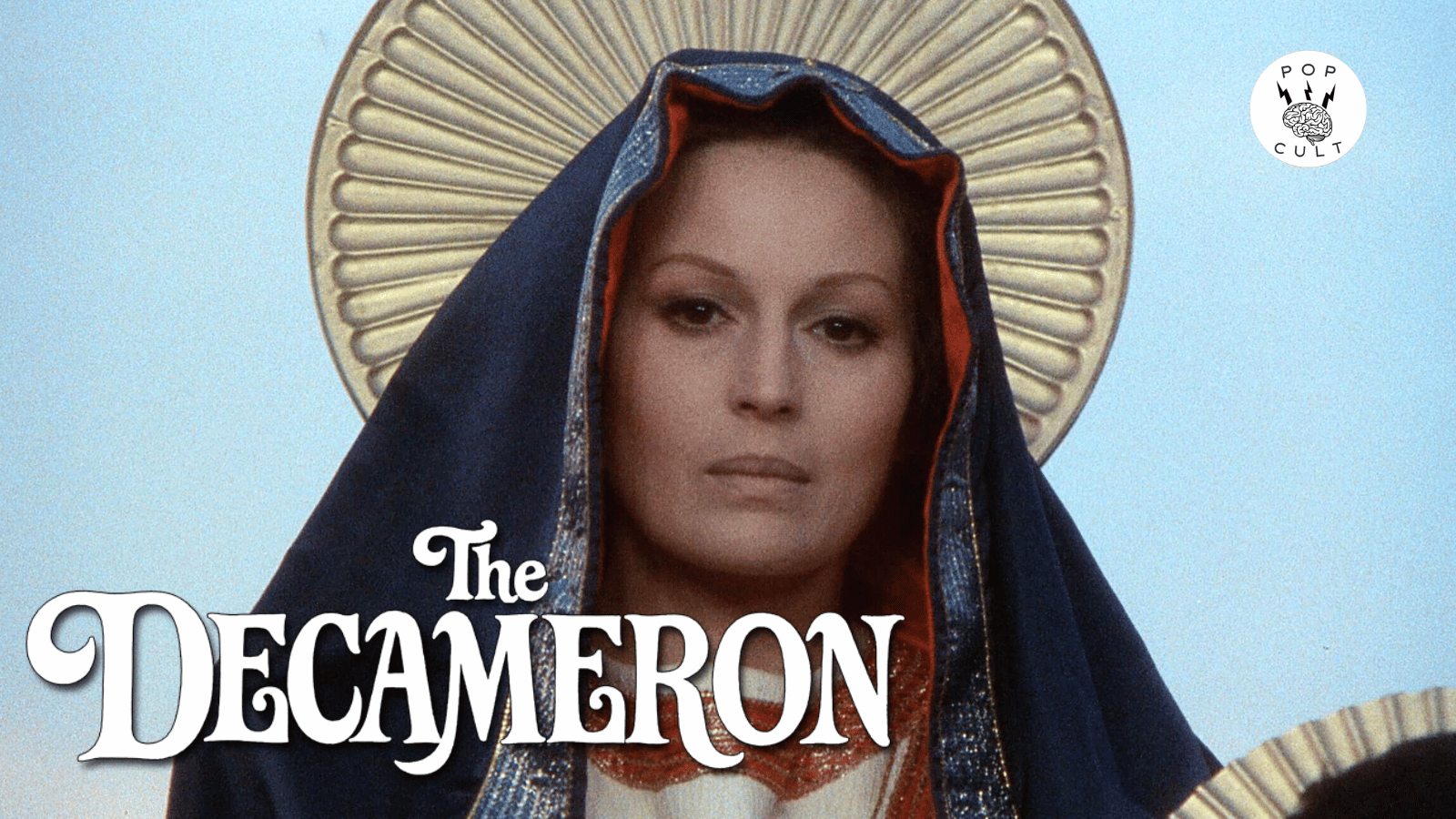
The Decameron (1971)
Written and directed by Pier Paolo Pasolini
While Pier Paolo Pasolini was fond of adapting classic pieces of literature, he wasn’t keen on making them period-accurate. Instead, he sought to use these foundational texts of Western civilization as critiques of the contemporary world. Changes to details like locales were commonplace to get his point across. This is why he transplanted Salo from revolutionary France to the era of Mussolini in Italy. The Decameron doesn’t see a shift in time; it’s still set in 14th-century Italy, but in the southern region where characters speak with a prominent Neapolitan dialect. Pasolini saw this as a commentary on southern Italy’s exploitation at the hands of the wealthier north.
The Decameron is a collection of short stories written by Giovanni Boccaccio, the title of which is translated into English as “ten-day event.” Pasolini stars as a young painter working on a mural, which serves as the framing device for the short films that make up this adaptation. The stories all serve as a celebration of human debauchery and passion. Part of what Pasolini is doing here is a continuation of his work in Accattone and Mamma Roma, a search for the holy within the peasants. With Theorem, the director clarified that he sees the ruling class as void of any spirit; they are tragedies waiting to happen. Returning to medieval literature is part of the filmmaker’s journey to find the meaning behind being human, a shaking off of the capitalistic feeding frenzy of his own era.
Pasolini chooses to interweave some of Boccacio’s stories, primarily the tale of Ciappelletto, a man who spent much of his life committing crimes, but on his deathbed, when asked to confess by a priest, says his only sin was to become angry at his mother for spilling milk when he was a child. Ciappelletto feigns tremendous guilt about this, which convinces the priest the dying man is a saint. Earlier, we see Ciappelletto as he pickpockets in a segment that intersects with Masetto’s and Peronella’s, respectively.
Masetto is a young man who gets a job as the groundskeeper of a convent. He convinces the Mother Superior he is a deaf-mute, and despite being a very handsome & young man, she lets him inside. Two of the young nuns decide to use Masetto for sex, believing he cannot tell on them. He plays along, and other nuns become aware of this opportunity inside their walls. Eventually, he becomes so exhausted from the constant sex that he speaks to the Mother Superior, who declares it a miracle that his speech & hearing have been restored. It’s a wonderful reason to keep him at the convent and in use by every woman there.
Peronella is a classic tale of cuckoldry, the type of narrative that would inspire Geoffrey Chaucer’s Canterbury Tales. While having sex with her lover, Peronella’s dim-witted husband, Giannello, returns home. Her lover has hidden in a large clay pot they own, which Giannello has returned home for. He’s found a buyer and is eager to sell it off. With quick thinking, Peronella explains she’s already found a buyer, allowing her lover to pop up and pretend he’s there to survey the item. The lover pretends that the interior of the pot is filthy, and Peronella demands her husband clean it. While he’s crouched inside cleaning, she and her lover resume their activities.
What results from the combination of these and the other shorts is that Pasolini has composed a cinematic mural parallel to the one his character is painting within the film. The original text contains one hundred stories, but these are condensed down to just ten, but ten of the most well-known and Pasolini’s favorites. Boccaccio shaped Italian through the original text, making the Tuscan dialect the standard. Pasolini’s reframing of the text through Neopolitan voices is a direct reference to that, a reminder of the cultures that were pushed to the margins when one dialect was given preference over the other. That initial Other-ing had a domino effect, which Pasolini could see in how impoverished the people of southern Italy had become.
Pasolini is searching for how humans interacted before the age of mass consumption. He is clear that they were not angels; their “sins” were somewhat innocent and linked to natural human desire. Sex is the driving force through almost every story. While there may be the occasional cuckold, in every case, the parties are mutually consenting and not seeking control or power but pleasure for pleasure’s sake. Sex is a kind of friendly entertainment in a world before movie cameras began their voyeuristic crusade. The sex is explicit, you will see fully erect penises, and there is no romanticism. People aren’t in love so much as they are just horny.
Pasolini’s Decameron is a dream of a time without the capitalist machine training people to reject their self-interests and consume non-stop. He intentionally changes certain characters’ occupations, often from ones considered a part of the nobility to more common professions. The statement is clear, there is no place for the bourgeois in such a pure, pleasure-driven world. People aren’t machines that can be programmed, and we’ve been held back from our natural state of being. This will not be the last time Pasolini makes this observation, as The Decameron was the first in his Trilogy of Life. The second film will be the subject of my next review.

 PopCult Reviews
3 thoughts on “Movie Review – The Decameron”