
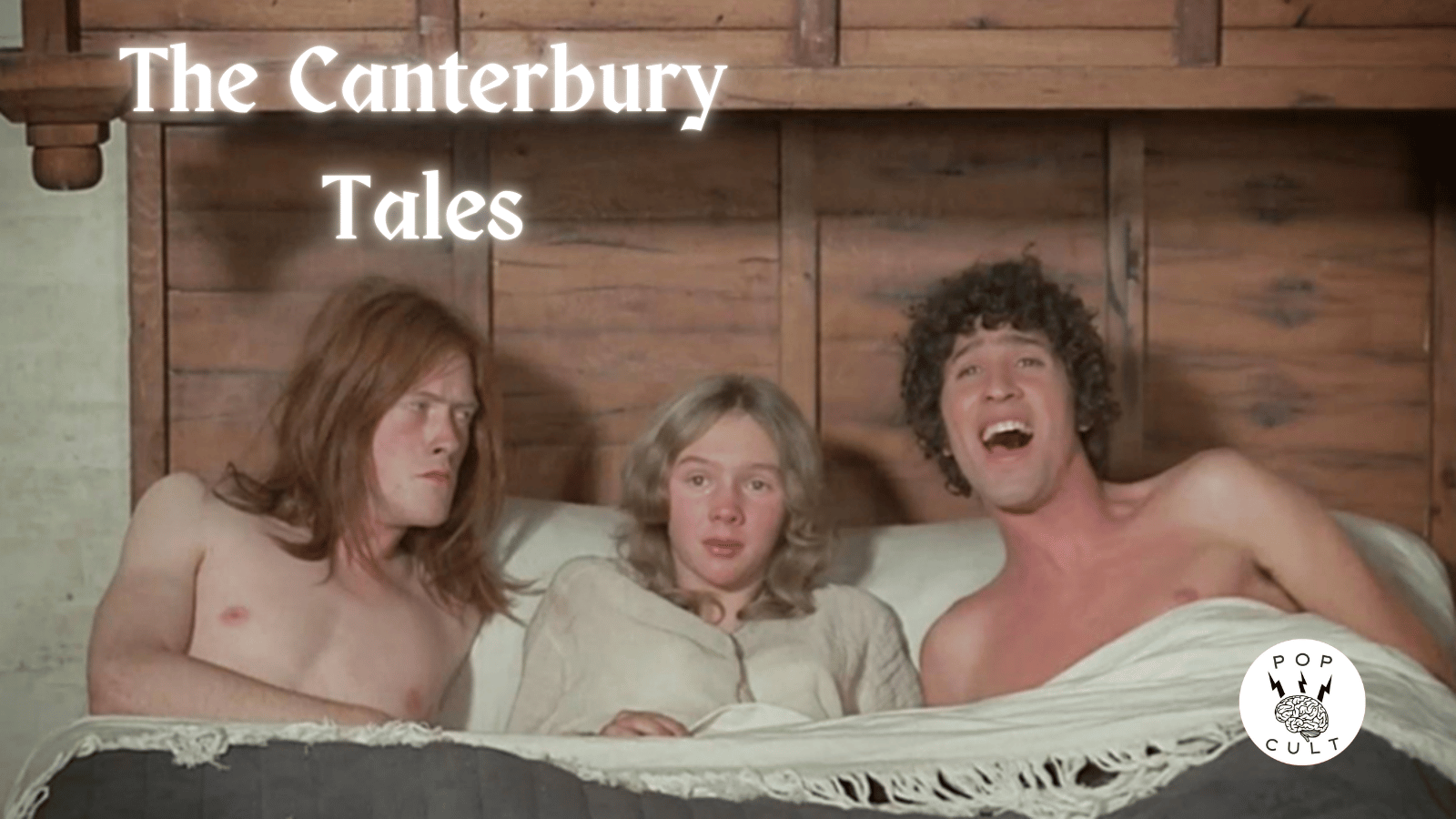
The Canterbury Tales (1972)
Written and directed by Pier Paolo Pasolini
The Canterbury Tales is a text I have some history with. As an undergrad, I was an English major after toying with a Mass Comm degree for too many semesters. One of the classes I took was Chaucer and Medieval Literature, not because I necessarily loved that era, but because it was either a requirement for the degree and/or a bunch of my friends were taking it. I don’t remember which now. The class was taught by the head of the English Department, one of the best teachers at the university, and by the end, he had me interested in it all. One of the requirements to pass was that by the end of the term, you had to stand in front of the class and recite the General Prologue (the first 18 lines) of the Canterbury Tales.
I’ve never been good at memorization and recitation, but this teacher found that it was an important part of an English literature education, and I agreed. I also had him for English Renaissance, where I memorized Shakespeare’s Sonnet 18 (Shall I compare thee to a summer’s day?). That had been in a form of English that was at least somewhat recognizable to me. The Middle English of Chaucer literally was another language. I did accomplish the task, and just like the professor said, once I had it in my head, I would never forget it. That was twenty years ago, and I can still recite the thing from memory, given a moment to knock the cobwebs off. The most memorable recitation had to be a girl on the volleyball team reciting it from memory while doing a handstand in front of the class. Who could beat that? She got a standing ovation from the class.
This was the second in Pasolini’s Trilogy of Life, which began in his adaptation of The Decameron. Part of the director’s move in making these pictures was realizing he’d spent the better of the previous decade making some fairly stark, pessimistic films. Pasolini wanted to remind himself more than anyone else of the joy that still existed in the world. To find it, he looked backward, a seemingly odd choice for such a contemporary person (queer, atheist, communist). He saw a pre-industrialized world that held some truths about the human race. One of these truths was how important sex is in the day-to-day lives of humans, as a form of pleasure but also community and a tool of power.
This was Pasolini’s first English-language film. It felt appropriate that Chaucer should be presented in its original language. Like most Italian productions of the time, he dubbed all the dialogue after filming but hired dozens of English actors. Charlie Chaplin’s daughter Geraldine and a pre-Doctor Who Tom Baker are here. So if you ever wanted to see the fourth Doctor’s penis, well…here’s your opportunity. Pasolini also chose to film the picture on location in England, with a few interior scenes shot in a studio in Italy at a later date.
Like in The Decameron, Pasolini acts as a character who shapes the framing narrative in the film. In this instance, he plays Chaucer. As a painter and art lover, the director references several period works without drawing too much attention to them. When you watch Barry Lyndon, it’s hard to ignore how directly Kubrick references 18th-century paintings or how Dutch art is explicitly cited in Peter Greenaway’s The Cook, The Thief, His Wife, and Her Lover. Pasolini isn’t quite overt, so it would make sense if the audience didn’t get the references. However, his grand finale, set in Hell and featuring the Devil, is derived from Hieronymous Bosch, and there’s no mistaking that.
Pasolini whittles down Chaucer’s collection of stories to eight of his favorites, which are a mix of raunchy and dire. In one, Franco Citti plays the Devil, who comes to Earth ready to foment strife. He does this by getting three young men to turn against each other when they discover a treasure and human greed takes over. There’s another, which feels like Chaucer was definitely boring heavily from The Decameron, where a woman tricks her husband into locking himself away while she has sex with her lover, only for her ex-lover to show up. We get a bit of the Wife of Bath, but it doesn’t amount to much. Overall, this felt less cohesive than The Decameron, which makes sense. That text has a strong cultural connection to Pasolini, while this one is less so.
There are two standout sequences. The first features the filmmaker’s muse, Ninetto Davoli, as a blatantly Chaplin-esque figure. Davoli played a similar character in The Decameron, a bumbling teenager who causes trouble no matter where he goes or what he does. There’s little dialogue here reinforcing the homage to the silent era and acting as a reminder that Pasolini is not making a direct adaptation. He understands that the text is merely a starting point, and art is made when an artist reshapes those elements into something new and connects them with other ideas.
The other is the finale I mentioned earlier, The Summoner’s Tale. A member of the church obsessed with wealth is taken by an angel to see what happens when holy men betray the will of God. Pasolini’s production design crew found a wonderful wasteland setting, with his male actors stark naked, painted up in primary colors, and with wings and horns. We glimpse a series of tortures, which are a mix of horrifying and ridiculous. The wildest bit is yet to come, which is when a very crude Devil puppet spreads its ass cheeks and begins shitting out wicked priests.
I wouldn’t say this is my favorite of Pasolini’s films, but you can tell he had a lot of fun making it. It’s hard to top that last story, which captures the ribald nature of Chaucer’s text quite well. Films like these remind us that despite all the pearl-clutching we see today about “falling standards of decency,” dirty humor has always been popular among humanity. Sex and shit jokes are clearly some of the most fundamental components of our sense of humor, at least in the West, though I suspect it’s something all of our species share from what I have seen. Even Ozu found a place for fart jokes in one of his movies.
That leaves one more film in the Trilogy of Life and one more film in our Pasolini series, The Arabian Nights.

 PopCult Reviews
2 thoughts on “Movie Review – The Canterbury Tales”