
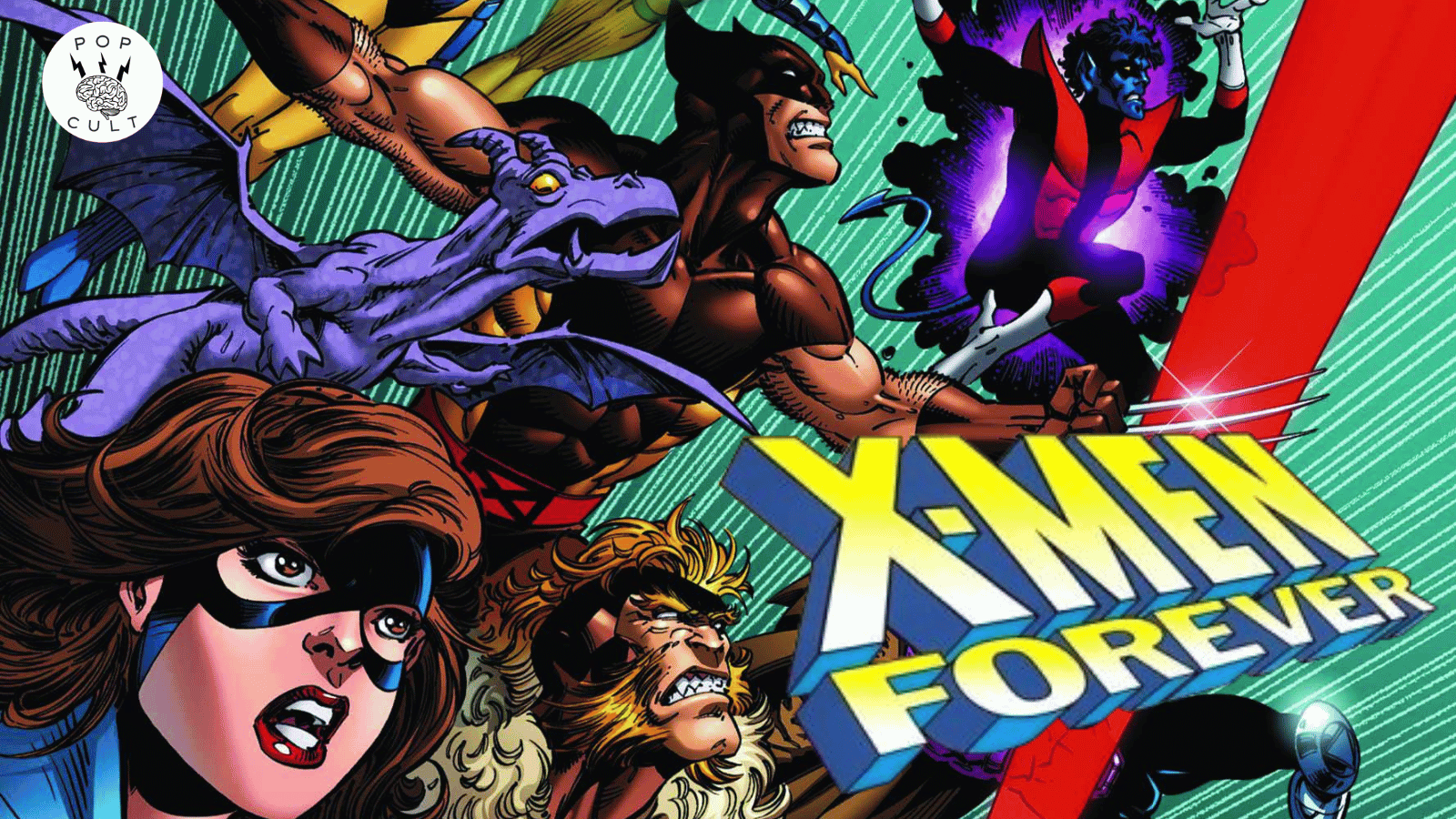
X-Men Forever: Picking Up Where We Left Off (2012)
Reprints X-Men Forever #1-5
Written by Chris Claremont
Art by Tom Grummett
X-Men Forever: The Secret History of the Sentinels (2012)
Reprints X-Men Forever #6-10
Written by Chris Claremont
Art by Paul Smith and Steve Scott
This year, 2024, I read through the entirety of Chris Claremont’s Uncanny X-Men run. It’s one of the all-time great comic book runs with highs and lows, but always something new and interesting. It came from when comic book characters were not IPs making billions of dollars in box office revenue. With less scrutiny came more creativity & risk. But, by 1991, Marvel Comics wanted an X-Men comic that wasn’t so weird and had traditional team dynamics with missions against the villains of the month. Claremont stepped away. But he wouldn’t burn his bridges; Claremont understood the spotlight shifted to the hot young artists like Jim Lee and Rob Liefeld in the early 1990s. He kept plugging away with little projects here and there, even writing for DC Comics. Eventually, he started writing new stories for Marvel about many of the characters he helped to create. The idea was to have Claremont write an out-of-continuity series that continued his X-Men as if there had never been an interruption. Sounds great, right? It’s one of the most insane X-Men things I’ve read in a long time.
Picking up after the events of X-Men (1991) #1-3, the book starts with the X-Men pursuing a lead regarding Fabian Cortez. However, this team has a slightly different make-up. The crowded-to-the-gills team present in those last three Claremont issues is gone. Instead, he’s pared the roster down to Wolverine, Cyclops, Rogue, Storm, Gambit, Beast, Jean Grey, and Professor X while bringing Nightcrawler and Kitty Pryde back into the fold. We don’t get an explanation for why the team is suddenly much smaller. Additionally, the presence of Nick Fury and SHIELD is made even more prominent to the point that some issues feel like complete diversions from the concept of the X-Men. This is Claremont with no limitations, and he’s not anywhere close to being done mixing things up for his alternate reality return.
The first big revelation occurs when Jean Grey directly confronts Cortez. The villain’s mutant power appears to unleash a fragment of the Phoenix that lay dormant in Jean. By the start of the second issue, Claremont has killed off Wolverine. At first, I thought this was a fakeout and he’d be brought back at least within a few issues. Nope. Wolverine is dead. Even stranger is that Kitty phased through him at one point and appears to have absorbed a single retractable claw and starts to take on his grimmer demeanor as this story plays out. Sabretooth shows up, and Claremont goes with one of many rumored origins of the villain, that he is Wolverine’s dad. He’s blinded in a fight with Storm and left that way for the remainder of the title’s run.
One of the story arcs Claremont was rushed to conclude was his age regression of Storm. She had appeared to die at the hands of the Reavers during the X-Men’s Outback era, only to reappear in Louisiana as a preteen girl. This is where she befriended Gambit and planted the seeds of the Shadow King’s return. Claremont takes this opportunity to wipe away that forced ending. You see, Wolverine was killed by Storm! But it wasn’t the real Storm. The X-Men battle their teammate while confused about why she would betray them. They follow Storm’s energy signature to the Brooklyn Bridge, where they find…still preteen Ororo Munroe. The adult Storm is a fake. And Claremont simply puts that subplot to the side and carries on.
Another confusing element of X-Men Forever is the covers. Often, the cover will show a familiar character in a new look. We see this with Kitty having a short haircut and new outfit or Gambit going from his Jim Lee design to a more mundane guy in a suit look. These outfits don’t always appear in the comics, but some do. Gambit eventually does start dressing like that, but he appears on the covers in the more plainclothes get-up months before he’s wearing it on the interior pages. The vibe I got reading through these issues was that Claremont had a lot of ideas but wasn’t organizing himself well.
The second volume kicks off with an issue penciled by Paul Smith, the artist who started on Uncanny with the Brood Saga and co-developed Storm’s 1980s punk/mohawk look. His art style has definitely changed since those days, and there are moments where it looks wonderful and others where some characters are clearly not his strong suit. I think he’s gotten better at making his faces more distinct – he draws Cyclops well, for instance, but Beast looks incredibly wonky.
A flashback issue exists to have Nick Fury and Wolverine team up during World War II. That serves as a prologue to the main story, which is the return of the Sentinels. The plot sees the reveal of a long-lost member of the Trask family. Sabretooth slowly starts to warm up to the idea of being an X-Man, and we get the introduction of Daisy Dugan. This last character is meant to be the granddaughter of Dum Dum Dugan, one of Fury’s Howling Commandos and fellow SHIELD agents. It seems evident in how she is featured that Daisy is a creation Claremont is more interested in than many of these X-Men. It’s also a reminder of the kind of comic Claremont had turned Uncanny into near the end of his run, which was more of an anthology series about mutants around the world than about a singular team.
There’s a funeral for Wolverine where Cyclops gives the eulogy. This is also happening parallel to a revelation made by Xavier at the end of the previous volume – mutants have shortened life spans due to how their powers burn out their bodies. This sudden epiphany regarding their mortality definitely affects the X-Men’s demeanors. In an even wilder turn, the second volume closes with the reveal that Nathan Christopher Summers, aka Cable, is a slightly older child living in Alaska with his great-grandparents. Claremont had joined Jim Lee and Whilce Portacio in scripting the X-Factor arc that sent Nathan into the future as a baby, infected with a technovirus. This scene is a declaration of Claremont that X-Men Forever will be ignoring many narrative decisions he hated. One of those he partially concedes to is bringing back Colossus, the main plot of the next volume discussed in our upcoming review.

 PopCult Reviews