
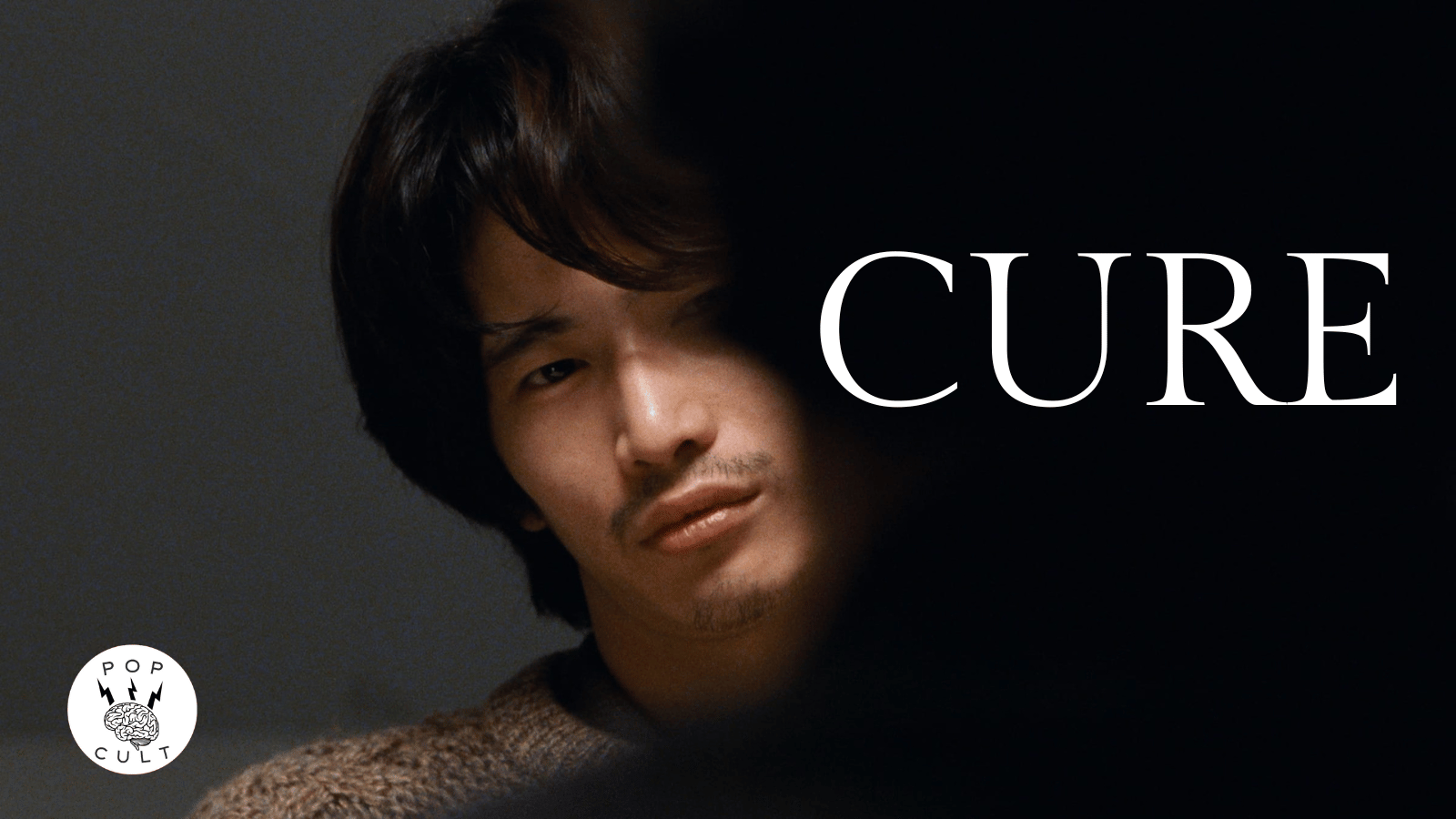
Cure (1997)
Written and directed by Kiyoshi Kurosawa
Something about disrupting the flow of daily patterns drastically unnerves the average person. The next time you have the opportunity, allow an awkward silence between you and another person. Study their reaction. You can learn a lot about how someone handles that silence when all they have is their own mind to listen to. In Cure, it appears we have a serial killer using hypnotism to get seemingly regular folks to kill their loved ones. Yet when the audience finally sees how it goes down, it’s far simpler than that. This interloper disrupts the pattern and, with minimal effort, shatters these people’s minds.
Kenichi (Koji Yakusho) is a detective for the Tokyo PD. He’s assigned to investigate a series of bizarre murders where all the victims have an X carved into their neck or chest. Each person is killed by someone caught close to the scene of the crime, and they are freaking out, unable to explain why they would do such horrible things. Meanwhile, at home, Kenichi’s wife slips further into schizophrenia and is found wandering around the neighborhood if she’s not monitored. Eventually, a common thread emerges. Each perpetrator was in contact with a man named Mamiya (Masato Hagiwara). They find the man, and he has short-term memory loss, unable to recall anything that has happened around him. Instead, this strange man begins prying into Kenichi’s private life, asking questions about his loved ones. The detective can feel his sanity slipping and this stranger somehow taking control of him.
One thing about the horror films of Kiyoshi Kurosawa is that they refuse to be easily defined. His picture Pulse is ostensibly about the alienation of the internet, but that is a very rudimentary reading of the ideas the filmmaker is bringing up. His recent short film, Chime, is a masterclass in atmospheric horror and refuses to directly answer any questions. Yet, that film built more suspense and horror in 56 minutes than many features can with a full two hours. Cure is also a movie that won’t be so quickly categorized and labeled. It’s a serial killer film unlike any you’ve seen before. Kurosawa is far more interested in the terror one feels with their certainty about the world being taken away from them.
Cure was Kurosawa’s breakout film after a career spent learning the ropes of direct-to-video and low-budget fare. He seamlessly slips into the space of an auteur filmmaker. The vision of the picture is crystal clear and his confidence with the camera is evident. Cure was released a year before the first film adaptation of Ring, and the J-horror elements are already being outlined by this director. This new type of end-of-the-millennium horror is going to be existential and indefinable. There are no evil spirits, at least not how we imagine them. What people can do feels far more horrible and mysterious than any monster.
The villain of the picture, Mamiya, remains an enigma even when the end credits roll. That’s the best thing about Kurosawa’s work; he fully embraces the ambiguity that makes horror work. There’s a roiling resentment in so many people towards each other, and Mamiya seems to enable them to act on this anger. He’s the “cure” of the title, the solution to these people’s problems. Once arrested, Mamiya pries Kenichi for information. At one point, he comments to the detective about what an asshole his boss is, something Kenichi has been feeling internally.
Mamiya also resembles a Japanese archetype of a rebellious young man with long hair and an unkempt appearance. His actions push back against the norms and behaviors of Japanese society. He doesn’t recognize the authority of the police, aided by his lack of memory, which begins to wear thin the more the cops question him. Mamiya is also never emotionally shaken. He takes on each situation with passivity bordering on the absurd. Even when accusations of participation in murders are leveled at him, the man can barely stifle a yawn.
Kurosawa is interested in pointing out how thin the line divides Kenichi and Mamiya. They are shown sitting on the same side of a table in the station at one point, appearing like accomplices (and a bit of foreshadowing). Kenichi comes to Mamiya when the latter is imprisoned in a hospital room, and the suspect seems to know the detective has come to do something horrible. In this way, Mamiya has become the doctor offering a cure to the sick Kenichi, a subversion of the police officer as a cure for society’s ills. In this dark world, the police are a joke, and only those who exist on the fringes of society (or reality) make any difference.
The theme is that social cohesion is a joke humans play on themselves. We feed each other myths that the broken systems we live within are actually good. We witness a communal breakdown, recurring throughout the three Kurosawa pieces I have watched. People kill so casually as if a chain that was holding them back this whole time is suddenly taken away. It reveals to us that more people than we would like to admit are walking around with some very dark thoughts and desires, especially when it comes to doing harm to fairly innocuous annoyances.
Despite living overseas, I can see this communal collapse in my home country of the United States. To expect any sort of meaningful solidarity among the masses is a delusion, frankly. There can be small localized pockets of people working together, but I don’t imagine we could see something on the scale that would be able to dismantle the institutions that are doing great harm. Everyone is expected to handle their problems in the privacy of their home/prison cell. If it leaks into the public view, it becomes a problem for people who lack empathy.
Kurosawa is a filmmaker who refuses to tie things up and provide closure. He understands an underlying element of horror is uncertainty. Images become more symbolic than literal as we reach the film’s end. Kenichi is shown in increasing isolation, with exterior shots becoming rarer and replaced with claustrophobic interiors. The startling conclusion that Kurosawa posits is that the “cure” for serial killings isn’t going to be the capture and imprisonment of the killer. Everyone is already imprisoned. Instead, the “cure” is the elimination of society. It feels similar to Kurosawa’s ending for Chime. There are no clear answers, only the dark void that lies ahead of us, the thing we’ve all built together that will eat us alive.

 PopCult Reviews
2 thoughts on “Movie Review – Cure”