
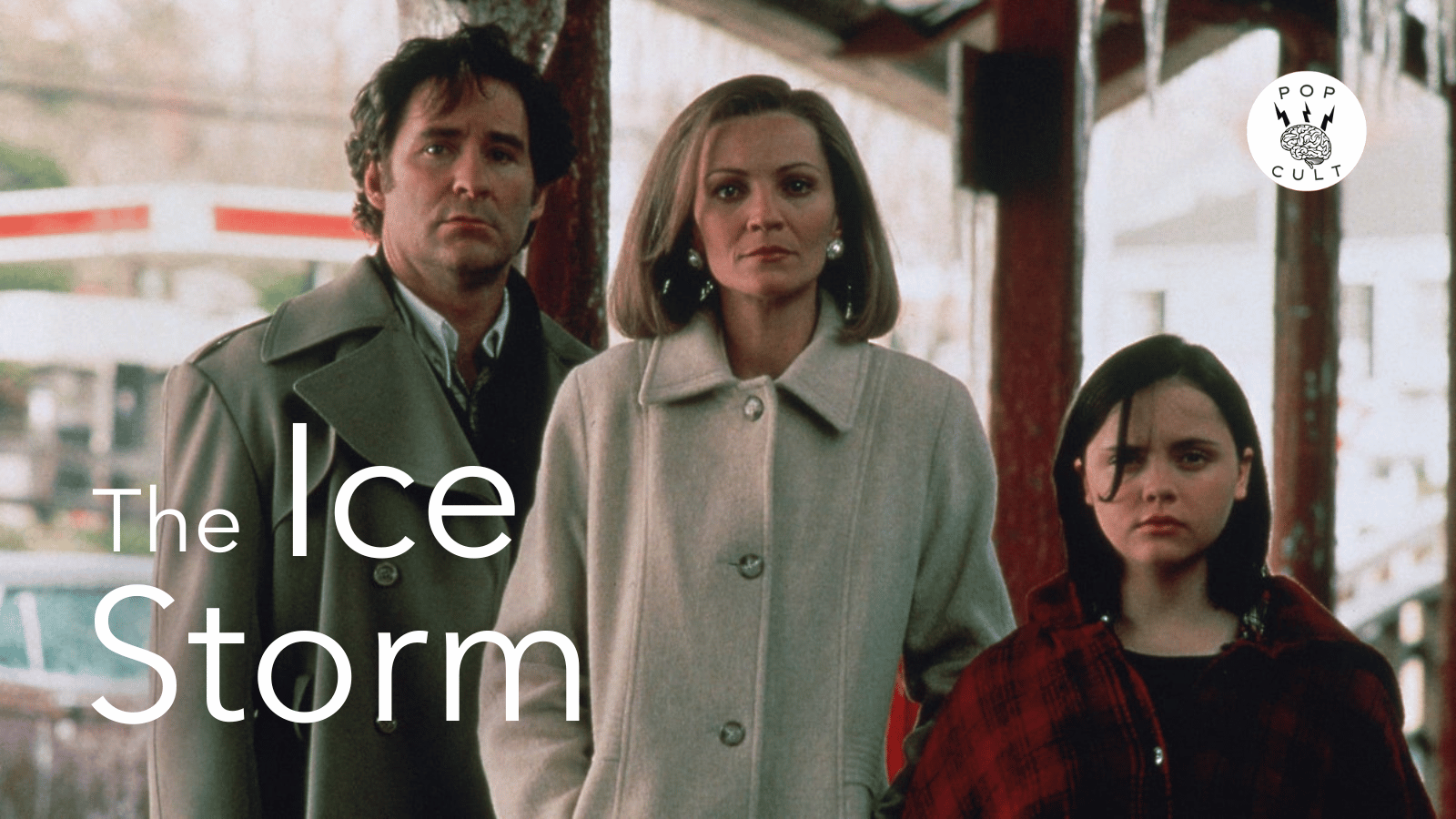
The Ice Storm (1997)
Written by James Schamus
Directed by Ang Lee
In our series “Hazy Shades of Winter,” we’ll be looking at films set during winter that also exude the cold, lonely feeling that the season can often bring about. Winter has often been seen as a necessary time of death in many cultures, with the spring being a renewal period. As a result, wintery films often feature themes of grief and desolation or even more interesting, deep self-reflection. As you’ll see in this series, characters often come to significant revelations about their current status; this may be the realization that a marriage is over or the recognition that a person has lost their religious faith. In the winter, the leaves have all fallen away, trees are laid bare, and there is nowhere to hide your secrets.
Set in Connecticut in 1973, The Ice Storm follows two affluent families over Thanksgiving weekend. Ben Hood (Kevin Kline) has become dissatisfied with his marriage to Elena (Joan Allen). He’s been carrying on an affair with Janey Carver (Sigourney Weaver), the wife of the other family. Janey’s sons Mikey and Sandy are quite different. Mikey (Elijah Wood) is mocked as a stoner at school and often seems to get lost in his daydreams. Sandy is intensely interested in Ben & Elena’s daughter, Wendy (Christina Ricci), who likes to play sexual games and tease the boy. The Hoods’ eldest, Paul (Tobey Maguire), comes home from boarding school for the holiday, but his mind is elsewhere. He’s become infatuated with his classmate Libbets (Katie Holmes) and keeps looking for opportunities to hop on the train and get back to the city to hook up with her.
I’ve always felt ambivalent about Ang Lee’s films. I’ve seen so many of them, from The Wedding Banquet to Crouching Tiger, Hidden Dragon to Hulk to Brokeback Mountain, and he’s covered several genres. However, I have never felt that strong emotional connection with his work. This continues with The Ice Storm, a well-made film, but one that left me cold (no pun intended). I am curious to check out the Rick Moody novel the script is based on because the story and its characters are intriguing. I think the film captures the listless nature of the 1970s coming out of an intense previous decade. You can see the sexual revolution is rippling through the culture, but it’s become tangled up with America’s capitalist individualism so that it’s not so much about connecting with others as it is hedonism.
The worlds of the adults and children are paralleled throughout the film, both thematically and visually. A scene of Ben and Janey in bed together, his head resting on a red pillow, is duplicated when Wendy sneaks over and takes Sandy to bed. Paul’s sexploits in Manhattan are juxtaposed with his parents’ attendance at a key party where so much of the infidelity and lies come to a head and leave everyone’s lives shaken. Both Paul and Ben make morally unscrupulous decisions, treating the women around them not so much as people but as objects for their pleasure. Both are met with failure, embarrassment, disappointment, and shame.
The film carries a sense of quiet foreboding from its opening scenes. We see Paul sleeping aboard the train, which stops overnight for a couple of hours and freezes over. When it begins to move again, we can hear the ice cracking, and the vehicle moves forward along the track, resembling a frosty mobile crypt. Later, we see one child precariously balanced on a diving board coated in a sheen of ice, foreshadowing future tragedies. These characters all seek something that they can’t articulate, leading them to make poor choices from start to end.
What they are seeking is often what they already have or what they don’t need at all. In Ben’s instance, he starts talking to Janey about his work and life after a tryst. His profession pushes him to play golf, which he doesn’t even like, and he shares that with her at length. She responds, “You’re boring me. I have a husband. I don’t feel the need for another.” This is what Ben is really looking for: a wife. Which he already has. He just doesn’t give her the time of day or see her. She tries to cheat on him and does, but it’s terrible & awkward. Similarly, Paul attempts to “steal” Libbets back from his more charismatic roommate only to ruin the evening for everyone.
The biggest weakness for me was a lot of the line delivery. I think it’s more the way the script is written. Characters sound literary to the point of feeling inauthentic; it doesn’t sound stylized, just off. Perhaps this is a key part of why I don’t love Ang Lee films; almost every picture he’s made is written by James Schamus. If these things are more representative of Schamus’s writing rather than Lee’s directing, I’ll allow him to share some of the blame. Despite the things I didn’t like, I think The Ice Storm is worth watching. Seeing this much talent on screen is wonderful, especially in a story that, while set in the early 1970s, feels quite relevant to America today.

 PopCult Reviews
One thought on “Movie Review – The Ice Storm”