
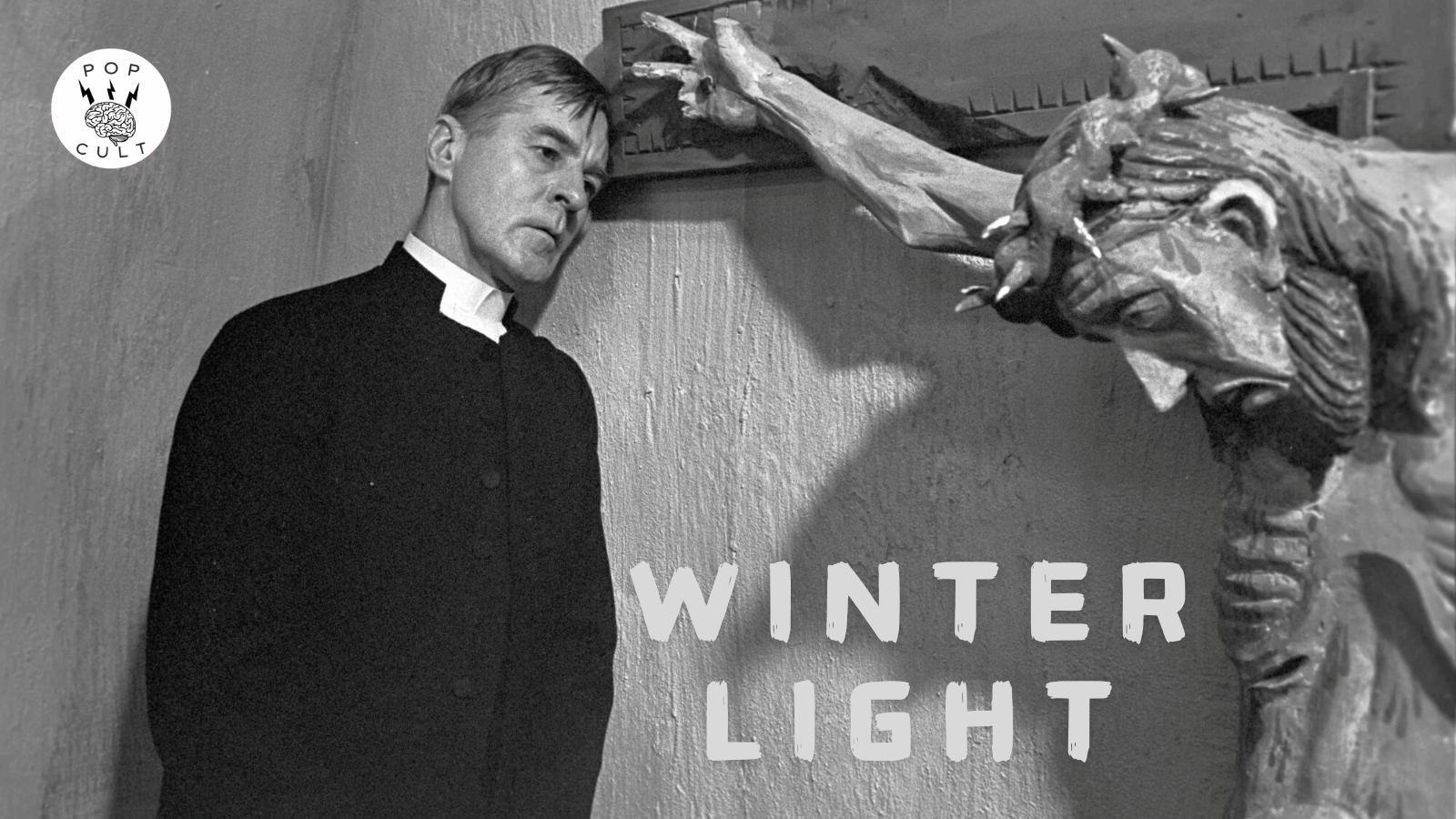
Winter Light (1963)
Written and directed by Ingmar Bergman
It didn’t take me very long while watching Winter Light to realize what contemporary film was essentially a remake of it, Paul Schrader’s First Reformed. Schraeder certainly localizes the story to upstate New York and removes or alters certain details, but narratively & thematically they share so much. Both are films where I can’t imagine them being set in any season other than winter. The cold, the snow, the silence. They are all significant parts of setting the atmosphere for this story of spiritual doubt and crisis. Ingmar Bergman was a person always in some type of spiritual introspection and with Winter Light he’s wondering about those who seem certain about the existence of a God who cares about humanity.
The Sunday noon service of a rural Swedish church is coming to a close. Pastor Ericsson (Gunnar Björnstrand) oversees the affair with only a small handful of people present. There’s fisherman Jonas (Max von Sydow) and his pregnant wife Karin (Gunnel Lindblom) and Tomas’s former mistress & the town’s schoolteacher Marta (Ingrid Thulin).
After things wrap up, while nursing his cold, Tomas prepares for his 3 o’clock service at a nearby town. Karin interrupts wanting the pastor to speak with her husband who has developed depression after reading about China’s development of an atomic bomb. Tomas tells the man everything will be fine, to take his wife home, and then return so they can talk further.
After the couple departs, Mara approaches Tomas wanting to know if he’s read a letter she left for him. He hasn’t and is instead caught up in how he feels that he won’t be able to help Jonas with his anxieties. In fact, Tomas is mired in his own doubts about faith and the Church. She leaves and he finally reads her letter, relaying her understanding that while she loves him deeply, the pastor simply doesn’t return her feelings at the same intensity.
Tomas falls asleep and is awakened by Jonas’s arrival. Tomas’s words become quite heretical. He states that his time serving in Lisbon during the Spanish Civil War and witnessing the atrocities there made it impossible for him to reconcile the existence of a loving God alongside these things. He ignored them then because it made it easier. But now he’s come to the realization that denying God’s existence is the only thing that makes sense in order to explain man’s cruelty.
I have struggled with Bergman’s work throughout my life. Some films sing to me while I still wrestle with others. Of his work I’ve seen Scenes From a Marriage (TV version), Persona, Fanny and Alexander, and Hour of the Wolf. Part of it is likely to do with stylistics. Winter Light clicked with me quite strongly because it keeps things structurally simple. I enjoyed how the whole film felt very real. I believed that Tomas was a real pastor and that Marta was genuinely in love with him. That authenticity is important in order to convey the profoundly spiritual themes Bergman wants to explore.
The film spans only a handful of hours, beginning with the end of the noon service and ending with the start of the three o’clock service at another church. Tomas makes such a fascinating character because we learn he hasn’t been a lifelong devotee of the Church. He came to the clergy as an older man and has reached a crossroads. He must either fully leap into the realm of faith or he can give into the love Marta is offering to him. The first is something that asks him to have faith and possibly never experiencing proof of that faith. Marta’s love is tangible, but through her letter we see Tomas balk at imperfection. She will never be exactly what he imagines.
What Winter Light comes to represent is a slice of a fully realized character’s life, and this particular slice is one of those potentially life-changing moments. Through Tomas’s interactions with his parishioners we can feel his distance from him. The clergy refer to each other in third person when talking to each other which symbolizes a distance that feels at odds with what we imagine would be a brotherhood in Christ. That’s because hierarchy became more important than authentic connection.
This is the core of what Bergman has identified as a problem in society – we are incapable of communicating with each other. In all the director’s work communication is one of the key themes. In the realm of religion, communication should be a chief component. In some spiritual beliefs (Buddhism, Judaism) discourse is folded into the system. When you experience Western forms of Christianity what you often discover are systems of blind hierarchical compliance. Your questions are labeled a type of heresy, by questioning the clergy you are told you are questioning God, further emphasizing hierarchical power over spiritual redemption & clarity. If God is beyond questioning and examination than it is a concept simply unworthy of our attention.

 PopCult Reviews
One thought on “Movie Review – Winter Light”