
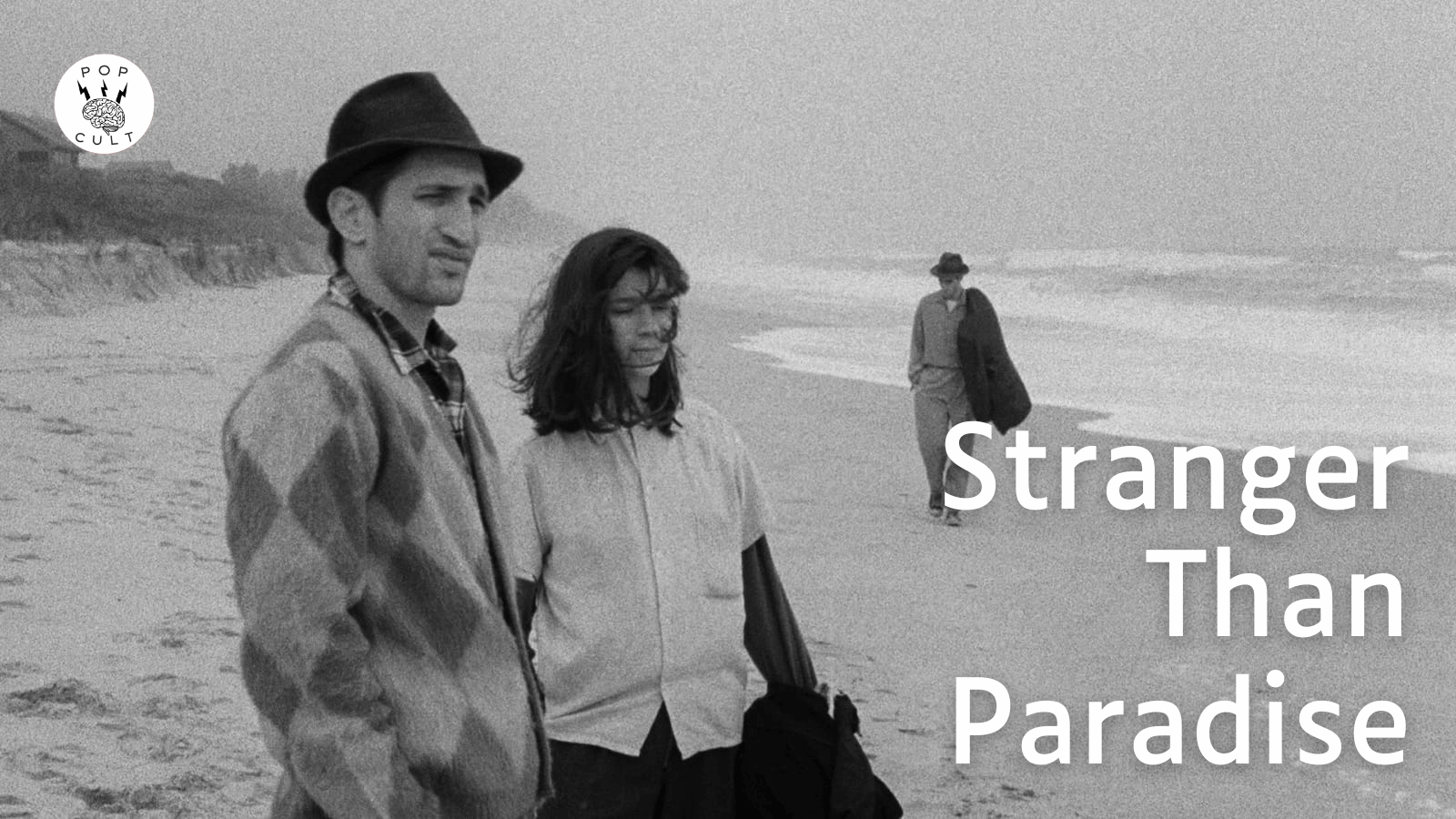
Stranger Than Paradise (1984)
Written by Jim Jarmusch and John Lurie
Directed by Jim Jarmusch
Everywhere looks the same. This sentiment is shared by Eddie, one of three central characters in Stranger Than Paradise. He shares this as he and his friends stomp across a snow-covered railroad track, feeling down & out. If you are from the States or have spent much time in the vast middle of the continent, then you know how concrete blasted, copied & pasted so many communities are. Corporate stores and eateries pop up like seeds planted in the asphalt. As someone who grew up in a small town with a main street littered with McDonald’s, CVS, Domino’s Pizza, etc., you do start to feel that any personality the place you lived in once had has been systematically replaced with dull homogeny.
Willie (John Lurie) gets a phone call from Aunt Lottie in Cleveland. His cousin, Eva (Eszter Balint), is coming to visit her from Hungary. However, Lottie needs emergency surgery, so Eva must stay with Willie in New York City for ten days before continuing her journey. Willie would prefer Eva doesn’t stay with him but begrudgingly accepts it. Over time, and thanks to Eva straightening his place up, Willie likes having her around. He won’t take her on excursions to the horse racing track with his pal Eddie despite her asking.
She leaves at the end of ten days, and a year passes. Willie and Eddie win big at the track and decide to take a road trip to Cleveland as they both miss Eva. The film’s second half chronicles this visit, which fails to meet everyone’s expectations. Eva’s life has moved on without them; there’s even a guy she’s considering pursuing a relationship with. Both Willie and Eddie start to grumble and interfere over it. A big win at the track convinced all three to journey to Miami, hoping the warmer climes would raise their spirits. But what really happens is that this trio of friends slides ever closer to falling apart.
I can’t say I’m a massive fan of Jim Jarmusch. He’s a director who makes some movies that clicked firmly with me (Ghost Dog, Broken Flowers, Paterson) and other movies I’m still trying to make sense of. Stranger Than Paradise is a film I really enjoyed, but I’m still trying to figure out if I loved it. It’s a cheap affair, to be expected, but that cheapness helps add authenticity to its characters and settings. The choice to shoot in a dreary grayscale was the right choice. It adds to the sameness Eddie notes about Ohio. Even when they arrive in sunny Florida, the film is still cast in this pallor, never allowing them to find the color they are searching desperately for.
The 1970s had been a time of ennui and desolation for many of the United States. New York City, in particular, experienced what amounts to a corporate coup by the banks, who started to make heavier demands before issuing the bonds that would keep the city functioning. This would lead to parts of NYC being perceived as “dangerous,” while there was a definite increase in crime, the trustworthy source of the danger was corporate greed, which immiserated the people. With the rise of Reagan in the 1980s, we saw many of the worst aspects of the 1970s become ever more heightened and worse. Being an Other has always been bad, and this was no exception.
Willie insists on playing the “big tough American” when Eva appears. He’s rude, not offering her food or drink nor attempting to hide his annoyance that she’s staying with him. He’s a Hungarian man posing as a typical white guy. People outside of his apartment can see he’s not a WASP, but his position in relation to Eva makes him feel like he becomes more American by her presence. That patriotic fervor is associated with a need to belong. Going it alone is a considerable risk, so any time you associate with others, it makes you a bit safer.
As Eva stays, Willie begins to feel a connection with her. I’m unsure if the film implied something romantic; they are cousins, and we never see a kiss or sex. Willie just suddenly seems to care intensely about Eva. We can read this as a familial connection reawakening, another kind of belonging. Before Eva shows up, Willie’s only contact with his family seems to be phone calls. There’s both a geographical and emotional distance between him and them. Hence, his pivot to playing at being an American.
Stylistically, Jarmusch clearly draws inspiration from the French New Wave. This plays in the same pool of themes those films so often did. Young people philosophically adrift in the blasted waste of the post-war world, Baby Boomers attempting to make sense of a wholly senseless world. In NYC, Willie’s life consists of smoking, drinking, gambling, watching TV, and, well, that’s about it. However, he enjoys having Eva there, only to become bored with her. She leaves. He suddenly feels lonely. They become even more isolated and trapped in Ohio, which is far less walkable, especially with the snow, than NYC. They escape to Florida and, within a day or two, are back to feel detached and adrift. I wouldn’t be surprised if this reminds you of someone you know. There have been times when I have felt this restless without any clear answer in front of me.
Few movies captured this feeling of ennui, especially in the States. Jarmusch emerges from the gate, establishing the style and tone that will flow throughout his work. While he might have dipped his toes in other genres, they always feel like a Jarmusch movie. It’s the same type of cool you find in a David Lynch piece without the surreal horror. It’s defined by the 1950s/early 60s, humor drier than the desert, and wandering characters who never quite find what they are searching for.

 PopCult Reviews
One thought on “Movie Review – Stranger Than Paradise”