
Superman: Up, Up, and Away (2006)
Reprints Superman #650-653 and Action Comics #837-840
Written by Geoff Johns and Kurt Busiek
Art by Pete Woods and Renato Guedes
Superman: Last Son of Krypton (2013)
Reprints Action Comics #844-846, 851, 866-870; Action Comics Annual #11; and Superman: New Krypton Special #1
Written by Geoff Johns (with Richard Donner)
Art by Adam Kubert, Gary Frank, and Jon Sibal
Geoff Johns had his plate full in 2006. He was the top writer at DC Comics, having just penned Infinite Crisis and writing one of the best Flash runs ever, and was helming Green Lantern. He was also writing Teen Titans, having led a reboot to introduce a new generation to the book. Toss in 52, which he co-wrote with three others and other event books, and Johns was quite busy. Amid this, he picked up Action Comics and worked on a soft reboot of Superman that sought to fold back in elements from the Silver Age that had been removed following 1985’s Crisis on Infinite Earths.
In Up, Up, and Away, we catch up with Clark Kent one year after Infinite Crisis. He had lost his powers at the end of that story, unsure if they would return. We see that they still have not. Clark finds that he enjoys life as a regular human, even if his workload at The Daily Planet catches up with him. Lex Luthor has just been cleared of charges related to involvement in a program to unlock superhuman abilities in the average person. His legal team can use the presence of Alexander Luthor of Earth-3 as an excuse that this world’s Luthor has been replaced by an evil clone. Good thing Alexander is dead now.
Of course, we won’t have a powerless Clark Kent for too long. It wouldn’t be a Superman book if it was like that. When a scientist experimenting with Kryptonite finds himself imbued with its radiation, it won’t be Superman stopping him, but his cousin Supergirl, who is picking up the slack. Luthor starts gathering people with a shared hatred of Superman – Toyman and Metallo, among others. The villain gets his hand on sunstone, the crystalline element used for advanced computing on Krypton, and attempts to ruin Superman’s pending return as his powers begin popping back in one at a time.
Here, we have a pretty standard “Born Again” type of story. That references Frank Miller’s deconstruction of Daredevil in the late 1980s. You’d see similar stories, but in far less decompressed manner, in single-issue stories about Spider-Man every few years or so. Knightfall is one of the longer versions of this, a sprawling epic. Almost every superhero has had a “Born Again” type of story, and this one is that but in the brighter, cheerier Superman tone. You can tell the comic is being influenced by Superman Returns, released around the same time, both stories featuring the hero re-emerging on the scene in Metropolis.
The book adheres to the post-Infinite Crisis promise that the DC Universe would have its darker edges dulled in favor of a more hopeful mood. You can see that here as Hawkgirl and Green Lantern swing by Metropolis to help Clark keep his city safe while he lives as a mortal man. Part of that is the camaraderie, with both heroes knowing Clark was Superman and helping to keep the secret. It is a reminder of the old days of comics when the Justice League knew who they all were and would even interact while in their civilian identities. The biggest problem here is the length – eight issues for a story that could be done in half that amount or less. It’s fun to spend time with Clark, Lois, and Jimmy.
The Last Son of Krypton marks where Johns and Superman writer Kurt Busiek go their respective ways of writing their individual books. From here, Johns begins spotlighting a Superman villain and reimagining them just slightly to emphasize something about our protagonist. In this collection’s first story, a child crashes on Earth in a ship similar to Superman’s. Clark and Lost secretly take the kid in, introducing him as a distant relative living with them, naming him Christopher. The boy happens to have powers just like Superman’s, and a check reveals that he’s a Kryptonian. But how?
The answer is shortly revealed when General Zod and his allies attack Earth after escaping the Phantom Zone. It turns out Christopher has connections to the spectral prison of Krypton, making him a living bridge between that place and the material world. Superman is pitted against an army with his powers and taken down. It’s up to Lex Luthor to save the day by gathering a team of villains who hate Superman, including Parasite and Bizarro, to take his planet back from these alien invaders.
The book and marketing at the time claimed that Johns was co-writing this story arc with Richard Donner, the film director behind Superman: The Movie, The Omen, The Goonies, Maverick, and many other pictures. That claim is a bit dubious. Johns did have a pre-established relationship with the director, having worked for him in the 1990s. Donner isn’t involved in any other capacity after this story, and I just didn’t get any sense that I was reading anything other than Geoff Johns-written story. Again, this is shortly after Superman Returns was released, and just a year later, the Donner cut of Superman II would be out, so as far as Warner Bros was concerned, slapping his name on Action Comics was good marketing.
I will say the Adam Kubert artwork here is spectacular, and I wish he had more regular DC Comics work. He brings weight and scale to scenes that few artists can do. Compared to the pencils in Up, Up, and Away (which are fine), this looks like a masterpiece.
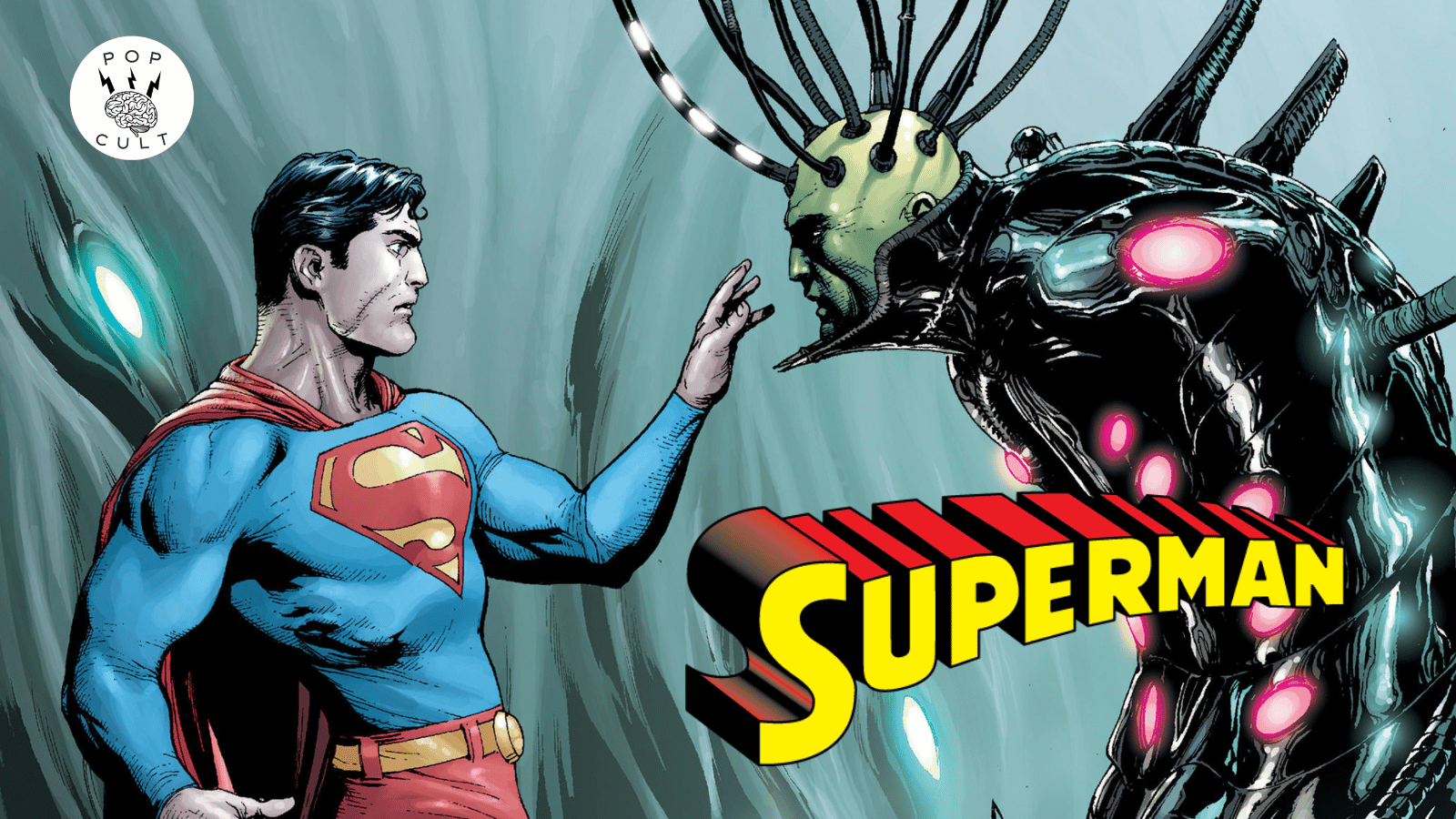
The second half of this collection jumps ahead to the “Brainiac” story arc. Johns does some retconning while attempting to keep established continuity in order. Following the Crisis, John Byrne rebooted Superman, and Brainiac received one of the more radical reimaginings. This time, carnival mentalist Milton Fine suddenly became plagued by visions of alien worlds. Eventually, he would claim to be the alien consciousness Brainiac and, over time, slowly changed Milton’s body to resemble his own. By this time, Vril Dox, Brainiac’s true name, would take over the physical form.
At this point, Brainiac starts to act a lot like his counterpart, and by 2000, the writers were making him more like a robotic machine, like he had been portrayed at the end of Crisis. Johns has Supergirl reveal that Superman has never actually fought Brainiac. Instead, he’s been tussling with various avatars the real Brainiac creates. She should know because the being destroyed her former home of Argo City. Far away, Brainiac’s proper form awakens, and he sets a course to Earth to capture the last of the Kryptonians and complete his collection.
I think this is the best of Johns’s run on Superman, and it is part of his transition off the book. This will lead into the New Krypton story where Johns is still around, but the story is really James Robinson’s show, in my opinion. As he’s done when rebooting other characters, Johns considers Brainiac’s origins in media, particularly the WB animated series, tying the villain closer to Krypton. He even provides a quick & easy way to understand Brainiac in the words of Supergirl: “You’ve told me Lex Luthor is everything bad about humanity. Well, Brainiac is everything bad about aliens.”
Johns gets very playful with the Daily Planet staff, including Cat Grant, who has recently returned from California, and Steve Lombard, the jock-bro sports reporter. We have fun interactions with them all, and Supergirl has a memorable run-in with Cat. I feel like Johns glosses past the circumstances under which Cat left the Superman books. I think it gets addressed elsewhere, but I always wanted to read a solid follow-up to the murder of Cat’s son, Adam. I believe it was Toyman who did it, but I always thought it would have been more interesting if it was someone like Skyhook, the monster from the Byrne run who kidnapped kids.
Johns makes a massive move in the Brainiac story, killing a longtime supporting character. I have mixed feelings about it because this character is better as a living part of the book. Yet, this story made solid thematic sense. It balanced Superman’s victory with a tremendous defeat. No need to worry, though, as with so many continuity changes, the character is alive again in the comics. This is not my favorite of Johns’s Superman stories, though. That will come next week when we look at the writer’s take on Brainiac, The Legion of Superheroes, and the origins of the Man of Steel.

 PopCult Reviews
One thought on “Comic Book Review – Superman by Geoff Johns”