
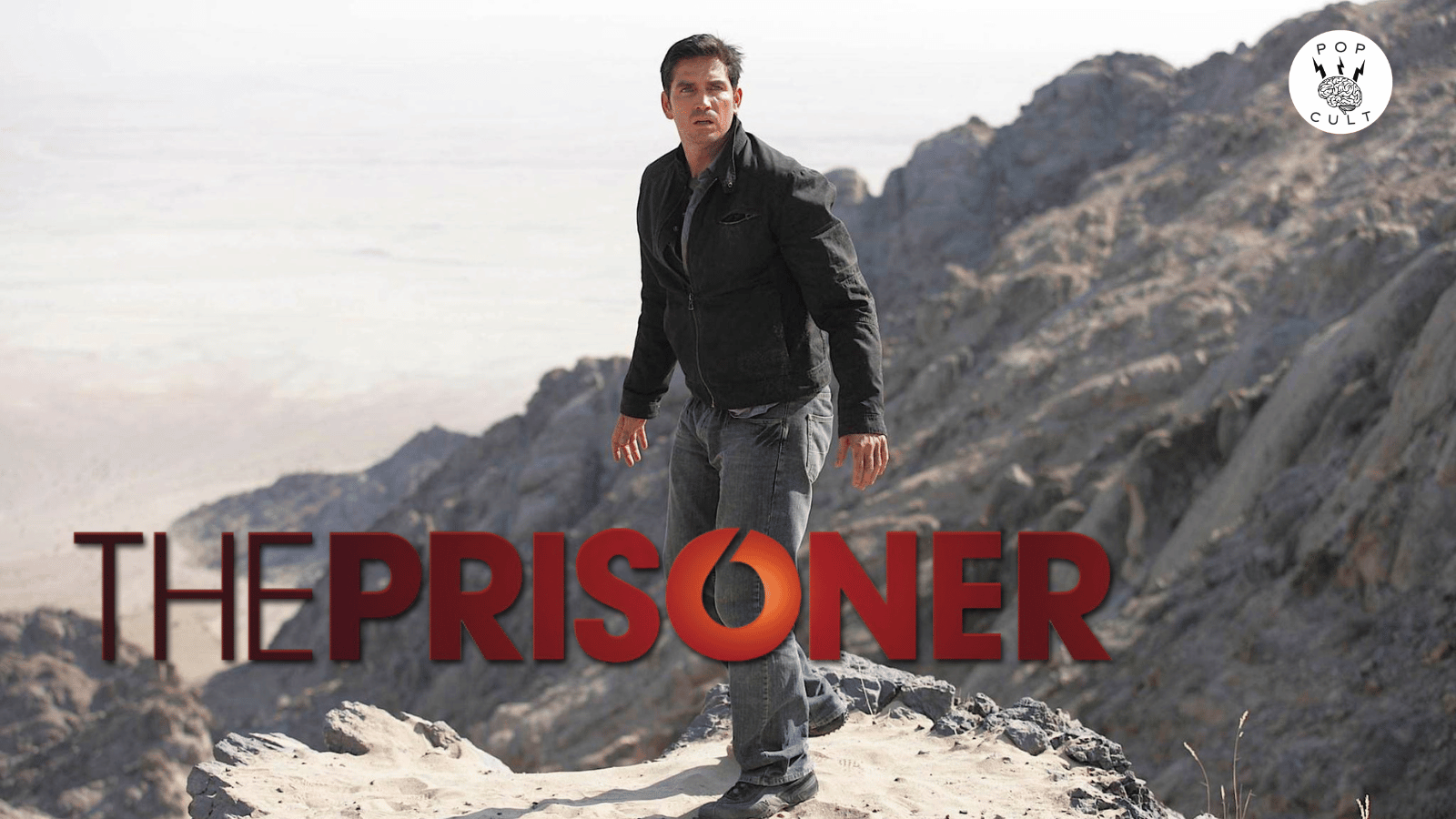
The Prisoner (2009)
Written by Bill Gallagher
Directed by Nick Hurran
J.J. Abrams had a stranglehold on U.S. media by the late 2000s. Not just that, but films like The Bourne Identity and the shooting style of director Paul Greengrass clearly became a trend in film and television. These aren’t terrible styles to emulate for a Prisoner remake in that period. If we think about the increased paranoia post-9/11 surrounding the rise of the surveillance state, it seems to mesh quite well with the themes & ideas the original series co-creator & star Patrick McGoohan sought to explore. However, the original Prisoner was a product of the 1960s Cold War era. If you want to tell the story in a modern context, some changes must be made. I don’t think the changes this miniseries made were the right ones, though, and despite having a few clever bits, the overall show was a disappointment.
A man (Jim Caviezal) wakes up in a desert. He comes across an old man being pursued by guards. The old man dies, but not before asking the new man to tell someone that he “got out.” Our main character wanders further and discovers a strange community called The Village, where everyone is known by number rather than a name. The man is renamed Number Six and meets the city’s mysterious ruler, Number Two (Ian McKellan). Six begins remembering another life in New York City, where he worked for an intelligence firm subcontracted by the U.S. government, but everyone insists there is nothing other than The Village. When Six tries to escape, he’s met with a massive white rubber ball that acts as a boundary keeper. He is a prisoner here.
I don’t see this miniseries as a total disaster. I don’t think I would ever sit down and watch it again, but it wasn’t tossing away all the tropes and ideas from the original show. Some aesthetic elements match the architecture of the original Village. The basic plot outlines all feel like episodes of the ’60s show but are presented in a contemporary, gritty style that was popular in the late 2000s. My biggest problem was that the big reveal at the end did not have an adequate enough payoff and was way too bland & boring for my tastes. The Secret of the Village annoys me and doesn’t make me feel my six hours of watching this show was worth it.
The most glaring problem with this show is casting Jim Cavezial as Number Six. I have never been a Cavezial fan, finding his performance so stiff and hollow. He repeats that here. His voice doesn’t have the air of authority that McGoohan’s did in the same role. His acting chops are severely lacking, and when he’s sharing the screen with McKellan, these flaws are heightened and obvious. As Robert Bianco said in his review for USA Today, “McKellen may be a sublime combo of the Wicked Witch and the Wiz, but Caviezel is no Dorothy.” If your central character is a dud, it will be a long, difficult ride for the audience.
This new Prisoner is made in the wake of forty decades of neoliberal order, wearing the world down into a bland, capitalist hellscape. This same affliction would cause this remake to constantly refrain from making relevant commentary on anything happening at the time. I was excited when I saw the surveillance state introduced, only to have the show go in a direction that reflects the self-centered notions of our time. It becomes a show about self-help and rehabilitation when it should be a show about the atomization of cultures & life in favor of something more easily controlled by the establishment. That’s why they lose their names for numbers.
Western society, especially the U.S., has fallen into this self-care rabbit hole. The irony is that the purpose of the care is not to help you but to make you more amenable to being exploited in your workplace, turned into a consumption machine that enriches an economy you rarely benefit from. Like its precursor, the Village we see in this show is a parody of our actual cities and towns. All the elements you expect are there but without any flourish of personality. This Village is far larger than the original, with urban elements; however, it still feels empty.
The original Prisoner was a show that rippled through the medium. It was such a strange, unique experience at a time when people were seeking those out. So many wanted to challenge their notions and perceptions, hence the psychedelic drug usage of the 1960s. This Prisoner comes about in a world influenced by the original show. The 1960s Prisoner was cited by the creators of Lost, for example, as a big influence on the strange aspects of the Island. The Smoke Monster is their take on Rover. The Others’s home is akin to The Village. I get the sneaking suspicion that someone at AMC, the U.S. co-producer, wanted this version to have a “coherent ending,” which meant the last couple of episodes become very annoying in wanting to “solve” the mystery.
While watching the original show, I felt the tug & pull between Six and Number Two. That was the engine that kept me interested. It felt like Two might actually kill Six at specific points to extract his precious information. The 2009 dynamic between these two characters falls flat. It never feels like Six will die, but he’s just inside a puzzle he’s forced to solve. Rather than feeling like a nightmare, the show has a sleepy haze, which means the energy is very low. In the original, Six had several moments where he believed he had escaped, only to realize he was still trapped. I think 2009 tries to do that in a roundabout way that I didn’t enjoy.
This miniseries focuses far too much on Number Two so that he becomes a co-star to Six. McKellan is a big name, so that’s why he’s so prominently featured, but it’s to the detriment of the show. With a different Two in nearly every episode, the original series was able to make that role a fascinating surprise as we explored Six’s clashes with different personalities. The gist here seems to be that Two and Six are two sides of the same coin, which is one of the medium’s most exhausting hero/villain dynamics.
Ultimately, The Prisoner of the 1960s was an original object, something unlike what had come before. Its 2009 follow-up feels like a cut-and-paste of many things that saturated the media landscape at the time and still are today. Christopher Nolan has shown interest in a feature film adaptation of the original. Here’s hoping if he goes through with it, it’s much better than this.

 PopCult Reviews
One thought on “TV Review – The Prisoner (2009)”