
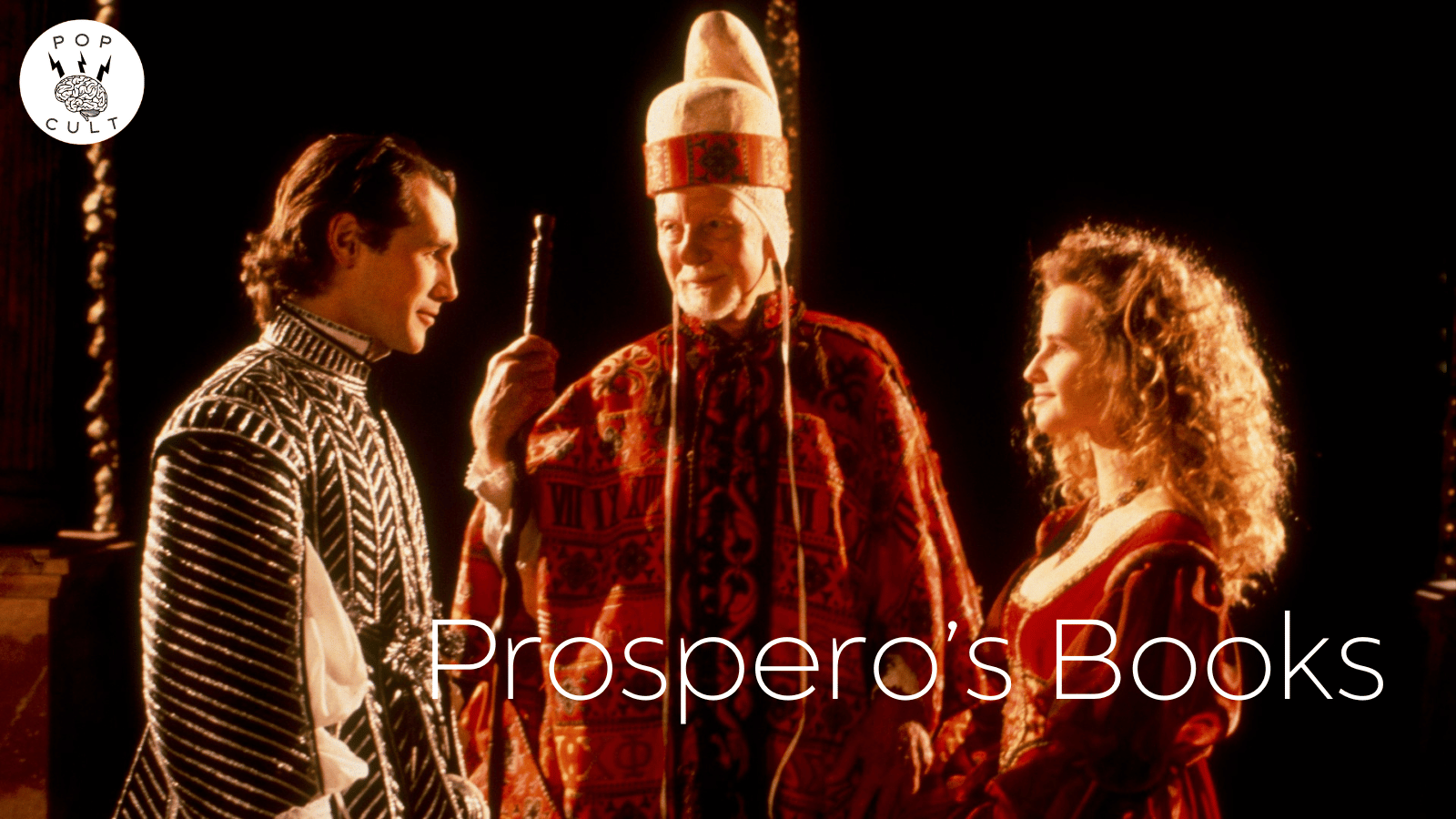
Prospero’s Books (1991)
Written by Willliam Shakespeare & Peter Greenaway
Directed by Peter Greenaway
I’ve always enjoyed The Tempest most of all Shakespeare’s comedies. I think it’s a fun, beautiful celebration of Shakespeare’s work in the theater. This isn’t a unique analysis on my part, but it is a widely accepted reading of the play. Prospero is the Bard; this island is his stage, and the magic he employs is really just imagination & writing. The story seems to be a revenge tale at the start but becomes a celebration of life by the end. Our protagonist realizes the revenge he seeks is not as important as the happiness his child could have, so he cedes to the future rather than dwells in the past.
In this version of The Tempest, filmmaker Peter Greenaway lets the visuals dominate the story. He uses the arcane tomes employed by the wizard Prospero. To illustrate these books and the magic being used, Greenaway employs some popular film special effects often seen on MTV in music videos. This was one of the critiques of the film at the time, but any good Shakespeare adaptation sets itself apart by how it visually presents the story. I don’t think much tampering should be done with the language if it is an English production, which is something Greenaway understood here.
For the unfamiliar, the story sees Prospero casting a spell to create a great storm. This tempest strands the man responsible for Prospero’s exile on these shores and several of his traveling companions. After putting his daughter Miranda into a magical sleep, Prospero employs a sprite, Ariel, and the bestial, Caliban, as part of his revenge plot. But this all comes apart when Prince Ferdinand, one of the shipwrecked, finds Miranda, wakes her, and they fall in love.
If this feels indulgent, I think that’s the point. This is only the second Greenaway film I’ve seen, the first being the incredible The Cook, The Thief, His Wife, and Her Lover. From that first work, I could understand this is a director who relishes the foundation of cinema in the same way that David Lynch did. Movies speak in a language of images, with words being supplementary. In this film, the spectacular nature of each magic book provides an opportunity for Greenaway to play with the image.
The pages of the books often appear in the center of the screen, creating overlapping images with multiple pages on the screen at once. One book purports to be a comprehensive tome on human anatomy enchanted so that the pages bleed, the organs on the page pulse, and move with life. Each book is not merely full of information on its given topic but physically representative of its subject, which provides many of the most incredible visual aspects of the film.
An aspect of the film that may rub some viewers the wrong way is that John Gielgud, who plays Prospero, delivers nearly all of the lines. It works like the narrator of an audiobook, with Gielgud serving as the narrator, providing voices for each character. The actor was a force of nature; having him deliver this dialogue is a treat. There is such care taken with the words, making Shakespeare’s best work connect with audiences strongly. Gielgud’s voice is the perfect mix of authority and tenderness; he plays the angry wizard just as well as a father whose heart is softened by seeing his daughter find love.
Throughout the film, Greenaway celebrates the nude form, with the screen often filled with naked bodies of all genders, shapes, and sizes. These are the spirits that Prospero has conjured and which he uses to implement his schemes. Ariel is played by three actors who speak in unison, from a child to an adult. This addition to the text highlights that Ariel is a being outside our material perceptions. It’s worrying to me that nudity has become so associated, especially in American cinema, with sexuality when there’s a robust artistic history of nudity outside of that context. The way Greenaway films these nude bodies is truly beautiful and evokes their primal nature as spirits.
Greenaway and Gielgud also sensitively portray Caliban. There’s a fantastic flashback to show the witch Sycorax, who birthed Caliban, and then Prospero killed her. Caliban has always been a sympathetic character. He is only a baby when Prospero arrives and is raised alongside Miranda. All this is to only be cast aside as a lesser being, treated as if he wasn’t meant to see Prospero as a father. In a larger context, we can see this as a commentary on colonialism. We can’t really say Shakespeare’s exact views on this topic, but I see Caliban as a profoundly human portrayal of an indigenous person. By the end of the play, Prospero acknowledges the cruelty he treats Caliban and is genuinely sorry for what he has done.
This plays into what I see as the core theme of The Tempest, forgiveness. Prospero has become so caught up in his revenge fantasies he’s lost sight of the purpose of life. He’s raised his daughter since she was a baby, meaning she’s never seen another human. The first one she sees is Ferdinand, and they fall in love. From a practical perspective, it seems silly, but I read these things as metaphorical. The moment Miranda makes contact with the greater span of humanity, she is enamored; she wants to be a part of the flow of life in this world. Prospero is pulled out of his hate and glimpses the beauty he had forgotten in the world. He no longer wants to kill; he wants to live and forgive.
I do think Prospero’s Books may not be the best introduction to The Tempest for an unfamiliar audience. Ariana doesn’t have much experience with Shakespeare out of things like Baz Luhrmann’s Romeo + Juliet, and I had to provide a lot of context so she could understand what was happening. This is a dense piece of cinema, and the pacing can feel very long with the dreamy structure. I also think these things helped me enjoy it more, but I had a lot of background coming into the film.
This is an art-house interpretation of Shakespeare, and that immediately narrows the audience of who might receive it positively. If I had to recommend how to experience the film, it would be to read the play and find a more faithful adaptation. Greenaway isn’t attempting to make the definitive version of The Tempest but to give his personal aesthetic take on it while also celebrating the acting legacy of John Gielgud, one of the great Shakespeare actors of the mid-late 20th century,
Films like this one and Akira Kurosawa’s Throne of Blood make me wish we could hear Shakespeare’s takes on these adaptations. His perception of theater didn’t contain film, and I’m not sure he could have conceptualized it. The stunning images of books that breathe, move, feed, dance, and more are beyond his understanding. This is the second Greenaway film I’ve seen, and I have to say I love this director. Don’t be surprised if you see more reviews of his work showing up in the near future.

 PopCult Reviews
One thought on “Movie Review – Prospero’s Books”