
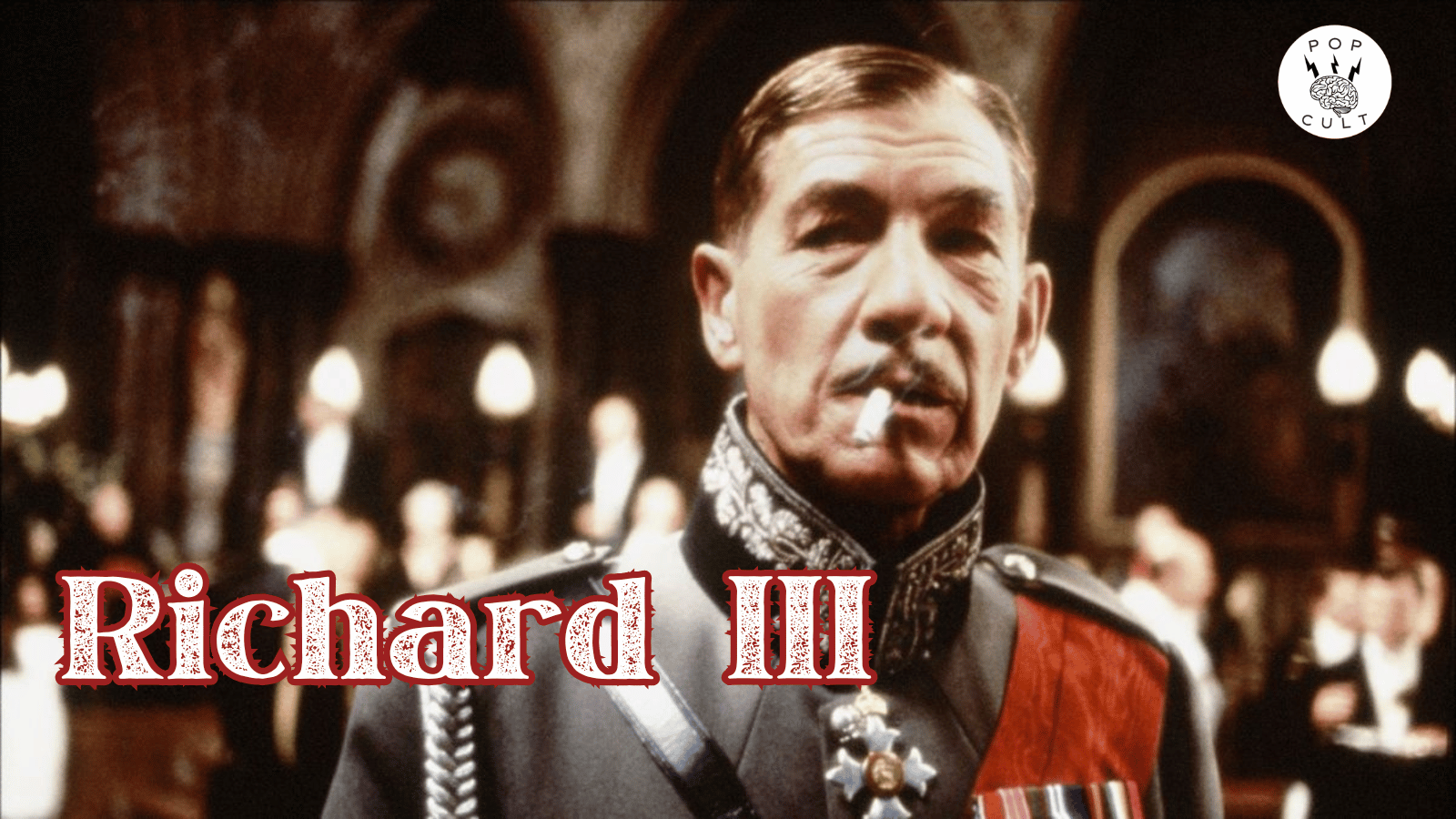
Richard III (1995)
Written by William Shakespeare & Ian McKellan and Richard Loncraine
Directed by Richard Loncraine
Shakespeare was no stranger to putting despicable people at the center of his narratives. The point was often to explore them in more complexity than a one-dimensional story might provide. He didn’t excuse evil but wanted to understand how these minds operated. How else can we prevent future evil if we don’t understand the roots of the present one? Richard III is a profoundly evil figure who revels in the suffering he causes others, yet he doesn’t exist in a vacuum. He is the byproduct of a cruel system that inevitably makes people like him.
This adaptation changes the aesthetics to make it more in line with 1930s England, adopting the fascist military iconography of the era. Otherwise, it’s the same story, reflecting the timelessness of Shakespeare’s work. People in power are the same no matter what period we glimpse them in. Adapted from a stage production with the same aesthetics, the film’s center is Ian McKellan, who gives a wonderfully evil performance as a man who delights in evil.
A bloody civil war comes to its conclusion when King Henry and his son Prince Edward of House Lancaster are killed. Edward York ascends to the throne, helped by his physically disfigured brother Richard (McKellan). In private, the field commander of Edward’s armies seeks to usurp his elder sibling. He begins pitting members of the royal family against each other while forcing the widow (Kristin Scott Thomas) of the late Prince Edward into a marriage with him. Richard comes to find a confidante in James Tyrrel (Adrian Dunbar)l, who he dispatches to do his dirty deeds, including the murder of child heirs.
As I said, this is an Ian McKellan vehicle, allowing him to showcase his acting talents. McKellan is no stranger to Shakespeare or complex characters. Even someone like Magneto is layered as much as a Hollywood film v can be. Richard is strangely sympathetic to me at specific points. He was born disfigured, and at one point, his mother (Maggie Smith), lamenting the horrors her progeny has done to his own family, wishes aloud that the monster had died at birth. I got the sense these proclamations weren’t new in Richard’s life. It doesn’t justify his actions, but it does help explain why he does what he does.
This is undoubtedly an all-star cast, but I don’t think the recognizable faces detract from the whole. Annette Bening is Richard’s sister-in-law, Queen Elizabeth, who is desperate to keep her family alive as a series of seemingly horrible accidents are revealed to be part of a grand conspiracy. Her brother, Rivers (Robert Downey Jr), is present but doesn’t play that vital role, at least in this abridged version of the play. Kristin Scott Thomas certainly doesn’t get enough screen time as Lady Anne, but what we get of her is fantastic. I certainly wanted to see more of her twisted dynamic with Richard.
There is an awareness in Richard, a touch that reminds us this is a Shakespeare production, and even his villain will have tremendous introspection that you won’t find elsewhere. Richard is incredibly conscious of his deformity. He walks with a limp, one side of his face sags, and he has a hunched back. None of it is overly grotesque, but just enough to contrast him from the noble “beauty” of his family. In his famous “Now is the winter of our discontent” monologue, Richard expresses his knowledge of how others see him:
Deformed, unfinished, sent before my time
Into this breathing world scarce half made up,
And that so lamely and unfashionable
That dogs bark at me as I halt by them—
Richard was not deformed, but Shakespeare’s creative license was a very interesting choice. It gives the character another layer and the actor something that adds to the performance. It reminds us of the horrible stereotype that external deformity is not a mark of internal character, which is why this work feels very delicate: it has to be handled with nuance lest the wrong message be conveyed. The focus on self-awareness is what makes the difference. Richard knows how he is seen and is never allowed to legitimately take the throne because of his appearance. He’s no more monstrous than the people around him. He is simply honest about it.
Richard looks at and speaks directly to the audience during his many monologues, which makes us complicit in his crimes. This made me think about Michael Haneke’s Funny Games, wherein one-half of the sadistic duo takes delight in literally winking at the audience and operating in a meta-space that acknowledges the audience is viewing entertainment. Richard’s murderous nature might have appealed to portions of the original audience in the Globe. The violence of Shakespeare’s plays was often played as thrilling delights to the crowd.
Richard seems to enjoy torturing everyone around him, for example, during the scene where he asks for Lady Anne’s hand and offers her a ring. The ring comes from his hand, which he removes by placing the finger in his mouth, pulling it off with his teeth, and spitting it onto his palm. When he slips it onto her hand, she visibly reacts to the feel of his spit coating it. This is the saliva of the man who murdered her husband and whom she will be forced to go to bed with. There is something that makes you laugh along with Richard, who is entirely aware of what he does to others. He’s in on the joke of his existence.
As often happens when someone is ignored by the powerful while in proximity to it, Richard has been observing. He has noted who will be most valuable to him and who is a liability. Lord Buckingham (Jim Broadbent) quickly fawns over Richard and worms his way into his inner circle. But for all of Richard’s insight, he is not a mentally healthy person. Paranoia sets in, paralleling the fascist leaders the aesthetics of the film infers. When someone wields power with such pleasure in the suffering they cause, those around them inevitably begin to think of ways to stop them. Power can not operate without interruption when it becomes too evident in its cruelty. This has been the folly of many historical rulers who reveal their true selves too nakedly to the public.
Because Richard knows he is an evil person, his downfall is inevitable. There is some sense of relief in this. We know that the madman will not be allowed to get away with what he does. However, there’s a knowing smile shared between Richard, the man who takes his life. To me, that was an acknowledgment that none of this ends here. It will be repeated with many others sitting in Richard’s chair. Many of them won’t have his awareness; they will see this as carrying the torch of the ruling class and convince themselves there’s an honor in the atrocities they commit. Richard never fooled himself in this way. He knew he was a rotten person, and what he did was only to please his dark ego. In that way, he is the most honest of the kings, who nods yes to the fact that he does nothing good.

 PopCult Reviews
One thought on “Movie Review – Richard III”