
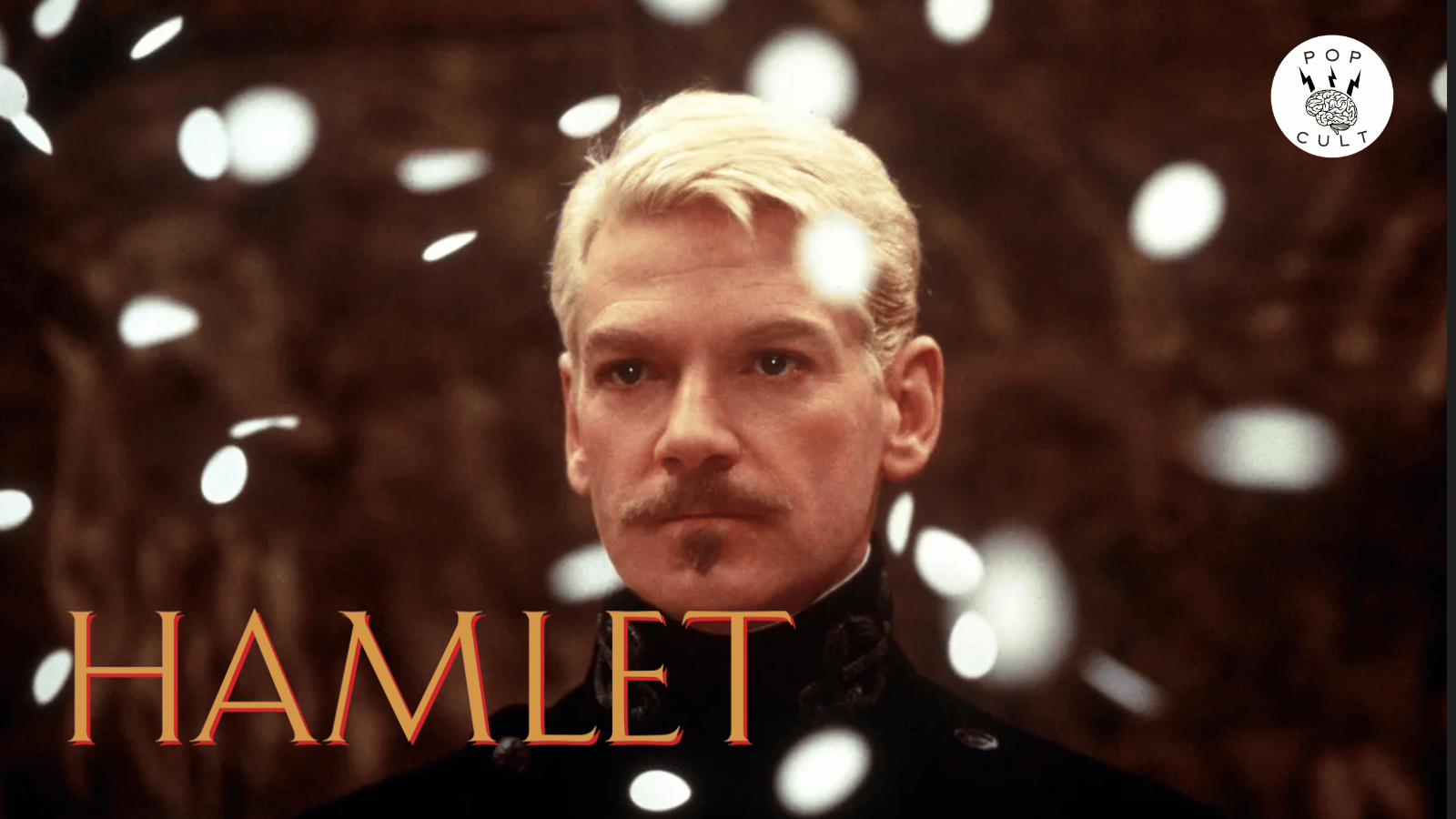
Hamlet (1996)
Written by William Shakespeare & Kenneth Branagh
Directed by Kenneth Branagh
If there was one Shakespeare play I would choose as my introduction to the writer, it would be Hamlet. I wouldn’t pick it because it is the easiest to read but because it exemplifies those literary elements that make Shakespeare’s work resonate across cultures and eras. Kenneth Branagh made this production based on the text presented in the First Folio, which is considered the most official version. That said, the director also allowed himself to play with the images. Flashbacks are employed throughout in a manner that couldn’t have been possible on stage. The result is what I believe to be THE film adaptation of Hamlet.
For the unfamiliar, Hamlet (Branagh), the prince of Denmark, recently returned home following his father’s death (Brian Blessed). Hamlet’s mother, Queen Gertrude (Julie Christie), has rushed into a marriage with her brother-in-law, Claudius (Derek Jacobi), which has driven the grief-stricken young prince into a rage, seeing it as a betrayal of his beloved father. Palace guards come to Hamlet and say they’ve seen his father’s spirit outside the gates and want the prince to see it for himself. He does and claims the ghost has charged him in seeking revenge on his uncle.
The problem with Hamlet is he’s stuck between his angst and action. When he hypes himself up to do something, someone interrupts and kills the momentum, or he talks himself out of it. He’s struck up a sexual relationship with Ophelia (Kate Winslet), the daughter of Polonius, the king’s advisor. He ends up using her as a pawn in his feigned insanity, which drives her into madness. Despite his father’s order to leave his mother out of this, Hamlet cannot help but seethe with contempt and contemplate punishing her, too. This is a tragedy that will end in nearly every character’s death.
Branagh tweaks the production to make it more cinematic while not compromising the text. We see brief glimpses of Hamlet in bed with Ophelia, clarifying things implied in the play. It’s nothing explicit, but it does push aside the theory that Ophelia is simply crazy. Hamlet made promises he never intended to keep, manipulating this sheltered young woman. He is, after all, another aristocrat who often sees people as things he can use to achieve his own ends. Winslet is utterly heartbreaking as the young woman, giving a performance that had me choking up. You really feel the pointless tragedy of her character and come to despise Hamlet more as a result.
The famous “Alas, poor Yorick” speech is accentuated with flashbacks, where the court jester is alive, interacting with young Hamlet. Perhaps it’s very on the nose, but I found it moving. Hamlet is reflecting on people who have been important in his life and how they are gone, something that is inevitable in all our lives. To see his memories underlines that internal suffering. It also makes the reveal in the next moment he discovers Ophelia has killed herself and is about to be buried. Another person, this one his fault, is gone.
There have been several adaptations of Hamlet over the years. I’ve seen the horrible Mel Gibson version, which edited the text to just around 90 minutes, and I never cared much for the modern take in Ethan Hawke’s version. I had seen segments of this production but never the whole piece until now, and it was an absolute delight to see the full text performed on screen. Hamlet’s personal struggles are expertly interwoven with the palace politics.
Professors told me at university that while reading Shakespeare was a good experience, seeing it performed was always better. I think that’s very true for Hamlet, which is as enriching as pouring over the text and learning how to read it; seeing actors’ interpretations adds another layer. It takes something that feels unwieldy on the page to a modern reader. An actor adds emotion that can’t be communicated simply in words. I sometimes find Branagh cheesy, but his theatricality is appropriate for this performance. He also brings in actors with different styles that complement each other. I saw Julie Christie’s approach as more naturalistic; Derek Jacobi presents a more controlled Shakespearean actor, while Winslet is full of pathos.
I don’t think Branagh could be accused of subtlety, though, which is where the production diverges from Shakespeare. The way he directs the film is straightforward, with no real room for interpretation. While Baz Luhrmann’s Romeo + Juliet attempted to pair Shakespeare’s work with contemporary sensibilities, I think Hamlet is a better example of that.
Branagh tries to add some bombast to the production. Hamlet’s seventh and final soliloquy takes place as he returns to England with Rosencrantz & Guildenstern. They stop briefly to watch the Norwegian prince Fortinbras (Rufus Sewell) and his army passing through Denmark to invade Poland. The camera is very melodramatic at the conclusion of this scene as Hamlet proclaims he will dedicate himself to killing his enemies. The point is meant to underscore our protagonist coming to a harrowing conclusion after flopping back and forth for so long. The sweeping score and ostentatious camerawork are a lot, and I wonder what that moment would look like if it was played quietly.
I also found some of the cameos by big names to be distracting. Jack Lemmon, as a palace guard, felt like a strange choice that didn’t really work. Billy Crystal, as a gravedigger, was a bit more interesting as he played up his New York accent. Robin Williams, as the doomed Osric, showed a decent understanding of the text; he was classically trained under John Houseman. However, these felt unimpressive for the most part. I don’t understand what they added to the production other than names to throw into a trailer, hoping to get more people to come to the theater.
I enjoyed this production overall, though. I think it does a great job of emphasizing the parallels between characters – Hamlet vs. Laertes regarding how they avenge their fathers, Hamlet vs. Fortinbras regarding two princes‘ different approaches, and Polonius vs. King Hamlet regarding fathers guiding their sons. I felt the weight of the tragedy in the final moments, bodies strewn about the throne room. Like all good Shakespeare tragedies, we’re left with the hollowness of it all, the questions as to why these people didn’t find a way to solve the conflict rather than be destroyed by it.
Hubris is the thread I see woven through all of Shakespeare’s works. In his comedies, characters often overcome their egos, while in tragedies, they succumb to them. And that’s the difference, in the end. People who live authentically content, happy lives are most often the ones who wrestle with and conquer their egos. Those who experience depression and dissonance with people around them are still working through it. These elements make Shakespeare’s work so very potent to me in our current era.

 PopCult Reviews
Saw Branagh play Hamlet at the Barbican in 1993? ish. Very good. Nice write up