
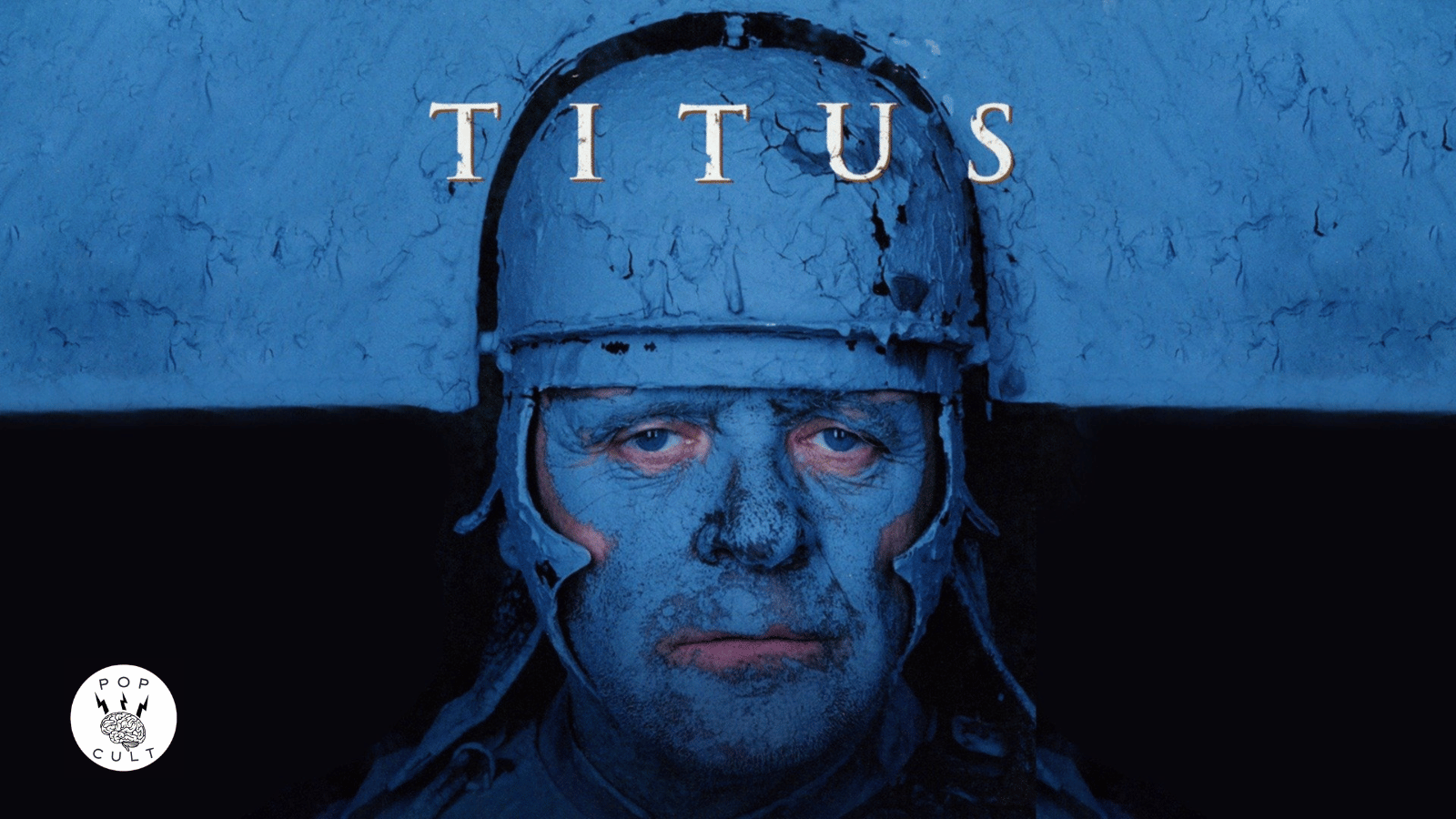
Titus (1999)
Written by William Shakespeare & Julie Taymor
Directed by Julie Taymor
Titus Andronicus was the first of Shakespeare’s tragedies, written between 1588 and 1593. It feels different than his later work, more concerned with the spectacle of blood & gore that was made popular by his contemporaries. Some critics hold that Shakespeare was parodying popular plays of the time, like the work of Christopher Marlowe, which was immensely bloody. Death was something people in the West had a far closer proximity to in those days, incredibly violent deaths. Disease ran rampant and was not a pretty thing to watch take a person’s life. While war had not become industrialized yet, it was more intimate. To kill with a blade meant smelling the breath of your enemy, feeling their blood on your hands. This was also an era where the mythologizing of the Roman Empire was in full swing, used to justify England’s first moves towards colonizing other lands. When the Victorian Era came about with its censorious bent, Titus was considered uncouth and fell out of favor.
Director Julie Taymor based this film version on a stage production she had previously done, making some tweaks to specific bits of staging and writing bridge scenes with additional dialogue. She also set the film in a surreal mix of the Roman Empire and 1930s Europe; the production design and music reflect this strange melange. She was riding high from a recent sweep of the Tonys for her staging of The Lion King musical, one of those Broadway shows that altered the trajectory of stage musicals for the next couple of decades until Hamilton. She would bring a unique perspective to the play, reframing its violence into commentary on the endless cycle of blood that inhibits societies from progressing.
A boy eating breakfast in a 1950s-style kitchen is suddenly pulled into the world of his imagination as he plays with toy soldiers. The Roman Empire comes to life, and we meet General Titus (Anthony Hopkins), who has just returned home from war with the Goths. He has captured their queen Tamora (Jessica Lange) and three sons. Titus has lost 21 of his own boys and, in performing the funeral rites, sacrifices and burns one of Tamora’s. Saturninus (Alan Cumming) and Bassianus are the feuding sons of the recently dead Caesar, each vying for the throne. The public has proclaimed their choice as Titus, but he has no interest in the position. Instead, he goes with tradition, choosing Saturninus as the eldest son should be heir.
Saturninus tries to take Titus’s daughter, Lavinia, as his bride simply because his brother loves her. However, the newly crowned emperor becomes more enamored with Tamora. She sees an opportunity to plot and scheme against Titus, who killed her son and hides her secret relationship with the enslaved African man, Aaron (Harry Lennix). As violent tragedy befalls Titus, he begins losing his mind, seeing wild hallucinations. Like Hamlet, this will come to a harrowing conclusion where nearly everyone involved lies in a pool of blood.
In Taymor’s Titus, we have a sample of cinematic maximalism, an overload of images and sound mixed across eras and intended to be surreal. Baz Luhrmann is another advocate of this mode of cinema, which you can especially see in his recent Elvis film. I go back and forth with maximalism. There’s no denying the power of the visuals. They evoke emotions, but often, after the shock of the first viewing, they lose their potency. I was happy to see Titus, which was still a very compelling film for the most part.
There’s a tightrope the film walks between becoming a farce and a serious drama. I think it’s handled well. Near the film’s end, we get Hopkins dressed in a chef’s outfit, cooking up a big surprise for Tamora and the Emperor. Taymor directs it, and Hopkins plays it very cheekily. He smacks his lips as playful music chirps over the radio. Juxtapose this with an earlier scene where he discovers his daughter Lavinia has been raped and mutilated. There is an aching tenderness in his actions, a release to the madness gnawing at the edges of his mind that is played entirely seriously.
Titus wisely remarks that “Rome is a wilderness of tigers.” In these lines, Shakespeare uses past stories to speak about his understanding of the human condition. For all their luxury & glory, the capitals of empires are often harsh, violent places. London was a place like that. Places like the United States are full of tiger dens. These are places where the poor and vulnerable are given no options beyond being worked until death or exploiting their fellow humans for the benefit of the powerful. In the West, tigers are on the hunt constantly.
A key piece to this story is that no single character besides Lavinia and Young Lucius might be considered “good.” Titus is one of those tigers he decries, ignoring Tamora’s pleas of mercy for her son’s life. He also follows tradition to the degree that it destroys his family and society. When his sons seek to protect their sister from the Emperor, Titus takes the ruler’s side, seeing his boys as pushing back against tradition, and even kills one of his own children in the process.
Titus never abandons tradition, as seen in how he “saves” his daughter in the final act. But he’s following a trail of behavior that other villains in the play adhere to. Tamora happily dispatches her two sons to commit vile acts. Aaron schemes in the background, planning to destroy Titus and the Emperor & keep Tamora as his own. There’s a clever subversion here where Aaron, on the lowest rung of the social ladder, is more clever than almost everyone seen as “above him.” That doesn’t mean Aaron will get away with his plans. After all, this isn’t a fair society; it is one where the deck is stacked in favor of those who already hold power.
The film’s opening sequence is Taymor’s way of remarking that the proliferation of violence is embedded in contemporary culture, especially in children’s media. It minimizes the severity of violence by turning it into a hollow “bad guys vs. good guys” paradigm. This bled out into the discourse of the War on Terror in the 2000s, and the language persists today. It casts aside the nuance of why violence is happening and reduces it to a cartoonish battle of light and dark. It’s no coincidence that the framing of these conflicts by the cultural hegemony never critiques themselves but always sees those outside the empire as pure evil.
Taymor brings a rhythm to the work through the cinematography, keeping pace with the music and the score by her husband, Eliot Goldenthal. I mostly think of Goldenthal’s work on the Joel Schumacher Batman films. Like with those, this is an epic, baroque, and intentionally overwhelming score. It plays a central part in the narrative. I can’t imagine the final, prolonged shot playing without Goldenthal’s music underscoring it. It likely helps that these two creatives were in a personal relationship, and we can see how artistically synchronized they are here.
A frustration Taymor expressed with initially adapting Titus for the stage in 1994 was that it is missing many things other Shakespearean tragedies possess. There really is no lesson to be learned in the text. It’s an excuse to allow the audience to watch stomach-churning sequences of bloodshed. In that way, Titus feels contemporaneous with the popularity of revenge films in Hollywood. There’s no catharsis for Tamora or Titus or anyone. Because of this, Taymor chose to make Young Lucius the centerpiece.
The story is seen through his eyes, and the camera always catches Lucius watching from the edges of the scene. It is his daydream that kicks off the film. It makes sense that the finale causes us to go backward from the reality of the play to the limbo of a ruined arena that ushered us in. This time around, Lucius matures, and he watches these people destroy themselves.
A baby is born throughout the play, and Lucius is the only person left to care for this fragile, crying life. We watch as he carries the child away from the arena, leaving behind the soldiers and their blood-drenched swords. He slowly walks towards an approaching sunrise. We aren’t guaranteed their safety; that would not be honest. All we see is the potential of something new. We don’t know if the same mistakes will be repeated or not. All that matters is that there is another chance; another day comes, another moment to try and get it right this time.

 PopCult Reviews
One thought on “Movie Review – Titus”