
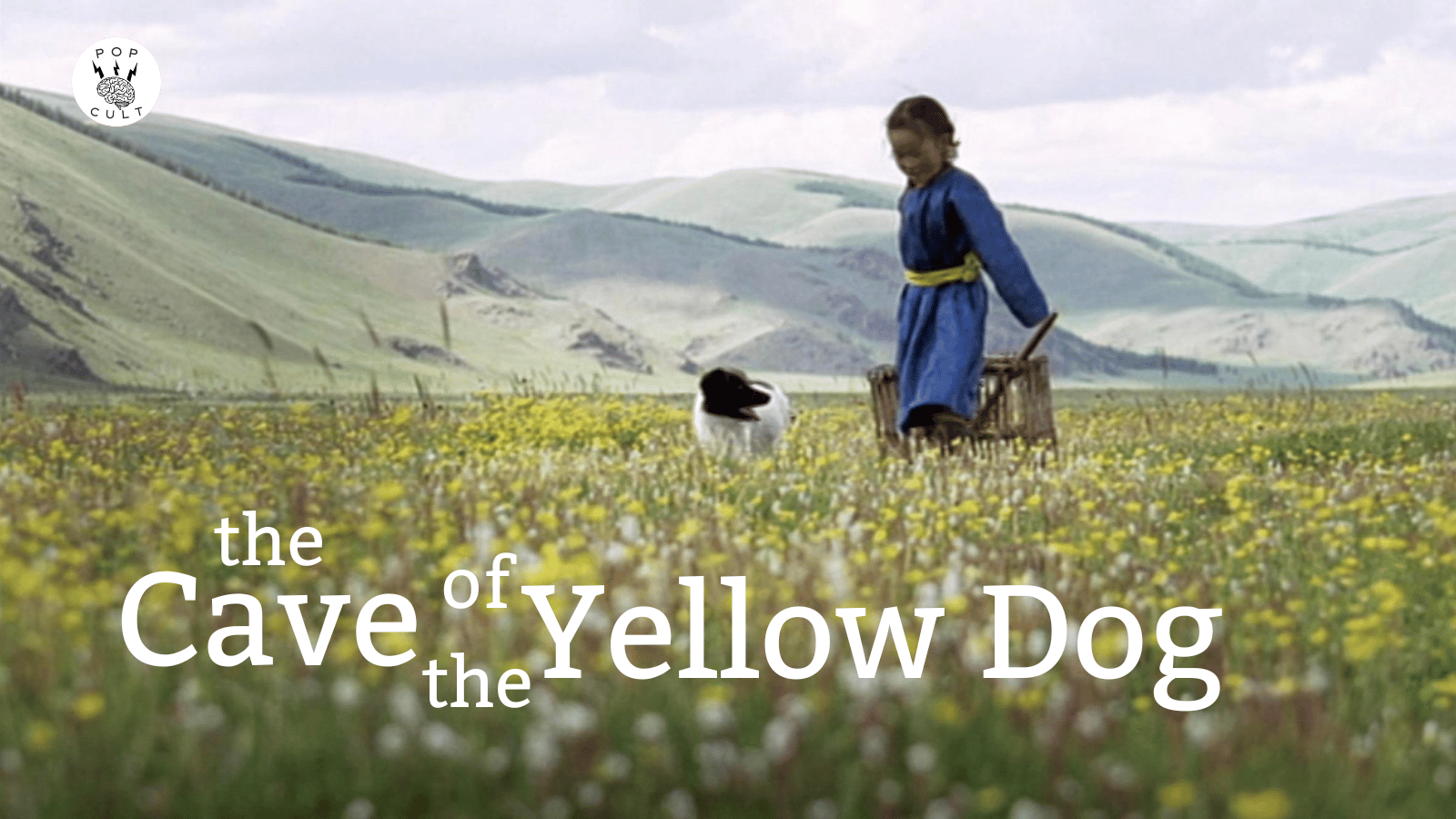
The Cave of the Yellow Dog (2005)
Written and directed by Byambasuren Davaa
I was surprised that I’d never seen a film made in Mongolia. Despite seeing so many Asian films over the years, this country has passed me by. The Cave of the Yellow Dog seemed like a choice for a couple reasons – it was rated quite highly on Letterboxd and focuses on nomadic life, a long-held cultural tradition in Mongolian. Byambasuren Davaa greatly loves this aspect of her people’s history and has made it the focus of several films, including this one. Her movies often involve amateur actors who play versions of themselves. Her films are generally called “children’s films” and blend documentary with fiction.
Nansai returns from boarding school to live with her nomadic family. They tend to herds of sheep, goats, and cattle. Nansai’s father is worried because wolves are attacking the animals. While out gathering dung for fuel, the little girl comes across a small cave home to a small stray dog. She names the dog Zochor (meaning Spot) and brings him home. However, her father is worried because wolves often live in caves, and he wonders if this dog has bonded with a pack and they will follow his scent.
Nansai’s father departs by motorbike to sell the pelts of the killed sheep, and the girl is expected to look after the herd. She becomes distracted and lost, finding refuge in the yurt of an elderly woman. The old lady tells the girl a story from which the film gets its title, which centers around a dog taking part in saving a child’s life. Eventually, Nansai is reunited with her family, and we see how this story intersects with the events of her own life.
Davaa truly loves Mongolia’s landscape and ensures that the seemingly endless blue skies and fluffy clouds transport those of us in the West to an entirely different world. Every time I see landscape shots of the Mongolian plains, they seem like a fantasy, which makes it all the more exhilarating to know they are real. I don’t expect to ever see them in person in my lifetime, but that would be quite an amazing experience.
Casting a real nomadic family in the primary role adds rich authenticity that professional actors just couldn’t have provided. Some bits of modernity seep in – the father’s motorbike or Nansai going to boarding school. The film’s end sees the family pack up as this is seasonal. They drive past a van with a loudspeaker announcing an upcoming election. Modernity also comes up in the gentle clash of ideas between Nansai and her father. She is a tiny child, so her protests are quiet but still resonate.
The film’s core theme is about opening one’s mind to see value in things you might see as a threat at first. The father’s concerns about bringing Zochor into their home are founded in reality. The wolves may follow his scent and harm more of the herd or the family itself. By the film’s end, the father has changed his perspective and sees Zochor in an entirely new light.
I kept referring to the Japanese film Milo & Otis as something similar. It had the elements of documentary mixed with a staged narrative. However, that film has become something I see as cruel in my later years because of the well-documented abuse of its animal subjects. That movie is pushed as a “kids’ film,” but I think, ultimately, it is too mean. The Cave of the Yellow Dog is far more appropriate.
Yet, the film is relatively slow-paced, with not much happening. This is where the documentary angle doesn’t work, and we linger on scenes that don’t add much to the narrative or our understanding of Mongolian culture. I suspect Davaa wasn’t so concerned about that; I thought the footage was beautiful. There is no arguing that. I’m also someone who loves a well-made piece of slow cinema. This is not a long film, but it feels stretched a little more than the story justifies.

 PopCult Reviews
One thought on “Movie Review – The Cave of the Yellow Dog”