
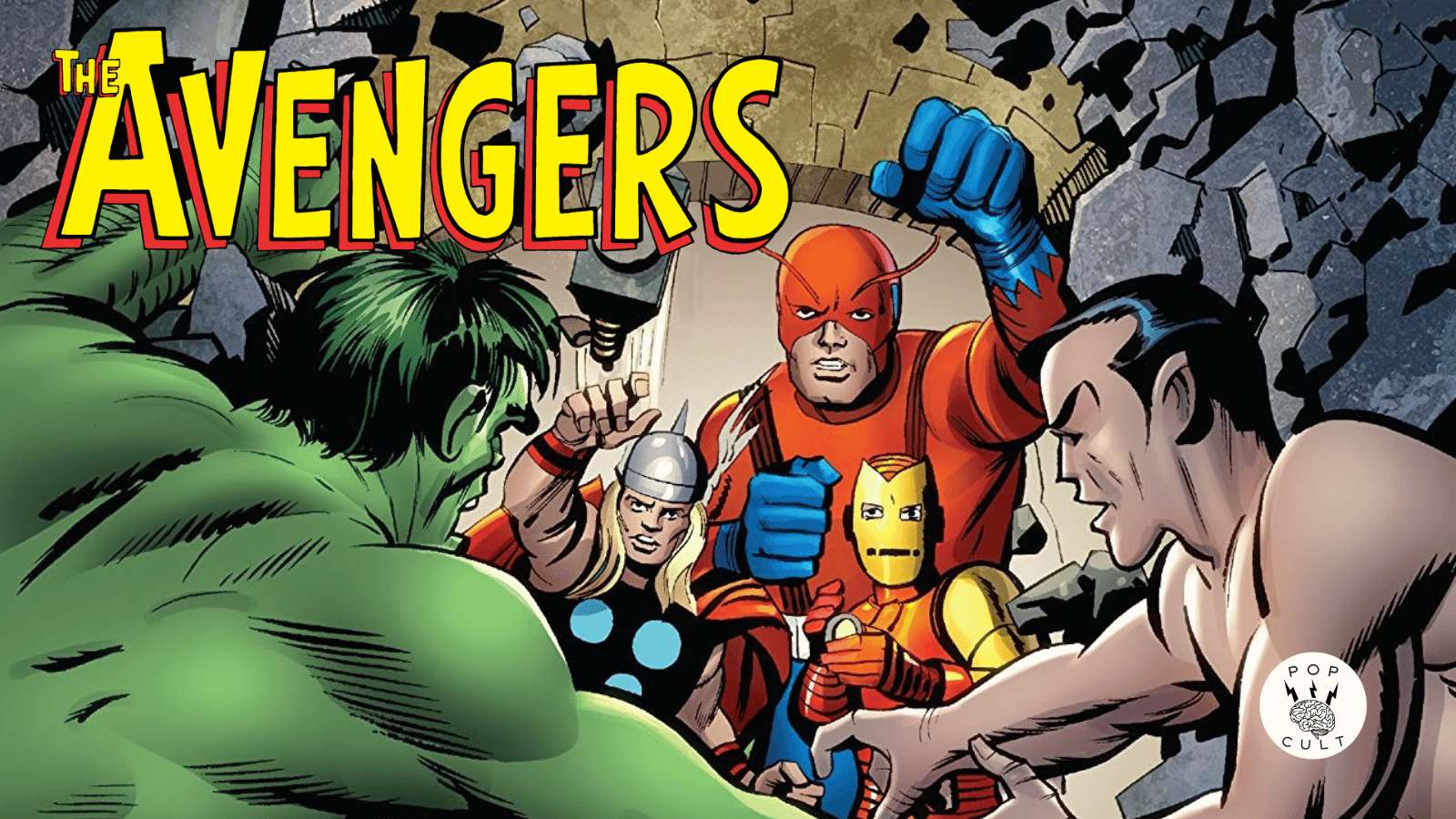
Avengers Epic Collection: Earth’s Mightiest Heroes (2014)
Reprints Avengers v1 #1-20
Written by Stan Lee
Art by Jack Kirby & Don Heck
When I was a kid with far more limited funds and had to pick a comic at the grocery store racks, I wanted the most bang for my buck. For me, that made team books far more appealing. You got a bunch of heroes and maybe more than one villain instead of a solo book. This made the Justice League, X-Men, Teen Titans, and Avengers more appealing. Yet, when I revisit some of these books, I find them lacking – especially Justice League and Avengers. Focusing on the latter, the Avengers is a comic that would have been the premiere book of the Marvel Age. Yet, it never overcame the appeal of Fantastic Four, Spider-Man, or even its individual members’ books.
The Avengers was a latecomer to the Marvel Universe. By the time Avengers #1 was published, readers had already met Spider-Man, The Fantastic Four, Hulk, Ant-Man & Wasp, Thor, and Iron Man. The X-Men would debut shortly after. This team became a place to read about everyone except for the FF and Spidey, but not all the members would stay put for long. Rather than introduce a new foe, Lee & Kirby opted to go with Loki, who had been plaguing Thor in the pages of Journey Into Mystery. The Hulk’s status as a menace is leveraged to pit the Green Goliath against Thor.
The scope of the Hulk’s destruction is picked up by others: Ant-Man and the Wasp and Iron Man suit up and head out to do their part. In the background, Rick Jones and his Teen Brigade sound a clarion call for anyone else who can help. For its 22 pages, a lot of story is packed in. It’s not a very compelling origin story and provides a false ending. The team seems united in that final panel, but the opening splash page of issue 2 has Hulk complaining about being on the team, foreshadowing his departure. However, he would remain an antagonist in several of those early issues.
Hulk had six issues of his own book before its cancellation. At the time, DC Comics was handling Marvel’s publishing ironically enough and allotted them only a few slots for monthly books. Hulk was one of the first comics to go, but Stan Lee kept him alive by having him pop up here and other books until he got a regular feature in Tales to Astonish (which would become The Incredible Hulk with issue 102). It made sense that the Hulk wouldn’t be a great team player, but I never felt like this team iteration felt genuinely cohesive.
The first original villain is Space Phantom, a rather generic alien foe that felt like something you might have encountered in the popular monster books Marvel published at the time. That second issue also shows how quickly things were changing outside of the Avengers, with Hank Pym showing up as Giant-Man. This would be a trend, as Lee wanted to make Marvel feel like a living interconnected comic book universe. Over this first year and a half of issues, we see Iron Man’s armor change a couple times, aside from some dramatic shifts in the roster. Plenty of thought bubbles and caption boxes try to keep readers updated on what’s going on with these characters’ solo runs.
Aside from recurring appearances from the Hulk, Namor the Submariner is also a thorn in the team’s side. He starts out by working alongside a rogue Hulk, and that fight transitions into the legendary issue 4. The Avengers and Namor battle it out in the Arctic Circle. An Inuit tribe worships a block of ice with a man encased inside. Namor tries to steal it, but the Avengers stop him and melt the ice. Within is the preserved, living Captain America, believed to have died during World War II.
This would lead to a regular portion of the book being dedicated to Steve Rogers as a fish out of water, adjusting to life in the 1960s. He would also open the door for Baron Zemo as a recurring villain. Other than characters like Space Phantom or Kang (more on him in a moment), the villain roster in early Avengers was two things: 1) primarily individual characters’ pre-established villains & 2) very, very repetitive. Baron Zemo will team up with Thor’s The Enchantress and The Executioner. I can’t say those stories won me over, either. I didn’t find any of those villains exciting, and much has to do with the Marvel writing style of the era – overly expository and unnecessarily wordy. I think it worked to an extent in Spider-Man and The Fantastic Four, but other books should have had their own style.
I was interested to see Kang’s first appearance as one of the core Avengers villains. I was very surprised that he was immediately revealed to be a future version of Rama-Tut, who had shown up in the pages of Fantastic Four. My expectation had been that this connection would have been a retcon made later on by another writer wanting to tie elements together. But right away, Lee establishes Kang as a complicated character.
The very next issue introduces Simon Williams as he becomes Wonder Man. I had known he debuted as a villain – one of many schemes concocted by Baron Zemo, Enchantress, and Executioner. He’s a struggling inventor who feels Tony Stark and his company are responsible for his failures. His tenure as Wonder Man is short-lived as he isn’t a bad guy and sacrifices himself to protect the Avengers. I had expected he’d recede into the background, not straight-up die. The whole story reminded me of the Tomorrow Woman issue of Grant Morrison’s JLA, and I have to assume they wrote that story as an homage to this one.
Immortus is introduced in the next issue (wanting to team up with Zemo and friends). If you’re up with your Marvel lore, you know Immortus is a future version of Kang. However, that will be a retcon and isn’t established here. Spider-Man shows up for an issue that sees the Avengers fighting a robot version of the hero. They fight Mole Man in another. The Maggia (a thinly veiled reference to the Italian mafia) and their leader, Count Nefaria, are introduced. He feels a little too much like a dollar-store Doctor Doom for my liking.
Issue sixteen sees the Avengers get a big shake-up that will become a recurring event every couple of years or so. Thor, Iron Man, Giant-Man, and Wasp depart from the team. Captain America stays behind and surprises the public by recruiting three supervillains seeking to be reformed: Quicksilver, Scarlet Witch, and Hawkeye. The former two were X-Men foes, and the third plagued Iron Man. I’d read through the original X-Men run a couple of years back, so seeing Quicksilver and Scarlet Witch spoken about as criminals wasn’t odd. Seeing Hawkeye and others talk about him as a villain was pretty strange.
This might make the book better. It did not. We get a fight against the Minotaur and a hilariously naive take on Vietnam. The Avengers go up against the Commissar, a hulking dictator of the fictional Sin-Cong. The story is rife with the poor natives praising the Avengers for saving them from the communist menace. While this was 1965, a decade later, the young people who read Marvel would already see it as total anticommunist propaganda not based on an ounce of reality. To close out this collection, we see the debut of the Swordsman, who would become a recurring villain and eventual member of the Avengers in a two-parter.
The Avengers has always been one of Marvel’s more complicated books outside the movies. It wasn’t until the last couple of decades that it became a core book. The Avengers wasn’t a premiere spotlight of Marvel’s best heroes for most of its history. It would not be. Eventually, Thor, Iron Man, Hank Pym, and the Wasp would return. But I would argue there are far fewer “classic” Avengers stories than most other characters in the Marvel Comics Universe.
I would like to keep reading through the Avengers, but I don’t feel much of a drive to jump to it right away. It is one of the more boring early Marvel books I’ve read, and I wouldn’t recommend it to anyone other than a true completionist.

 PopCult Reviews
One thought on “Comic Book Review – Avengers Epic Collection: Earth’s Mightiest Heroes”