
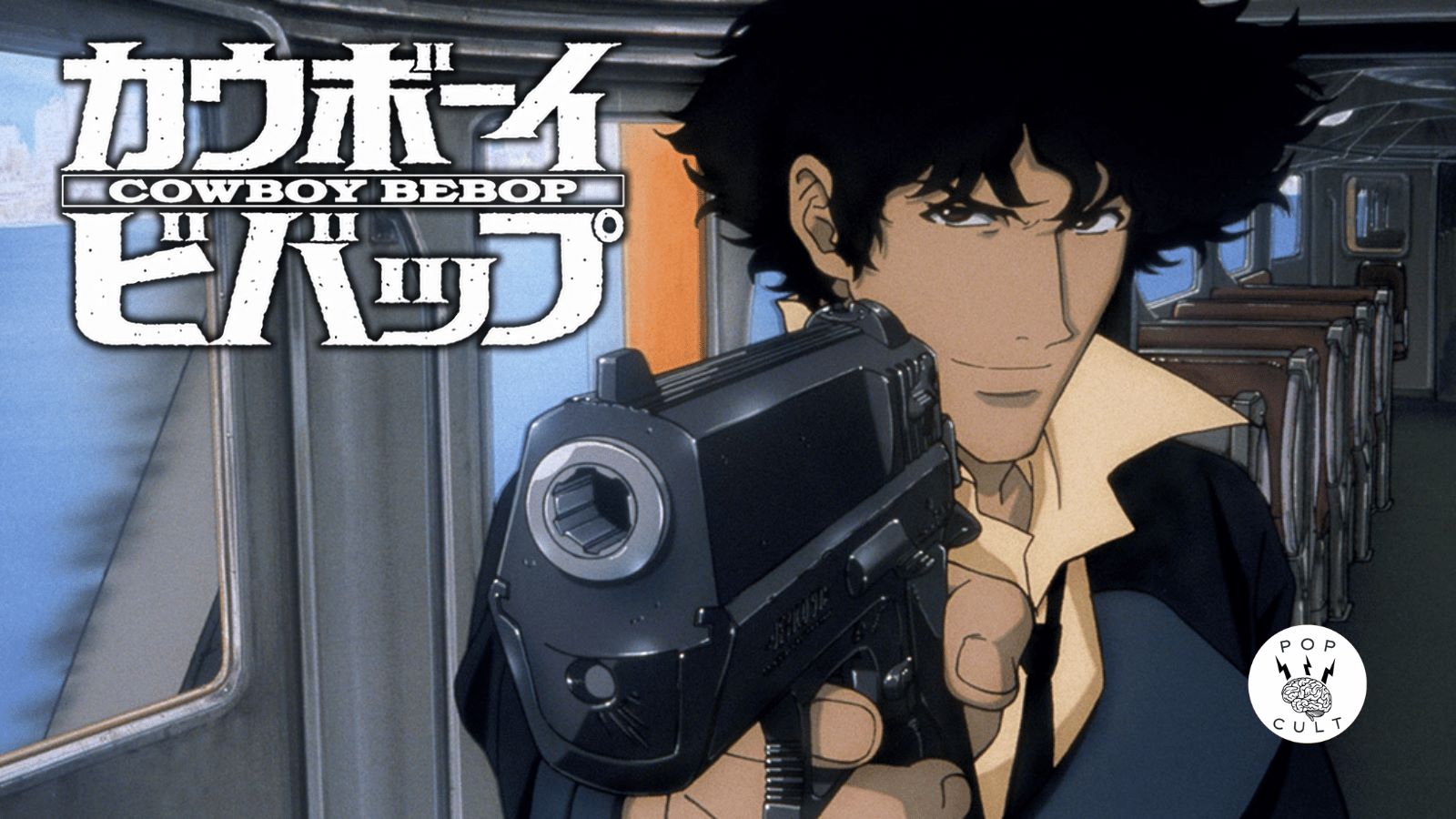
Cowboy Bebop (1998)
Written by Shinichirō Watanabe, Keiko Nobumoto, Michiko Yokote, Ryōta Yamaguchi, Sadayuki Murai, Dai Satō, and Akihiko Inari
Directed by Shinichirō Watanabe, Yoshiyuki Takei, Ikurō Satō, Kunihiro Mori, Tetsuya Watanabe, Ikurō Satō, Kunihiro Mori, and Hirokazu Yamada
Last year, after a lifetime of not finding anime TV series really appealing, I watched Neon Genesis Evangelion. I enjoyed it and decided to check out another anime series. I’ve been well aware of titles over the years but never felt like sitting down and watching them. One show I heard about over and over in the early 2000s was Cowboy Bebop. I watched a lot of Adult Swim comedies, and I can recall a vague image of Cowboy Bebop, but I don’t think I had ever seen an entire episode. I saw reviews later of people claiming it was the best anime of all time, in their opinion, and several people I know adore it. This seemed like a good choice for my next watch.
Spike Spiegel is a former hitman turned bounty hunter who travels the solar system with Jet Black, rounding up wanted criminals to make some cash. They aren’t really raking in the woolongs and often find themselves eating whatever crumbs lay around their ship, The Bebop. Throughout the series, they add three members to their crew: Faye Valentine, an amnesiac con artist; Edward Wong, a strange child who is a talented hacker; and Ein, a genetically engineered Welsh Corgi. As they take up bounties, the group often finds themselves unaware of details that change the situation or experience a catastrophic disaster that ends with them just as broke as when they started.
I expected the show to be more serialized, but it’s mainly a procedural. Each episode has a bounty, and the characters pursue it. The show is just as much comedic as action-oriented, two styles that have always been very complementary. I did some background research to figure out where the series’ overall tone came from. Creator/director Shinichirō Watanabe had been a part of several other anime series, but this was his first solo project. He was inspired by the crime drama Lupin III and started with the characters before developing the world. He also fed in a love of westerns and film noir. Watanabe said he knew how the show would end, and this is foreshadowed in the episodes where Spike confronts his nemesis, Vicious. Some of the other people working on the show didn’t like that there was a set ending, but Watanabe said he didn’t want to make an open-ended show where he’d be stuck for years.
One of the most striking things about Cowboy Bebop is the eclectic soundtrack. Composer Yoko Kanno was in charge of that aspect of the show, and Watanabe said she often wrote pieces without considering the scene’s context. That may sound like something that would result in terrible sequences. The result is the opposite. I found so many of these moments to be hypnotic. The music would bring out an aspect of the scene that wasn’t present in the animation or the writing, making it seem more emotional. Watanabe said he would listen to Kanno’s music, and it would often lead to him rewriting certain scenes because he realized a different direction would heighten the experience. In turn, Kanno read the new work, which inspired her to compose new pieces. This reciprocal creativity results in a tone I haven’t seen in many other anime projects.
I’m not a huge fan of procedural shows. I prefer serialized stories, so I struggled to sit down and watch an episode daily because I didn’t have an ongoing story to keep me going. That said, when I hit a powerful episode, I was mesmerized. Everything about this show oozes such strong style that you can’t help but enjoy the characters. Even the fast-paced theme song is something I never got tired of hearing. Such a delightful earworm sets the tone for the series so perfectly. I think Neon Genesis did a better job of the procedural (the Angels) with the serialized storytelling, but this show has me keen on checking out Watanabe’s further body of work.
Of the twenty-six episodes of Cowboy Bebop, these were some of my favorites and why.
Honky Tonk Woman: This is the first appearance of Faye Valentine, where she’s at a casino to get a fake chip that contains valuable data. Spike happens to be there too for other reasons, and through a series of comical circumstances, the chip ends up in his hands.
Waltz for Venus: Spike meets Roco, a small-time crook with a heart of gold who asks him for fighting lessons. Roco secretly tries to help his blind sister by stealing a rare and valuable plant. The episode balances lighthearted moments with profound melancholy, the tone where Bebop shines the brightest.
Jupiter Jazz: This two-parter was another entry in the ongoing Spike/Vicious story. It has some stunningly beautiful musical movements and is very progressive regarding gender identity. Faye runs off with all the money to Callisto and meets a mysterious saxophone player named Gren. The final scene between Spike and Gren has really stayed with me since I first saw it.
Mushroom Samba: One of the more comedic episodes, this episode sees The Bebop crash land on the moon. While searching for food, Ed and Ein meet an outlaw who is smuggling psychedelic mushrooms. The shrooms are brought onboard, and the rest of the crew mistakes them for standard edible mushrooms. The show does a good job of not doing a cliche version of a drug trip and really captures the feeling of being on psilocybin.
Speak Like a Child: This is another episode where most of the runtime is focused on comedy but then gut punches you with such a poignant ending. A Beta cassette is delivered for Faye, which she mistakes as something from a debt collector and runs off to avoid it. What’s really on the tape is a revelation about who she forgot she was.
Pierrot le Fou: Spike faces a deranged serial killer who appears to have superhuman abilities. As the bounty hunter tracks down his target, Jet investigates how this man came to be. Again, the show manages to take a villain and an absurd concept and make them achingly human.
Hard Luck Woman: Faye Valentine pieces together her forgotten past, discovering her childhood home in ruins, while Ed reunites with her absent father. This is the third-to-last episode, which tugs at the heartstrings in a way that feels earned. It masterfully blends nostalgia and heartbreak, primarily through Faye’s story.
The Real Folk Blues: The two-part finale. The Spike/Vicious story gets resolved. I was genuinely shocked and pleased with how the show ended.

 PopCult Reviews
One thought on “TV Review – Cowboy Bebop”