
“The ruling ideas of each age have ever been the ideas of its ruling class.”
— Karl Marx
The United States is governed not merely by laws or markets, but by the libidinal economy of its elite. The fantasies, kinks, and psychosexual obsessions of a narrow ruling class seep into everything from legislation to advertising, from architecture to warfare. This is not metaphor. It is the literal operating code of a late-capitalist order whose leaders rule not only through economics or violence, but through desire.
In any functioning democracy, governance is a public service. In the American imperial state, it has become a performance, and like all performances, it has a private script. The billionaire class, the military-industrial elite, and the surveillance state do not merely seek efficiency or order; they crave control in its purest, most aestheticized form. Control that is felt, flaunted, and fetishized.
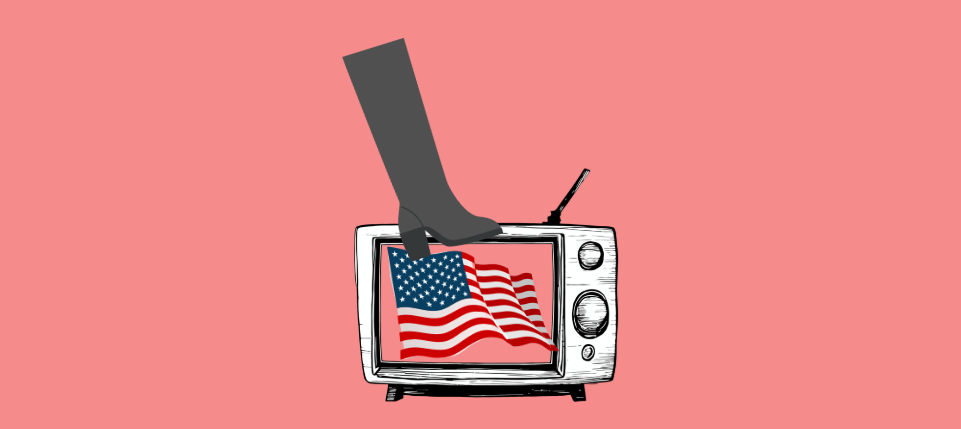
Consider the architecture of power: the phallic rise of corporate skyscrapers; the brutalist compounds of government intelligence agencies; the black SUVs with bulletproof windows, moving through public spaces like sharks in a koi pond. These are not just functional designs, they are kinked. Their violence is coded, their silence erotic. Their function is not just to dominate, but to titillate. The military’s massive budget isn’t only about defense; it’s about displaying hard, firm authority on a global scale. It’s about making America look powerful, like a dom dressed in polished boots and mirrored sunglasses.
America’s love affair with incarceration is no accident. With just 4% of the world’s population, the U.S. holds nearly 20% of its prisoners. Mass incarceration, particularly of Black and brown bodies, is not a failed system. It is a successful performance of disciplinary desire. Prison becomes a BDSM dungeon on a national scale: submission, uniformity, isolation. The prison guard and the warden are doms in state-issued cosplay.
Michael Parenti once argued that “the primary function of the state is not to regulate capital but to protect it.” What Parenti left unsaid—but implied—is how. And increasingly, the “how” is not rational policy but affective management. The pleasure of punishment becomes a spectacle: migrant children in cages; protestors tear-gassed on live TV; poor people shamed for needing help.
This sadism is not reserved for the prison system. The American workplace is a soft dungeon: surveilled emails, monitored keystrokes, HR as a panopticon. The ideal worker is one who accepts humiliation with a smile and the elite derive great pleasure from designing this performance.
The fetish of domination often comes paired with its inverse: infantilization. American culture insists its citizens be both obedient workers and helpless dependents. The worker is punished for independence, but rewarded for compliance. The consumer is bombarded with babyish design: pastel colors, emojis, TikToks, happy apps. Adult lives are gamified like kindergarten lessons. This isn’t coincidence, it’s control through regression.
Corporations like Amazon monitor bathroom breaks. Workers at McDonald’s are forbidden from sitting. Teachers buy their own classroom supplies. What are these if not elaborate, ritualized humiliations designed to enforce status? The boss doesn’t just want work; he wants obedience as performance. This is a system designed not just to profit, but to discipline.
No political moment in recent memory embodied the elite kink of fascism more vividly than the Trump presidency. Here is a man who delights in nicknames, punishments, and televised humiliation. His rallies were live-action scenes of dominance: he mocks, threatens, teases, and promises retribution. The crowd adored him not despite this cruelty, but because of it.
Slavoj Žižek noted that Trump allows Americans to fully participate in a political fantasy where language is violence and cruelty is a kind of erotic honesty. The fascist leader is not just feared; he is admired for his willingness to be obscene. Trump turns politics into roleplay, into a national kink scene where he is the top, the media the brat, and the public the voyeur.
Why does American media dwell so long on suffering? Why do disaster zones get full-color photo spreads? Why does CNN pan slowly across the wreckage of war? Because suffering is not only content, it is kinked content for the ruling class.
Reality TV, true crime podcasts, school shooting footage; this is America’s collective snuff film. We watch, we grieve, we move on. But the elite (politicians, billionaires, media execs) consume it differently. They profit from it. They fetishize it. Žižek once quipped that modern capitalism can absorb even its own resistance as spectacle. Suffering has been commodified into pornographic loops of victimhood, watched, liked, monetized, then discarded.
Even activism has been fetishized. Black Lives Matter signs on Starbucks windows. Rainbow flags at weapons manufacturers. Resistance, within this sphere of neoliberal “democracy”, becomes another costume for the corporate elite to wear.
Fascism doesn’t always wear jackboots. Sometimes it wears Allbirds and a Patagonia vest. The elite’s desire to rule through aesthetics is visible everywhere. In Silicon Valley, technocrats worship optimization; the fantasy of a frictionless, sterile world where emotions, labor, and people are all manageable. This is fascism as UX design.
Peter Thiel wants to live forever and believes democracy is incompatible with “freedom.” Elon Musk wants to colonize Mars while fighting child labor allegations. These are not technologists, they are fetishists with empires. Their desire to control biology, labor, and environment is not rational—it is libidinal.
Their fantasies shape the material world: smart cities that surveil, apps that nudge behavior, AI that predicts desire. They are not creating tools; they are building playgrounds for their perversions and will forces us to participate because that is another layer of the kink.
To understand power in America today, one must look not only at the policies and politicians, but at the desires of the elite. What are their kinks? What do they fetishize? What do they dream about in the dark? Because it is from these unconscious drives that the architecture of our world is shaped.
As Herbert Marcuse wrote in Eros and Civilization, liberation is not just economic—it is libidinal. To truly resist power, we must resist the way it hijacks our desires, our pleasures, and our pain.
It is not enough to vote. We must break the fantasy.
We must stop participating in their scene.
Further Reading
Eros and Civilization – Herbert Marcuse
The Culture of Narcissism – Christopher Lasch
Capitalist Realism – Mark Fisher
Our Enemies in Blue – Kristian Williams
The Society of the Spectacle – Guy Debord

 PopCult Reviews