
Hamnet (2025)
Written by Chloé Zhao & Maggie O’Farrell
Directed by Chloé Zhao
In 2025, I did a series on Shakespeare adaptations, which was a lot of fun because I got to introduce my wife to several of his stories. She was, of course, familiar with Romeo and Juliet and knew the names of several plays, just not the stories or characters. I got to introduce her to Hamlet, my favorite play, through Branagh’s adaptation and was happy to see her find pleasure in what a rich piece of art it is. Despite having been an English major and taking multiple Shakespeare classes, I didn’t really know much about the author himself. I don’t think that’s too dissimilar from most English majors’ experiences; he doesn’t get as much focus as his work does. And while this film is more fiction than fact, it attempts to bring a human face to someone who has become such a distant, iconic figure.
Hamnet is a historical drama directed by Chloé Zhao, adapted from Maggie O’Farrell’s novel, that reimagines the life of William Shakespeare and his wife Agnes as they build a family in 16th-century England and confront the devastating loss of their 11-year-old son, Hamnet, to the plague. The film intimately follows their courtship, marriage, the birth and fragile survival of their children, and the profound grief that fractures and reshapes their bond. The film suggests that this personal tragedy became a source of inspiration for Shakespeare’s immortal play Hamlet. Anchored by powerful performances from Jessie Buckley and Paul Mescal, Hamnet is less a conventional biopic and more a poignant exploration of love, loss, and the art that emerges from deep sorrow.
Chloé Zhao has been a filmmaker whose style has always caught my attention. Her breakout hit, The Rider, was the first time I took notice, and I found her follow-up, Nomadland, to be a visually rich picture. A throughline in her work is a sense of observational naturalism, akin to a documentary, with lots of handheld camerawork. She typically evokes interior performances from her actors, requiring the audience to read their faces to fully understand the story. This allows scenes to unfold with minimal exposition, delivered with contemplative, humane qualities. Her stories have centered on how people endure, adapt, and find fleeting grace in an indifferent world, and it’s no different for this picture despite its mythic aspects.
While Paul Mescal’s Shakespeare may be the well from which this story springs, the focus of the movie is clearly his wife, Agnes, played beautifully by Jessie Buckley. Buckley is an actor whom I’ve long waited to see reach the highest stages so everyone can recognize the incredible performances she can give. I’ve been following her work since 2017’s Beast, where she feels fully realized even though it was so early in her career. As Agnes, she conveys grief as something bodily and elemental. Because Zhao is minimal with dialogue, this is communicated through Agnes’s posture, her breath, and the way she occupies space. She has roots in the natural world through her deceased mother and feels like a nature goddess—something Shakespeare likely sees in her. Agnes is a woman of intuition and agency rather than a passive vessel for tragedy. The central tragedy at the heart of this movie is not something that befalls her; it happens while she is aggressively trying to prevent another one.
Mescal plays the Bard with a deep emotional opacity that feels deliberately withheld. He’s a writer, so his emotions express themselves best on the page. It’s Agnes’s primal, natural aura that draws Shakespeare to her. His masculinity is shaped by silence, not sternness, but a contemplative nature. She serves as a muse—an image of love he doesn’t experience in his home under the controlling thumb of his father. Mescal’s performance is built on pauses, avoidance, and the subtle tension between presence and absence. Around the halfway mark, he leaves for London to embark on his career while Agnes stays behind with their children. Shakespeare becomes an absent figure, and Agnes supports him because she believes in his gift.
There are three primary locations in the film, each reflecting stages of life. The forest, where Shakespeare first glimpses Agnes, is also the place where they conceive their first child and where that same child is born. It is also the place from which Agnes’s mother emerged and where she married Agnes’s father. When Agnes chooses to support her husband’s art, she transitions to the home, and we jump years later to three children in a crowded but happy house. This is where Agnes comes into her own as a mother, fighting to prevent a vision of her youngest daughter dying young. We also get to know Shakespeare’s mother (Emily Watson), who becomes a source of support for Agnes. Agnes’s journey comes to an end at the stage, where she watches her husband’s play, Hamlet, which the film frames as inspired in part by their son’s passing.
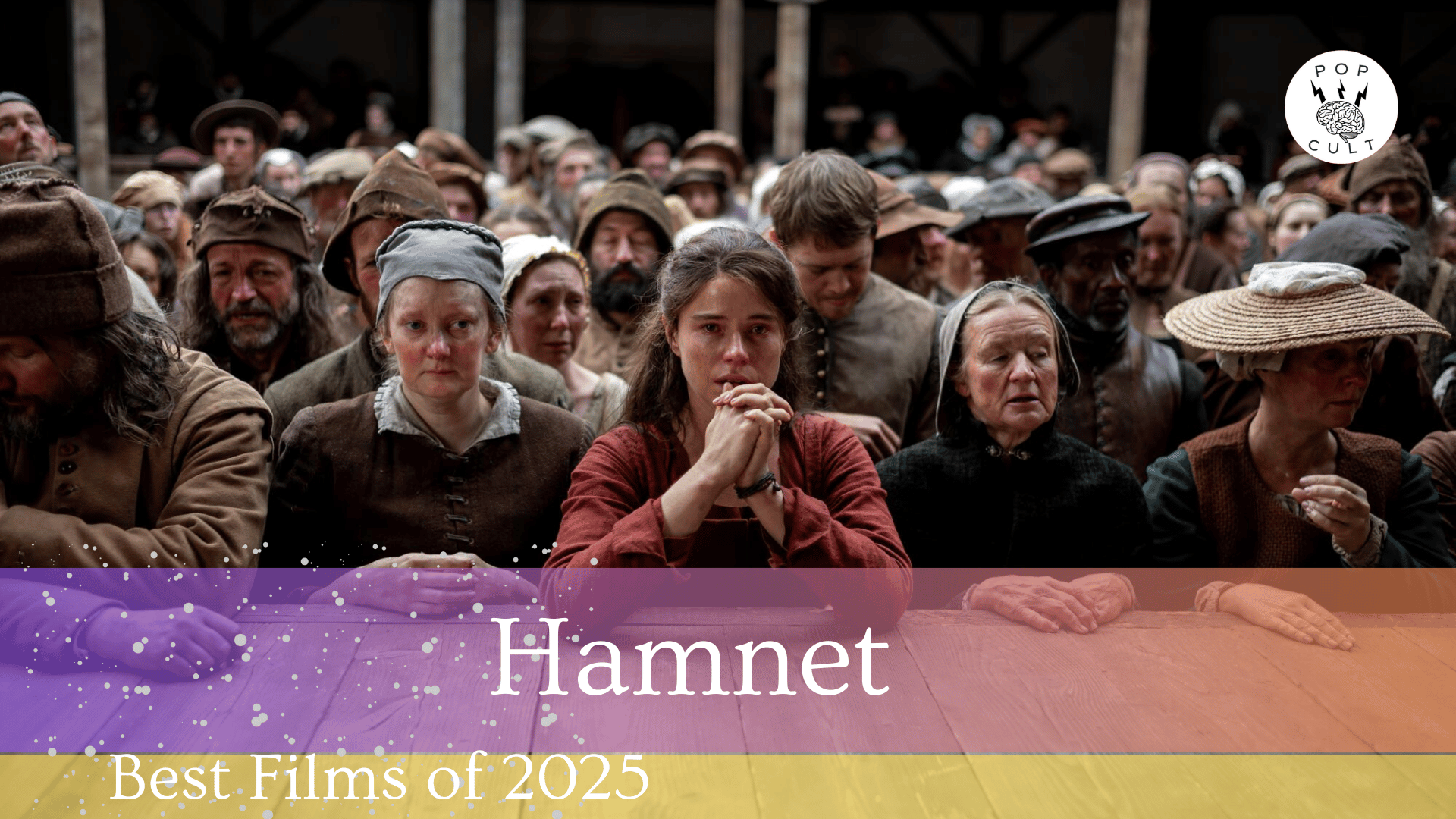
In the final scene of Hamnet, Chloé Zhao pares everything down to breath, gesture, and the quiet of time passing. Agnes has come to see what her husband has been devoting his time to while his children suffer back home. The camera finds meaning in small, almost incidental movements: hands hovering, eyes failing to meet. Agnes believes it is her son standing in front of her, not the actor in her husband’s company; her performance trembles with restraint. Opposite her, Paul Mescal offers a study in grief turned inward, his stories acting as emotional expression. Zhao’s direction resists narrative closure, instead circling the idea that life simply changes form, becoming something stranger and harder to name. The scene doesn’t ask us to move on; it asks us to sit with what remains.

 PopCult Reviews
One thought on “Movie Review – Hamnet”