
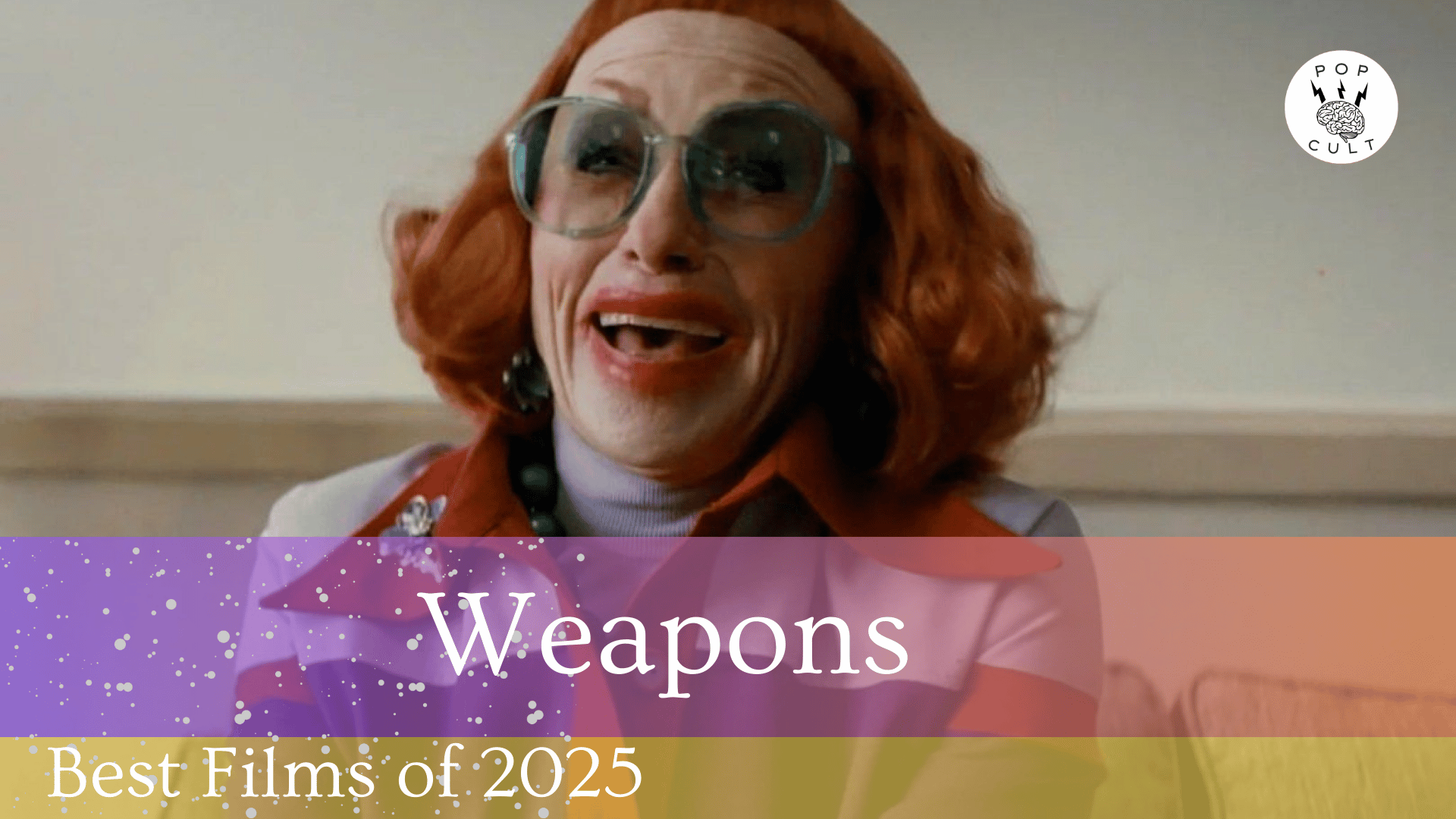
Weapons (2025)
Written and directed by Zach Cregger
The voiceover of a little girl telling us the story of something she may not have experienced herself, a communal trauma, opens the film. This blooms into a nighttime montage of children running with their arms slightly extended at their sides, set to George Harrison’s “Beware of Darkness.” The song appeared on Harrison’s first post-Beatles album, All Things Must Pass. The tracks were mainly derived from songs the rest of the band had passed on, which in turn became side projects Harrison would play around with until the band inevitably fell apart. “Beware of Darkness” tells us at the outset to stay clear of people who appear fashionable for the moment and to be wary of destructive thoughts that seek to entangle our minds. The final verses of the song become far more specific when they say, “Take care, beware of greedy leaders / They take you where you should not go / While Weeping Atlas Cedars / They just want to grow – grow, grow…” There doesn’t seem to be an explanation anywhere as to what Harrison meant by this, but he does seem to be referencing something specific. He’s dead now, so we’re left to wonder what he was saying there, knowing there will likely never be an answer.
Weapons is a mystery-horror film written and directed by Zach Cregger that unfolds in a small American town rocked by an inexplicable event: at exactly 2:17 a.m. one night, seventeen children from the same elementary school class vanish without a trace, leaving behind only one student. As grief and fear ripple through the community, the children’s teacher, Justine Gandy (Julia Garner), becomes a target of blame, while a distraught parent (Josh Brolin) and a cast of other locals—including a flawed cop, a principal, and a homeless man—pursue their own investigations through overlapping, nonlinear perspectives. The mystery deepens with unsettling clues, ultimately revealing sinister forces at play and forcing the town to confront both what happened to the missing kids and the fractures in their own lives.
Since filmmaker Zach Cregger’s debut film, Barbarian (2022), I knew I was onboard with whatever he had next. He has established himself as a maker of unpredictable films with complex themes and characters that nevertheless embrace genre tropes, albeit in new and interesting ways. Here, he takes the nonlinear storytelling he used in his first film and pushes it to another level of complexity. There are more characters, which means an even more fractured kaleidoscope of events. That’s not just a gimmick; it is central to the film’s thesis: we live in a world where horrible things happen, and we are often given no answers as to why. There’s no reason it was this town and these children who became part of this horror story; it’s just what happened. That idea can be applied to a dozen other moments in the film when you view them from individual characters’ perspectives.
There is an evil at the center of this film that is predicated on uncertainty. I was a bit annoyed to see articles pondering the idea of a spin-off origin film; that would undermine Weapons. This is a story where we get a “happy” ending in the sense that the mystery of the missing kids is answered and they all come home, but it is not one where all the loose ends are tied up. From Gandy’s point of view, she has seen the only friends she had in this community become incoherent monsters who tried to murder her. She will never understand why they did it or who was ultimately responsible. She’s alive and perfectly capable of carrying on with her life; but what kind of life will that be after witnessing these things?
Cregger has spoken about Weapons emerging from his grief over longtime writing partner Trevor Moore. It was an accident that occurred while Moore was intoxicated and awakened trauma Cregger carried from growing up as the child of addicts. These emotions are woven throughout the film, and when you follow the characters’ arcs, you find that nearly every poor decision stems from a self-destructive dependency of some kind. The only character I would place outside this pattern is Alex, a child who simply depends on adults to exist. It makes sense, then, that as the credits roll, it’s the children who carry the most devastating impact of everything that happened.
There has been some effort to connect Cregger’s film to contemporary issues of gun violence in schools. I think that’s present to a degree, but it’s only one manifestation of a broader uncertainty in modern life. There is a surreality in both this film and Barbarian, akin to the liminal feeling found in Backrooms memes and lore. It’s reality, but it feels as though something is hidden just between the layers. The tone being recreated here is that sinking anxiety you feel when you realize something is deeply wrong with the world while nearly everyone around you continues on, either ignorant of it or—worse—aware of it and choosing to ignore it.
Cregger has cited Paul Thomas Anderson’s Magnolia as a major inspiration, and you can feel it here, just beneath the surface of the horror genre. What grounds the horror are the performances. Julia Garner is excellent as Ms. Gandy, the schoolteacher driven back to drink as she becomes the town pariah. She shares top billing with Josh Brolin as a grieving father. You might expect them to be at odds; and they are for much of the film, but they are also the primary investigators, and sooner or later they begin sharing notes. Supporting performances by Alden Ehrenreich and Austin Abrams, as a cop and a criminal whose paths keep crossing, further enrich the film. And it is Amy Madigan’s role as Aunt Gladys that ultimately brings everything together and completes Cregger’s vision of horror.
In that sense, Weapons ultimately functions less like a puzzle to be solved than a wound you’re asked to sit with. Like Harrison’s lyric that opens the film, it gestures toward meaning without ever pinning it down, warning us that some forces are felt more than they are understood. Cregger isn’t interested in explaining the darkness so much as tracing the way it spreads through grief, dependency, fear, and the quiet decisions people make when they think no one is watching. The children return, the town survives, and yet nothing is restored. Something has grown here and everyone who remains will carry the knowledge of it, whether they acknowledge it or not. That lingering unease, the sense that an answer, even when given, doesn’t save you, is what makes Weapons unsettling long after the credits roll.

 PopCult Reviews
One thought on “Movie Review – Weapons”