
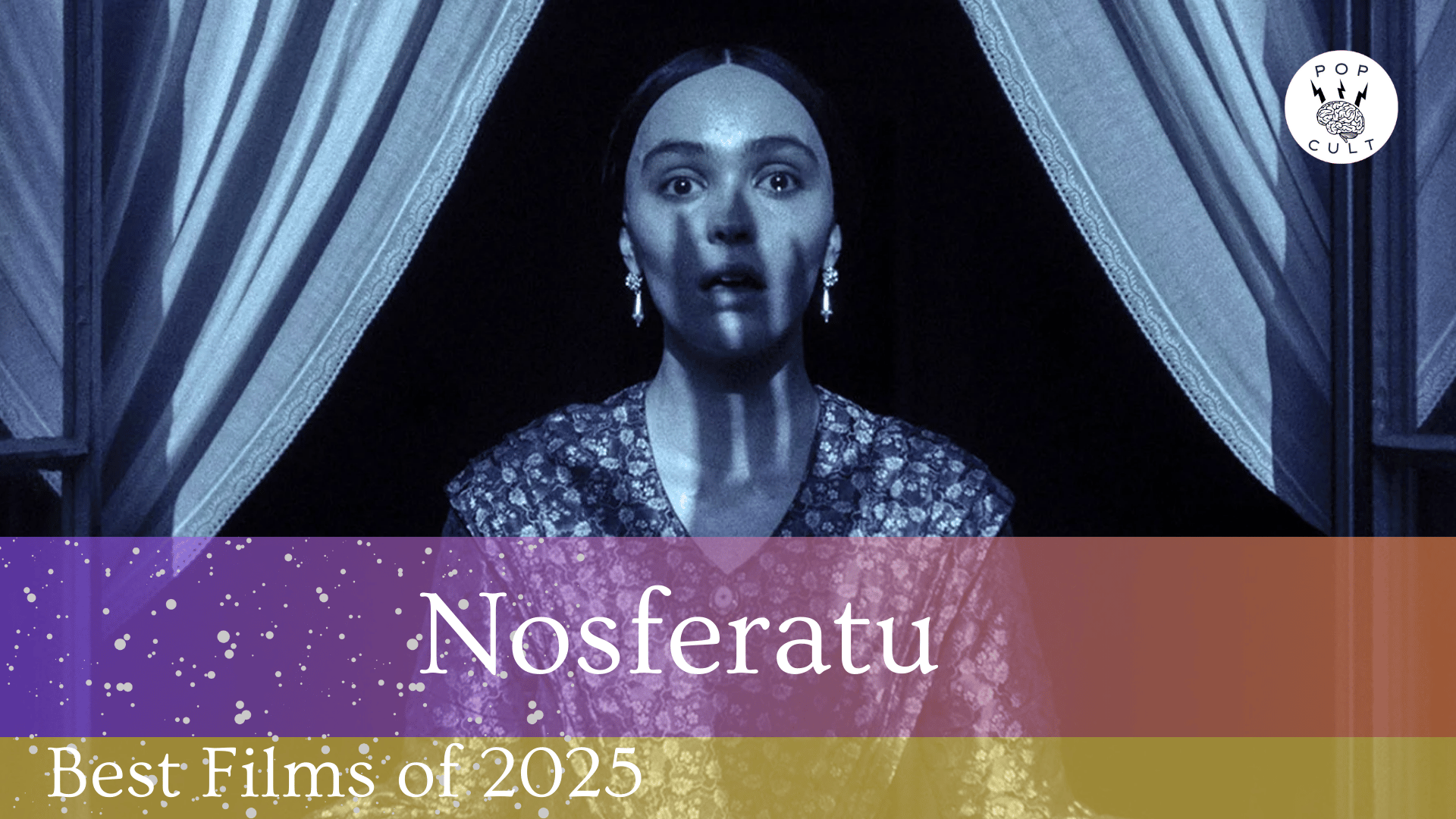
Nosferatu (2024)
Written and directed by Robert Eggers
I don’t really care for vampires. I’ve never felt drawn to this particular monster compared to others. I understand all the tropes and metaphors that orbit the vampire, and they’ve simply never appealed to me. What I do enjoy are the full-throttle productions of Robert Eggers, where he fills the screen with a healthy mix of period accuracy and atmosphere that seems to drip off the edges. I’ve enjoyed his previous features, and it didn’t surprise me that Nosferatu was no exception. The vampire here is wonderfully grotesque and inhuman, but it is not the focal point of the film. In my opinion, that distinction belongs to Lily-Rose Depp’s Ellen, who delivers one of the most surprising and satisfying performances of the year.
In Nosferatu (2025), newlywed real estate agent Thomas Hutter (Nicholas Hoult) travels from his German home to the remote Transylvanian mountains to help the eerie Count Orlok (Bill Skarsgård) secure a property, unwittingly unleashing a supernatural terror. As Orlok follows him back to Wisborg, the ancient vampire becomes obsessively drawn to Thomas’s wife, Ellen (Depp), whose haunting connection to the creature blurs the line between dread and desire, forcing the couple and their allies into a grim fight for survival against a force that embodies both plague-like horror and unrelenting obsession.
Whether you liked this film as much as I did or not, you have to give it to the production design and vision of Eggers. With each film, he creates a vividly rich and detailed world drenched in gloom and horror. It’s not historical accuracy per se, but a heightened version of the period. Costumes, lighting, and spaces are meticulously crafted so that we are completely taken in by the world. This occurs in conjunction with Eggers pulling on cinematic horror strings—crafting perfectly considered shots and using shadow like paint on a canvas. What feels different here than in previous Eggers films is the amount of time spent on beauty, and on the presence of something resembling hope.
Lily-Rose Depp’s performance is the emotional and physical center of Robert Eggers’s Gothic reimagining. She anchors the film’s eerie atmosphere with a visceral intensity that refuses to let viewers look away. Ellen’s thoughts of Count Orlok are a nuanced dance between terror and longing. Subtle emotional fractures give way to explosive physicality, making her inner turmoil palpable in every convulsion and gurgling whisper. Her commitment to demanding physical scenes—many of which were performed practically, without CGI—heightens the sense of possession. Depp’s work here pushes her into territory that is both emotionally and physically grueling, elevating what could have been a conventional horror heroine into something hauntingly memorable.
Bill Skarsgård’s Count Orlok offers a chilling, almost elemental counterpoint to Depp’s emotionally tormented Ellen. Skarsgård embraces the prosthetics and eerie vocal choices to render Orlok not simply as a monster, but as an uncanny force, giving the vampire an unsettling corporeality that lingers long after he leaves the screen. This is an elemental being, not a material one. What makes his interplay with Depp especially compelling is how their performances mirror and amplify one another: Depp’s visceral embodiment of fear and desire gives Orlok a focal point for his predatory fixation. Their scenes together become a complex dance of repulsion and attraction. Skarsgård’s restraint complements Depp’s expressive volatility; each confrontation feels like a negotiation between desire and destruction, heightening the film’s psychosexual dread and emotional stakes.
Beyond Depp and Skarsgård’s haunting central turns, the film benefits greatly from a strong ensemble whose varied styles help shape the world around them. Nicholas Hoult brings a grounded earnestness to Thomas Hutter, embodying a man whose gradual unraveling mirrors the film’s creeping tension. As he goes madder, so does the film. Willem Dafoe, as the occult expert Professor Albin Eberhart von Franz, offers gravitas and eccentric intensity that punctuate the gothic atmosphere. His performance is a balancing act between grounded seriousness and a touch of camp melodrama.
Meanwhile, Emma Corrin and Aaron Taylor-Johnson, as Anna and Friedrich Harding, provide a crucial emotional counterbalance to the horror, their friendship with Ellen sharpening the sense of loss and impending doom. Ralph Ineson and Simon McBurney add texture as figures caught in the film’s irrational darkness, reinforcing the oppressive world that Eggers conjures. Together, these supporting performances deepen the dread and give additional life to the film’s world.
At its core, Nosferatu is a film about repression and the quiet violence that emerges when desire is denied or misdirected. These themes are embodied in the triangular relationship between Ellen, Count Orlok, and Thomas. Ellen exists at the center of the film’s psychic storm, caught between a socially sanctioned marriage and a supernatural bond that externalizes her repressed fears and desires. Orlok functions less as a romantic rival than as an invasive force, drawing out what polite society insists must remain buried. Thomas, by contrast, represents rationality and masculine duty; however, his inability to perceive the depth of Ellen’s interior life exposes the limits of his reason. Together, the three form a closed circuit of longing and denial: Ellen’s sensitivity becomes vulnerability, Orlok’s desire becomes domination, and Thomas’s love becomes helplessness. Eggers uses this dynamic to suggest that horror is not an external force, but something invited in through the cracks of repression.
Eggers delicately balances the bleakness of this story with the tragic beauty of Ellen wresting control back for herself. By the end of the film, the gates of Hell feel as if they have opened. Even the intrepid monster hunter Professor Eberhart seems to have succumbed to madness, swinging a lantern wildly in a rat-infested crypt. What we are reminded of is that the monster film still has places to explore, and can be continually reframed through the eyes of new filmmakers. Having watched the other Nosferatu films in preparation for our podcast episode, I was struck by how the base story functions like clay, molded by each filmmaker. Eggers has, in my mind, solidified his place as one of the great horror storytellers of the 21st century.

 PopCult Reviews
One thought on “Movie Review – Nosferatu”