
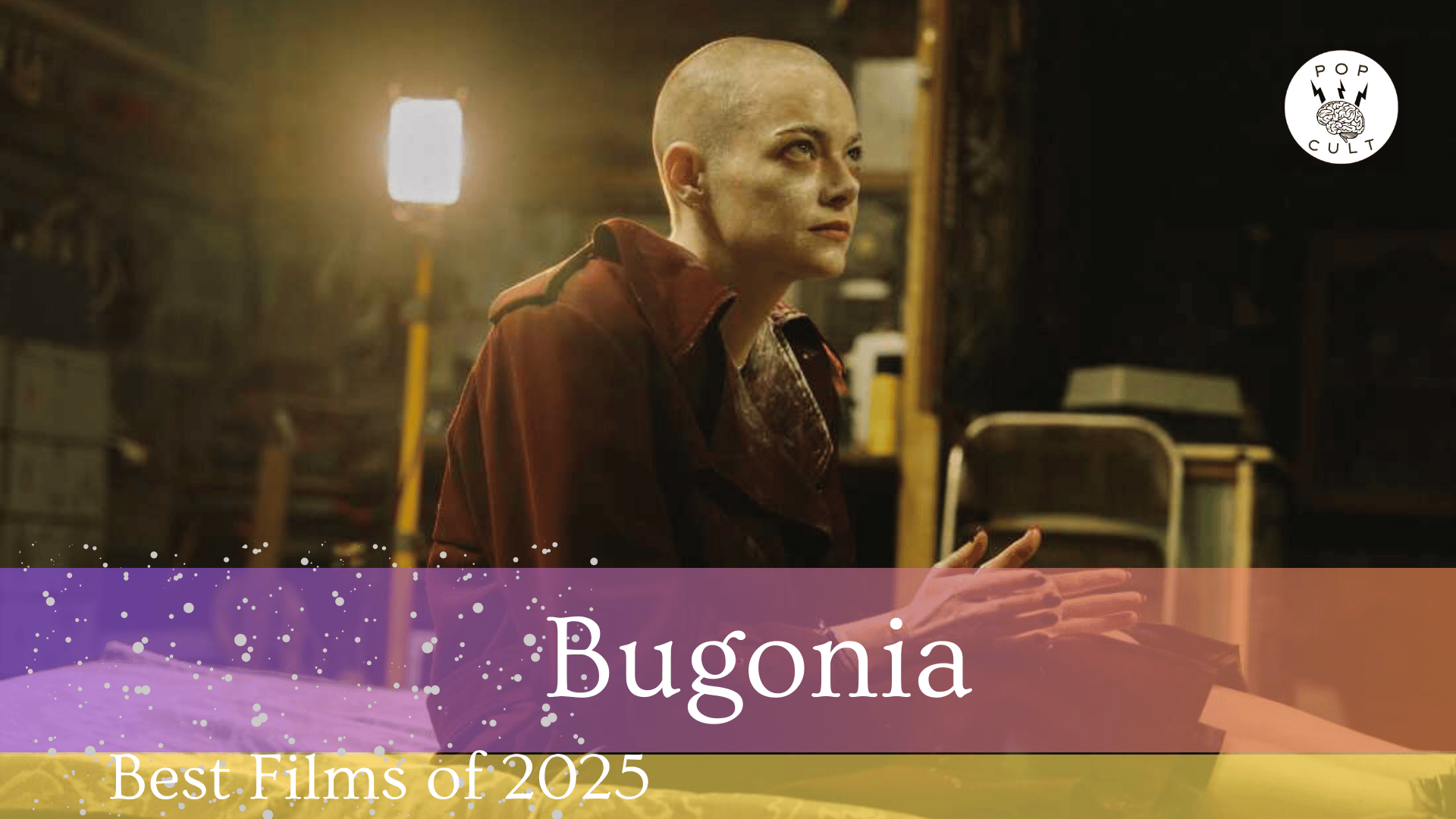
Bugonia (2025)
Written by Will Tracy
Directed by Yorgos Lanthimos
In the West, we are no longer living in a shared reality with our neighbors. I think COVID accelerated this, with the internet acting as a pipeline of ideological sludge that has led to a backslide reminiscent of the Dark Ages, but with smartphones. I have a family member who has fully embraced a reactionary mindset, going so far as to become a flat Earther. When someone has deteriorated that far into mental illness, it is beyond the ability of their family members to help them; only someone professionally trained will have the patience, while I am too emotionally entangled. This person has always held fringe beliefs, but it was through the internet that they linked up with similarly delusional people; a feedback loop of insanity. Bugonia is a film about people who cannot accept that the source of so much suffering in our world is human cruelty and instead fall back on increasingly incoherent explanations.
Two deeply paranoid young men—Teddy (Jesse Plemons) and his cousin Don (Aidan Delbis)—become convinced that Michelle Fuller (Emma Stone), a powerful corporate executive, is not only corrupt but literally an alien preparing Earth for invasion. This belief prompts them to kidnap her and subject her to an increasingly unhinged “interrogation” designed to expose the truth. As the film unfolds, their conspiracy-laced worldview collides with the banality and cruelty of modern power. What begins as a frantic sci-fi thriller curdles into a darkly comic psychological descent, questioning whether the real threat comes from inhuman outsiders or from the very human systems the characters are trapped inside. As Teddy’s very personal reasons for these actions come to the surface, it becomes clear he is a danger to himself and everyone around him.
Teddy convinces himself that aliens are behind his mother’s deteriorating health because that presents something he can imagine himself defeating, rather than confronting the banality of evil infused into the society around him. This disassociates him from his pain, turning it into a righteous crusade that expands to the entire cosmos. He becomes “more important”; the only one who knows the truth, the hero who will save the world from the aliens. All of this is predicated on not feeling his pain. He turns himself into an operator, justifying his violent actions as necessary for the “cause.” Everything he does is drenched in ego and a need to feel superior, rather than to process his life and the harm done to him. He becomes a destroyer, not a savior, when in reality the best thing a person can be, given the limited power we have in the shadow of these systems, is a carer, a listener, a healer.
Michelle is also a delusional person, but from a different angle. She has nothing but her work and convinces herself this is good because she’s “improving the species.” This gives her the illusion of purpose, just as Teddy’s conspiracy theories do for him. Without this delusion, she would be forced to face the fact that her work helps no one but shareholders; people who already have more wealth than they could ever use in a lifetime. She actively ignores the victims of her company by positioning herself as acting for the greater good. By the end of the film, she is unable to deny this truth any longer, but instead of growing, she retreats into emotional detachment. Her actions become petty and cruel; she has lost touch with her humanity and is, in a way, an alien.
The musical score of this film is an extraordinary piece of work and is essential to understanding the themes Lanthimos is exploring. The music is ominous and fitting for a science-fiction epic, but it is layered over ordinary domestic scenes (two people sitting in a house, Teddy riding his bike). The dissonance is intentional and reflects Teddy’s interior world. He believes he has the fate of the world on his shoulders, but we can clearly see that this is not true. The score is part of his delusion and is meant to work ironically.
The film’s conclusion has drawn a great deal of controversy, and I think most people are either overcomplicating it or unable to analyze it in any meaningful way. The point of the ending is this: what does it matter to be “right” when it changes nothing and the universe continues with or without you? Teddy needed his and his mother’s pain to matter, which is why he needed the aliens to be real. Okay—so they are real. What did that get Teddy in the end? Instead of trying to heal or care for his mother, he became fixated on revenge and striking out mindlessly at the world. He could have joined political activist groups working to improve healthcare systems and care for those harmed by them. His ego was too powerful a driver, and his trauma too overwhelming to confront. What Teddy does instead is vomit his pain onto others and kill innocent people in the process. Michelle wasn’t even the first person he did this to—she just happened to be the last. When he didn’t get the answers that confirmed his delusions, he killed them.
We can argue that whoever killed the UnitedHealthcare CEO was justified based on the behavior of that organization and the CEO’s role in refusing to cover essential care. But what did killing that one person accomplish in the long run? UnitedHealthcare is still denying claims; they simply increased security for their top executives and removed some photos from their website. Our delusion is thinking we can climb to the top of the pyramid and eliminate the “bad guys,” when realistically that is impossible without caring for one another. What we ignore is the people suffering alongside us and the work of unifying, caring, and rejecting the cruel systems imposed on us. This is the consequence of hyper-individualism: everyone imagines they are the main character, the hero who will save the day. In reality, many people want to climb to the top so they can become the tyrant.
Lanthimos is a director who has never implied—or stated—that he has a hopeful vision of humanity. His films are dark examinations of who we are. The real problem is a culture that lacks the ability to see beyond surface-level readings and rarely, if ever, engages in self-reflection. Poor Things was a film about a blank-slate person who experiences immense harm, yet because they come from privilege, they ultimately settle into a comfortable position of power over others—ensuring that nothing changes. Lanthimos’s work has always been about how things are, not how they should be. Bugonia is not a literal film about whether Michelle is an alien. It is a film about the destructive nature of being so convinced you are “right” that you become blind to how you are destroying the lives of those around you; how you become the very harm you claim you want to eliminate.

 PopCult Reviews
One thought on “Movie Review – Bugonia”