
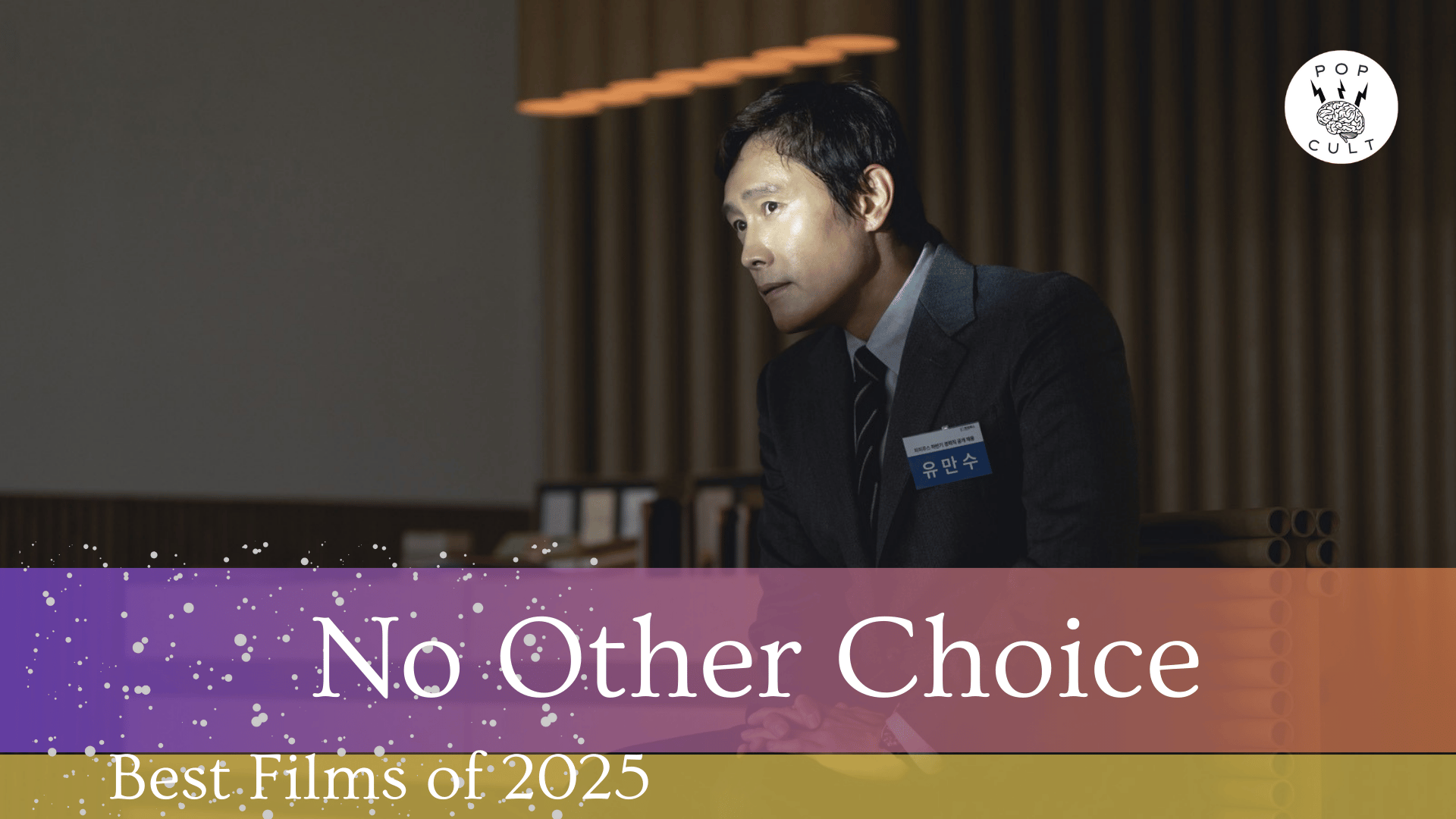
No Other Choice (2025)
Written by Park Chan-wook, Lee Kyoung-mi, Don McKellar, and Lee Ja-hye
Directed by Park Chan-wook
It’s always struck me as strange, bordering on obscene, how completely hands-off society is when it comes to job placement. We build entire educational systems around the promise of employability, saddle people with debt, tell them to “do everything right,” and then, at the moment where guidance would actually matter, shove them into the dark and say good luck. Even with a degree, even with experience, the expectation is that you will wander an increasingly incoherent job market on your own, refreshing dashboards like a lab rat pressing a lever for food pellets that never arrive. The application process is almost entirely online now, regardless of what boomers insist about “walking in and demanding a job.” I’ve played the LinkedIn game; I found nothing of substance. My wife did too and only ended up employed because of someone one of my sisters happened to know.
No Other Choice is a darkly comic satirical thriller about Yoo Man-su (Lee Byung-hun), a seasoned paper industry expert who is abruptly laid off after 25 years of service and thrust into a brutal job market where experience counts for nothing. Facing financial ruin and desperate to provide for his family, Man-su concludes that the only way to secure a new job is to eliminate his competition, setting in motion an increasingly violent and absurd campaign that blurs the line between survival and savagery. The film blends black humor with sharp social commentary on capitalism, job insecurity, and personal identity in the modern economy, following Man-su’s descent into moral chaos as he fights to reclaim his place in a world that seems to have left him behind.
That premise could easily tip into cartoonishness. Lesser films would play it as a gimmick or make it all about shock value. Park Chan-wook finds dark humor within it, but doesn’t shave off the edges. The film understands something crucial: capitalism doesn’t need to explicitly tell you to destroy other people. It just needs to arrange the conditions where doing so feels reasonable.
One of the film’s most unsettling choices is its apprehensive protagonist. Man-su is not a gleeful sociopath. He’s hesitant and anxious. This reluctance forces the film to spend significant time with his potential victims; other middle-class men caught in the same downward spiral. We get to know them not as obstacles but as people, particularly, their own quiet humiliations. In doing so, No Other Choice exposes the false bravado of the middle class under capitalism. These men imagine themselves as tough, self-made, resilient. In reality, they’re entirely unprepared for how quickly the floor can vanish beneath them.
Man-su is a “tough guy” only in abstraction.To proceed, he has to viscerally destroy a part of himself. This isn’t framed as a transformation into something powerful but as an act of humiliation. Each step forward costs him something irretrievable. The social disgraces Man-su experiences that drive him to this point are pointed out for comic effect. He must put the family home up on the market, the children have to pause their music lessons, the dogs go stay with relatives, and Netflix must be cancelled. Some of these are genuinely painful, especially losing the pets, but others are amenities that aren’t going to kill him. He sees certain work beneath him which means he sees the people who do it as on a lower rung of society, not a misreading of capitalism, but a sad interpretation so many have.
Characters are constantly forced into decisions that harm others and may not even benefit themselves. The title isn’t ironic. There really is no other choice, at least not one the system allows. Corporations perform care while extracting value, offering wellness emails and severance packages that offer no meaningful support. The illusion of concern masks the fact that these institutions are structurally indifferent to human suffering. They don’t hate you. They simply don’t register you as anything other than a line item. You exist to enrich them and once you don’t then you don’t exist.
And yet, the film refuses the easy moral out. We understand why Man-su does what he does. His actions are monstrous, yes, but they are also an exaggerated version of an experience most people recognize intimately: competing with peers for dwindling opportunities, quietly hoping someone else fails so you might survive. The film’s message isn’t that Man-su is good or evil. It’s inevitable. He is what happens when you toil under a system that encourages people to become completely self-serving while pretending it’s about merit or fairness.
Visually, the film is immaculate. Park Chan-wook’s compositions are original without calling attention to themselves. Every frame feels considered, every movement purposeful. He blocks scenes with a master’s understanding of space and movement. Offices feel cavernous and impersonal; homes feel cramped and provisional. The camera rarely offers comfort. Even moments of stillness carry a sense of impending pressure, as if the walls themselves are judging the characters’ usefulness.
The pacing is brisk but never rushed. The film understands when to linger and when to cut, allowing tension to build not through spectacle but through anticipation. The writing is razor-sharp, balancing bleak humor with genuine dread. The comedy doesn’t undercut the horror; it deepens it. Laughter catches in your throat because it’s rooted in recognition. You’re not laughing at absurdity so much as at the terrifying plausibility of it all.
One particularly memorable sequence begins with Man-su about to kill one of his rivals in the target’s man cave. A gun, sealed in plastic, rests in his hand, swallowed by a pair of oven mitts. Their removal provides one of the comic points of the scenes. The man has fallen asleep in his recliner. Man-su cranks up the music to serve as a buffer, smothering the sound of the shot. The man wakes. What follows is not a plea for mercy, but a petty, almost marital argument conducted at gunpoint: an accusation that the victim never listens to his wife, that all his problems would evaporate if he simply took her advice. Because this kill has been so delayed, we’ve gotten to see the infidelity and struggles of the marriage up close. The absurdity sharpens as a cheerful, infectious pop song bounces through the room. Behind Man-su, the man’s wife moves in, prepared to knock him out, until she hears him sincerely defending her. There’s slapstick comedy, pathos, and tension all delivered by a filmmaker who is one of the best to have ever made movies.
By the time the film reaches its conclusion, there’s no grand revelation, no triumphant reversal. Just a sense of exhaustion. The system continues. The cycle remains intact. Man-su’s journey doesn’t resolve anything so much as illustrate a pattern. That’s what makes the film linger. It doesn’t pretend that awareness alone is enough to save us. Park doesn’t know the answer, all he can do is put on display what he sees, filtered through his particular aesthetic. No Other Choice is a masterpiece of writing and direction, a film that understands both the mechanics and the psychic toll of modern labor with unsettling clarity. This is not a film that offers solutions. It offers recognition, which sadly, in a culture obsessed with optimism and hustle myths, feels almost radical.

 PopCult Reviews
One thought on “Movie Review – No Other Choice”