Movie Review – A Streetcar Named Desire

A Streetcar Named Desire (1951)
Written by Tennessee Williams, Elia Kazan, and Oscar Saul
Directed by Elia Kazan

Things are terrible in the States and getting worse. Every day there’s another story about someone making an honest mistake and getting shot, typically being killed. People are like snarling dogs, mistrustful of others, and ready to snap at anyone who gets too close. I would argue things have always been pretty bad, and it’s just that more people are awake & aware of the situation now. Despite the American media’s vociferous attempts to lay on the myths & the fairy tales, American society has often been cruel in a downward direction. Tennessee Williams captured this mundane inhumanity in his incredible stage play, adapted here by himself & others. It’s the story of people caught up in pain and unable to connect with each other meaningfully.

Continue reading “Movie Review – A Streetcar Named Desire”
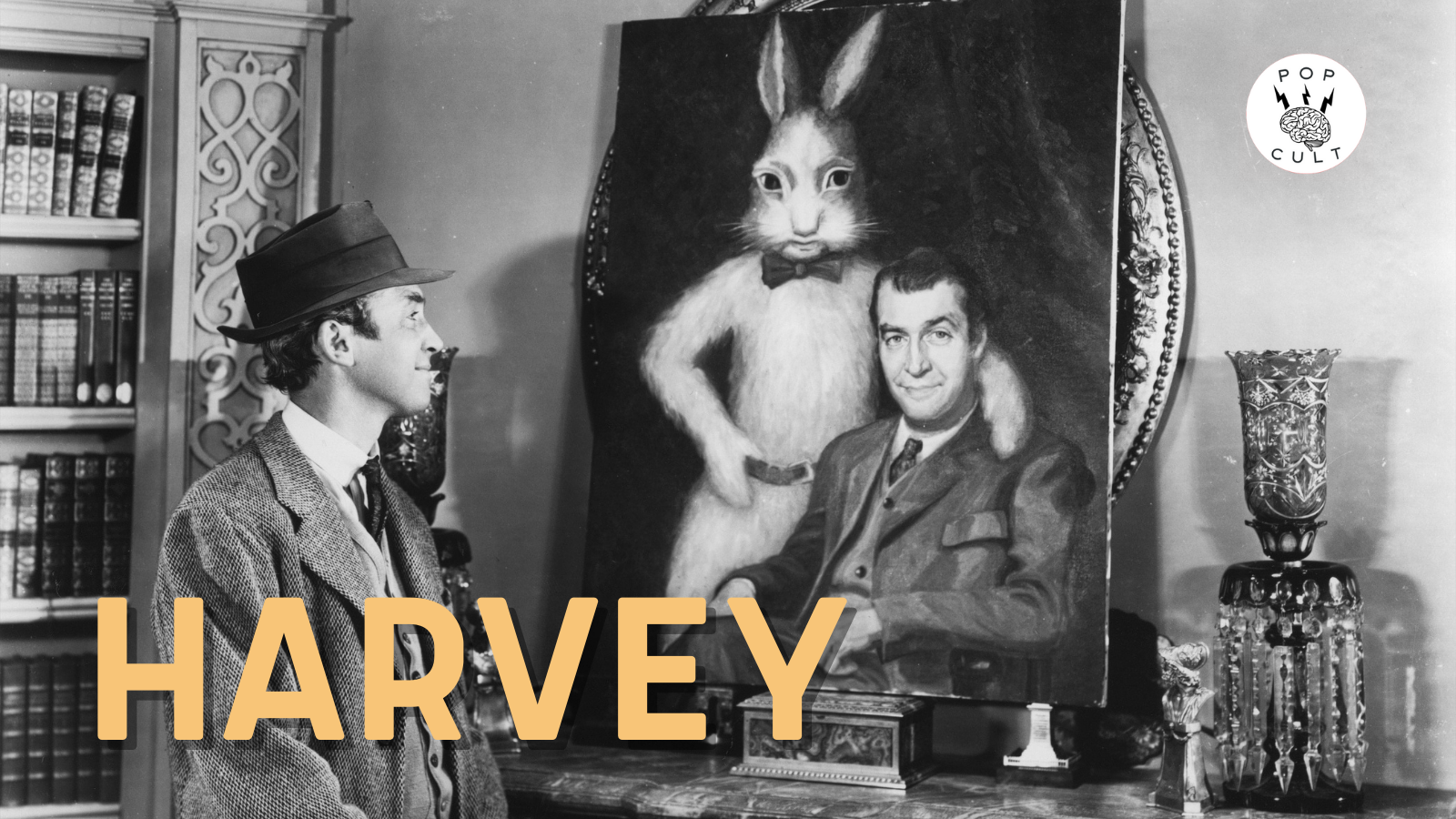
Movie Review – Harvey (1950)

Harvey (1950)
Written by Mary Chase, Oscar Brodney, and Myles Connolly
Directed by Henry Koster

In American media, the dichotomy between smart and kind is often raised. I think it’s important to note what “smart” means in these instances. To be smart in the United States is not to be intelligent. Intellect is an entirely different concept. American smartness is on par with the idea of cunning, being able to outwit others and ensure you are on top of the heap. We can see this in how people with a talent for capitalist exploitation are heralded as brilliant people. They are smart because they find a way to play the game, screw over people not as bright as them, and end up higher on the ladder of power. A smart person in America simply does evil and manages not to get caught. So, when Elwood P. Dowd says, “In this world, you must be oh so smart, or oh so pleasant. Well, for years, I was smart. I recommend pleasant”; it means something more profound.

Continue reading “Movie Review – Harvey (1950)”

Movie Review – Imitation of Life

Imitation of Life (1959)
Written by Eleanore Griffin & Allan Scott
Directed by Douglas Sirk

This was the final film from Douglas Sirk. He didn’t die following its release. He just left the United States and lived in Switzerland for the next twenty-eight years when he passed. He taught briefly in the 1970s at Munich’s University of Film and Television. But this was it. When asked about this stint in America making movies, Sirk said in a 1975 interview: “When I went to the United States, I was making films about American society, and it is true that I never felt at home there, except perhaps when my wife and I lived on a farm in the San Fernando Valley. But I always wanted my characters to be more than ciphers for the failings of their world. And I never had to look too hard to find a part of myself in them.” Sirk and his wife, Hilde, would quickly become tired of the Hollywood scene and return to Europe, but never Germany for too long. The memories were too harsh.

Continue reading “Movie Review – Imitation of Life”

Movie Review – Written on the Wind

Written on the Wind (1956)
Written by George Zuckerman
Directed by Douglas Sirk

Is melodrama something that naturally occurs in real life? Our inclination is to say, “No, people behave melodramatically. Life isn’t that way on its own.” But sensationally strange things happen in the real world all the time. What we often attach to melodrama are the characters’ reactions to the dazzling explosions of emotion. People, especially Americans, flock to melodrama. Look at the popularity of sensationalist politics and reality television that has only built over the last two decades. It could be argued that America is the most melodramatic country on the planet. Check out the frequency of road rage, mass shootings, political violence, racism, and the list goes on & on. My personal view is that Americans are drawn to this exaggeration of life because it makes the mundane misery of their actual existence feel somewhat more important. Rather than engage in the collective struggle to improve life for themselves and their fellow human beings, Americans fall listlessly into an opium-like fantasia where they are central characters in a big story.

Continue reading “Movie Review – Written on the Wind”

Movie Review – All That Heaven Allows

All That Heaven Allows (1955)
Written by Peg Fenwick
Directed by Douglas Sirk

There is a way to use the tools laid out for you by fascism to strangle it. As mentioned in my Magnificent Obsession review, Douglas Sirk left Nazi Germany when it became intolerable. It was harder to protect his Jewish wife, and his ex had used the law to make it illegal for Sirk to see his son. Eventually, Sirk would find his way to “women’s pictures.” While not as strong a genre as it once was, these types of domestic slice-of-life stories still exist, mostly on television more than in movie theaters. There’s a wide variance in quality these days, with some being prestige cable dramas while others being formulaic churned-out Hallmark Movie trash. Sirk himself commented on this perceived schism in art: “This is the dialectic—there is a very short distance between high art and trash, and trash that contains an element of craziness is by this very quality nearer to art.”

Continue reading “Movie Review – All That Heaven Allows”

Movie Review – Magnificent Obsession

Magnificent Obsession (1954)
Written by Robert Blees, Wells Root, Sarah Y. Mason, Victor Heerman, and Finley Peter Dunne
Directed by Douglas Sirk

Douglas Sirk discovered a love for the performing arts at a young age. While being born to Danish parents, the future director’s homeland would be Germany. In his teenage years, Sirk discovered Shakespeare and went to the cinema more often. He would speak about this period as introducing him to the intensity of emotion and the drama that comes with that. After that, Sirk studied the law and wrote for his father’s newspaper but kept wandering back to the arts. By the early 1920s, he would be directing stageplays, set on the path the rest of his professional life would follow. But, if you know anything of history, then you know Germany in the 1920s was a prelude to something terrible, and Sirk experienced it in a cruel & painful way.

Continue reading “Movie Review – Magnificent Obsession”

Looking at Art – Mural de La Plena

Welcome to Looking at Art. Here’s what we do: I just spend some time looking at the piece, writing down thoughts & questions I have. Thinking about how it makes me feel and trying to make connections. Then I will do some research and report back to you with any details that are relevant to the piece. Finally, I put all that together and contemplate how the piece’s meaning has changed for me & what my big takeaways are. Today’s selection is:

Mural de La Plena (1952-1954)
Rafael Tufiño
Painting, Mural, Oil on Masonite (20 panels)
4.6 m x 9 m

I chose this piece because it comes from Puerto Rico, and Ariana is from Puerto Rico. Beyond that and the essential information above, I have yet to learn about the history of this mural. I do know bits & pieces of Puerto Rican history. It is a colony (labeled ‘commonwealth’) of the United States. Puerto Rico was handed over to the United States in 1898 after being a Spanish colony since Columbus landed there. It was initially inhabited by the Taino indigenous people, who are now primarily interracial, having been forced into & more recently chosen to be in relationships with non-Taino people. Puerto Rico, like Washington D.C., is a place where the citizens do not have representation in the U.S. federal government and therefore are denied the rights enjoyed by the mainland states, Alaska, and Hawaii. They may vote in presidential primaries but are legally forbidden to vote in the general election unless they have residency in the States.

Continue reading “Looking at Art – Mural de La Plena”

Patron Pick – Sweet Smell of Success

This special reward is available to Patreon patrons who pledge at the $10 or $20 monthly levels. Each month those patrons will pick a film for me to review. If they choose, they also get to include some of their thoughts about the movie. This Pick comes from Matt Harris.

Sweet Smell of Success (1957)
Written by Clifford Odets, Ernest Lehman, and Alexander Mackendrick
Directed by Alexander Mackendrick

Possessing a title that drips with as much irony as grease seems to exude from its central character, Sweet Smell of Success is a bold reminder that America in the 1950s was not some picket fence, sunny side wonderland. It was the same festering sore before, and it remains a place where no one gets ahead because they have talent or have cultivated a skill. Nope, the only skill that counts is how well you can lie, cheat, and steal your way to the top. Success is defined as power, and you get that power with money. How do you get the money? Well, with power. See what a con job it is? Some gatekeepers sit on makeshift thrones, not in throne rooms but in nightclubs where they humor desperate politicians and desperate talent who want a kind word thrown their way in tomorrow’s paper. But what will they do for that bit of ego-boosting fluffery, hm? There seems to be no bottom.

Continue reading “Patron Pick – Sweet Smell of Success”

Movie Review – Nights of Cabiria

Nights of Cabiria (1957)
Written by Federico Fellini, Ennio Flaiano, Tullio Pinelli, and Pier Paolo Pasolini
Directed by Federico Fellini

Failure is not the end. This is a lesson that it’s tough for people to learn and understand. We’re conditioned to see failures & mistakes as signifiers of personal faults in people. The homeless are viewed with such rancor by the general American populace. Their financial ruin is seen as a quasi-divine punishment, while successful people are blessed by a benevolent god. Fellini’s early failure was the soil from which one of his best movies grew. The White Sheik, his first solo-directing venture, was not a tremendous success, received middling reviews, a few signs of the genius to come. Fellini extracted a supporting character from that film, Cabiria, a prostitute played by his wife, Giulietta Masina. 

Continue reading “Movie Review – Nights of Cabiria”

Movie Review – La Strada

La Strada (1954)
Written by Federico Fellini, Tullio Pinelli, and Ennio Flaiano
Directed by Federico Fellini

Some of the best filmmakers, living & dead, talk about coming to their projects based on a feeling or intuition. Fellini found La Strada through a tone he felt, described by the director as “a diffused sense of guilt, like a shadow hanging over me. This feeling suggested two people who stay together, although it will be fatal, and they don’t know why.” Images came to Fellini while he meditated on this feeling: snow falling on a quiet ocean, clouds, a nightingale singing. As with many of his greatest films, Fellini was profoundly inspired by his wife Giulietta Masina; pictures of her as a child helped him see La Strada’s central character. And his hometown of Remini, a place that became mythologized in his movies, provided the director with inspiration. He recalled the story of a pig castrator that was a known womanizer. The man impregnated a mentally handicapped woman in the town and cast her aside, claiming the baby was “the devil’s child.”

Continue reading “Movie Review – La Strada”