PopCult Podcast – The Life and Death of Colonel Blimp/A Matter of Life and Death

It’s a World War II Powell & Pressburger double feature today. In one film we follow the storied life of a career soldier in the British Army as he watches the world change around him. In the other a British soldier gets a second chance a life that might be snatched away from him.

Continue reading “PopCult Podcast – The Life and Death of Colonel Blimp/A Matter of Life and Death”

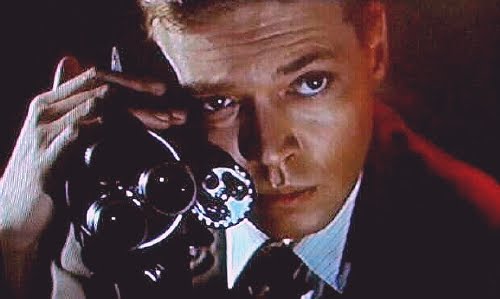
Jolly Good Thursdays – Peeping Tom


Peeping Tom (1960, dir. Michael Powell)

Starring Karlheinz Bohm, Moira Shearer, Anne Massey

Released the same year as Hitchock’s Psycho, critically panned in Britain, pulled from theaters after an incredibly short run, and reviled by its director, Michael Powell. Peeping Tom sounds like it should have been forgotten. However, the film was years ahead of its time and is a masterful piece of commentary on voyeurism and the film audience. Infamous for containing the first nudity in British cinema (a nude model’s bare breasts are glimpsed for a couple seconds), but is about much more than seedy exploitation.

Mark Lewis is film studio cameraman by day, with side job taking nudie pictures for a corner newsagent. What no one knows is ,that from time to time, Mark takes to the streets with his camera and films the faces of women he murders. This is the result of a psychologist father who experimented on the compulsion people have to gaze, or be a peeping tom, on his own son. He fetishistically films young Mark, waking him up in the middle of the night by tossing a lizard in his bed or making him listen to the sounds of women being murdered. Now, with Mark alone in the world he has been lost in the damaged inflicted on him. He befriends a young boarder in his large mansion and fights his urges to make her gaze into the camera.

Peeping Tom  has some very clever camera play, especially during the murders where we see everything through Mark’s camera. And it does a very effective job of getting across the seediness of the world Mark inhabits. At the photo shoot over the newsagent’s shop, one model complains that Mark needs to hide her bruises from the camera, while another is frightened of people seeing her harelip. Powell creates exterior, physical deformities to emphasize the corruption infesting Mark. Are these women truly this scarred? Or it a manifestation of Mark’s psychosis?

One of the most interesting aspects of the film is, that despite Powell’s dislike of the picture, he weaves himself so personally into it. He plays young Mark’s father in old reel to reel footage, cast his own son as young Mark, and his own wife as the body of Mark’s lifeless mother in a funeral scene. In addition, the most elaborate murder is performed on actress Moira Shearer, famous as the prima ballerina in The Red Shoes. Powell and Shearer reportedly could not stand each other, he viewed her as an “airhead”. The film Mark is working on involves a director struggling with a red-headed flighty actress he is having to do retakes of constantly. In addition, Shearer plays the younger actress’ stand-in and is presented as an aging actress on her way out. A rather cruel, yet clever, way of Powell addressing his own problems in cinema.

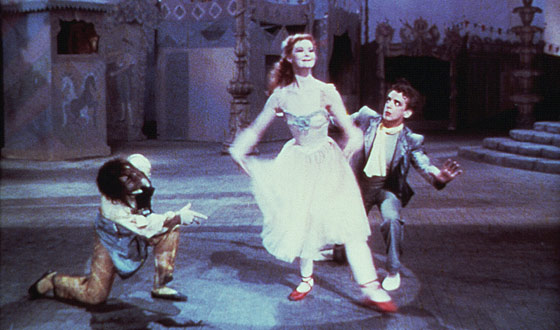
Film 2010 #34 – The Red Shoes

Since 2005 I have kept a list of every new film I have seen. With this film I have hit the 1000 mark. Before long, I’ll probably be hitting 2000.

The Red Shoes (1948, dir. Michael Powell & Emeric Pressburger)
Starring Anton Walbrook

This was a film long on my list of ones to see and said to have been an inspiration to directors like Steven Spielberg and Francis Ford Coppola. That’s not to say its plot or screenplay is similar to their work, rather the way the directors utilize the camera and art direction to create a lush and amazing world. The story comes from the Hans Christian Andersen fable of a young girl who acquires a pair of magical red slippers that cause her to dance and, unable to stop, she begs an executioner to chop of her feet. He does and gives her a pair of wooden feet, yet she is haunted by the disembodied dancing feet.
Powell and Pressburger were a directorial pair in the United Kingdom, as well respected as Hitchcock or David Lean, yet their work has faded from the larger collective memory in the following years. For The Red Shoes, they took the Andersen fable and set it in contemporary (1940s) Europe. Boris Lermontov runs a prestigious ballet company and encounters two young up and coming artists: Victoria Page, a company ballerina and Julian Craster, a budding composer. Lermontov goes on to commission an adaptation of the The Red Shoes. Around the same time, the company’s prima ballerina announces her engagement which infuriates Lermontov who immediately lets her know she is no longer a part of his works. To replace her, he promotes Victoria Page, and this is where the trouble begins.
Lermontov is dangerously obsessed with his ingenues. His original prima announcing her engagement turns him into a petty, spiteful man who takes glee in letting her go. As similar things begin to develop with Victoria, we see Lermontov’s role as a metaphorical evil wizard take hold. He is jealous of any one who might break a dancer’s devotion to his will alone.
The most spectacular piece of the film is the 17 minute long ballet sequence that comes smack dab in the middle. The first half of the film is about the three individual strands of Lermontov, Craster, and Victoria coming together and the second half is about how the lives of these three are eventually torn apart. And what ties it all up is a visually stunning abbreviation of The Red Shoes ballet that will cause the viewer to ask some questions. From the start of the sequence, it is apparent that this is simply a dress rehearsal, yet then it starts incorporating what might be seen as subconscious thoughts of Victoria (the villain of the ballet flashing into Craster and then Lermontov suddenly), as the sequence continues Victoria moves into impossible landscapes that could in no way actually be on stage. And finally, everything pulls back to reveal the actual performance on opening night. This one sequence both serves to expose subconscious ideas and transition our characters through time.