The Pryor/Wilder Quartet – Another You

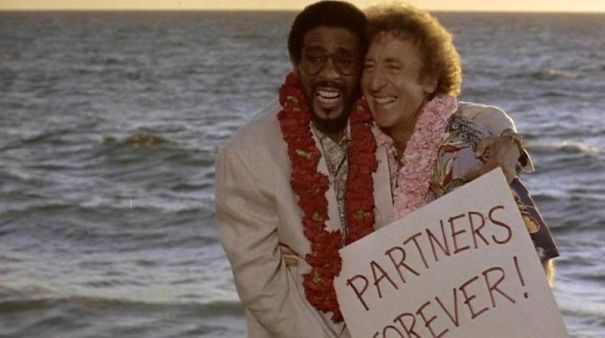
Another You (1991, dir. Maurice Phillips)
another-you

Eddie (Pryor) is a con-man that got caught and must fulfill 100 hours of community service per his probation. He ends up as the caretaker of George (Wilder), a recent mental hospital patient and reformed pathological liar. It doesn’t take too long in the outside world, and George is back to his old habits due to a case of mistaken identity. He’s thought to be Abe Fielding, the heir to a brewery empire and Eddie sees this as an opportunity to make some bank. A villain pops up in the form of Fielding’s business manager (Stephen Lang), but the twists and conceits used to get to the finale are incredibly convoluted and messy.

Another You was made in the period where Richard Pryor was succumbing to the effects of Multiple Sclerosis. He had announced his diagnosis four years earlier but it was this film that showed the public just how badly he was losing the battle. The film tries to work around it but it’s obvious when we see him being steadied by other actors in scenes and the way he tremors through the picture. Gene Wilder had done one film after See No Evil and prior to this one, Funny About Love, that was a box office failure. This would be the final film appearance of both actors. They would make the occasional television appearance and Wilder would star in his short-lived sitcom, but feature films would never be a medium they returned to.

It’s no wonder they gave up on movies after this. Another You is an unmitigated disaster. Peter Bogdanovich (The Last Picture Show, Paper Moon) had been hired to direct but quit after five weeks and Maurice Phillips was brought in as a replacement. Phillips and his editor showcase their complete ineptitude to construct a cohesive story. If reasonable minds had prevailed Pryor would have been left out of this because it becomes painful to watch him being forced through the picture despite his condition. It’s a nod to him that he just decides to say “fuck it” and do his own thing despite the movie happening around him. The picture is riddled with external car shots that have sloppy post-production ADR plastered over them expositing on plot points the director realized were unclear. The story is a complete mess that shifts its focus about three times and ends up in a confusing unfunny place, with relationship resolutions that are completely unearned by the script.

In the 1990s and early 2000s, Richard Pryor became the focus of a myriad of television documentaries about his stand-up career. His actual appearances were limited to a few and in 2005 he passed away due to complications from a heart attack. Gene Wilder tried his hand at television sitcoms in his own, Something Wilder; that was cancelled after a single season. He was seen in the television film version of Alice in Wonderland, playing the Mock Turtle. He subsequently starred in and wrote a duo of mystery films for A&E focused on a theater director turned investigator. In more recent memory, Wilder had a two-episode stint on Will and Grace as Will’s unbalanced boss. Wilder passed away in 2016 from complications of Alzheimer’s

The films of Pryor and Wilder never got better than Silver Streak. The key was that Silver Streak was a tightly scripted movie. Their subsequent films gave them lots of space to ad lib and mug, and that needed to be much rarer and tightly edited in post to be genuinely funny. For people around my age, I think we look back through the fog of nostalgia at these two men’s work together because with a crisper, more recent viewing of it I see there were a lot of problems. Somewhere, in some parallel reality, they were able to partner on Blazing Saddles, and movie houses are showing it on repeat for their Wilder retrospectives.
The Pryor/Wilder Quartet -See No Evil, Hear No Evil

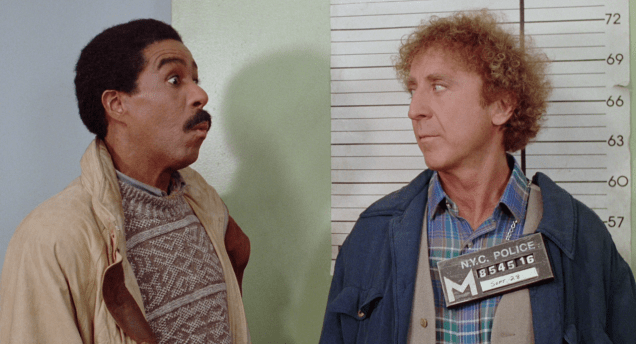
See No Evil, Hear No Evil (1989, dir. Arthur Hiller)

top-365-films-see-no-evil-hear-no-evil

Wally Karew (Pryor) is a blind man who isn’t letting his condition slow him down, despite protests from his sister. He ends up getting a job working for newsstand owner Dave Lyons (Wilder), who happens to be deaf. The two become embroiled in a murder mystery. Karew’s bookie comes looking for money he’s owed but instead stashes a valuable coin in the newsstand when some, even more, unsavory types show up. Karew and Lyons get implicated in the murder, as ludicrous as that sounds and they have to bust out of jail and track down the real killers. Clearing their name involves posing as doctors at a hotel convention and enlisting Karew’s sister for help.

In both Stir Crazy and this film, there is a palpable desire to recreate the past success of Blazing Saddles and Silver Streak. In my Silver Streak review, I mentioned how Pryor was initially set to play the Cleavon Little role. I get the feeling the interaction between Gene Wilder and Cleavon Little looms over these films. Add to that the iconic moment in Silver Streak where Wilder is forced to “black up” to sneak past FBI agents and you can see the pressure these new movies had to create similar iconic comedic moments. That’s the problem with forcing those moments; it won’t ever happen. Comedy is a very organic thing and letting your actors “just ad lib” is rarely a smart move, even if they are as talented as Wilder and Pryor.

Instead, the comedy in this film awkwardly comes from the characters’ disabilities. Almost every joke is a slapstick play on blindness, deafness, or a combination of the two. There are some occasional amusing moments, but often it comes across as offensive and ableist. Isn’t it funny how the deaf guy misreads lips or isn’t it funny how the blind man gropes that lady? It doesn’t help that the main storyline, the valuable coin, is dumb and forgettable. It resolves in a very sloppy way that gives off the sense that the writers and director just threw up their hands and said: “Forget it!”.

A carryover from Silver Streak has been the idea that Wilder’s character must always have a love interest. Here there is an attempt to make it the female villain. It never goes anywhere which makes it better than the forced love interest in Stir Crazy. When I think back to the chemistry between Clayburgh and Wilder in Silver Streak, it feels real and natural. Much like the best moments between Wilder and Pryor, these romantic plots can’t get shoehorned in if there isn’t a reason for them and them chemistry isn’t there between the leads.

1989 was a critical moment in Wilder’s life. His wife of five years, Gilda Radner, died the year this film came out and it had a profound effect on his work. Previously, he had made three films with here that had not been well received by audiences or critics, so he was a rough place personally and professionally. Pryor had a mixed bag in the years since Stir Crazy. He’d co-starred in Superman III and had made the pictures Brewster’s Millions and Moving. He was enjoying a bit more commercial success than Wilder and was working to soften his edges. In 1980, the actor notoriously freebased cocaine which led to him dousing himself in rum and setting himself on fire. That violent incident would be a huge turning point in his personal life and lead to his eventually sobering up.

Wilder and Pryor would make one more film together, Another You, which we’ll look at next week.

The Pryor/Wilder Quartet -Stir Crazy

Stir Crazy (1980, dir. Sidney Poitier)

5449_1

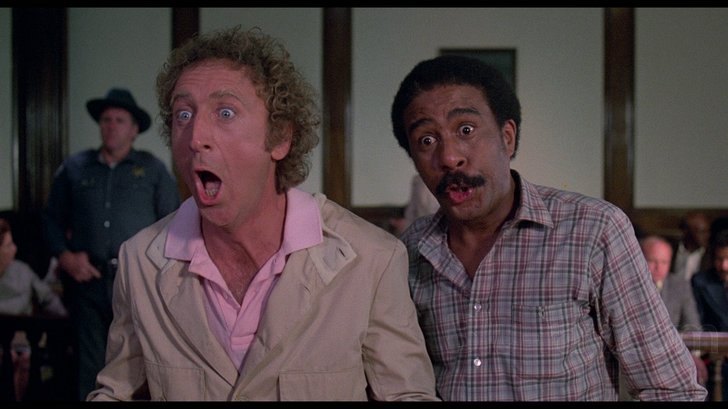
Stir Crazy is the second collaboration between Gene Wilder and Richard Pryor. This time, they are brought together by actor/director Sidney Poitier. The premise has the men as friends and roommates burnt out from life in New York City. They set out for the American Southwest where Wilder promises they will live a free and happy life. However, they end up framed for a bank robbery and receive a sentence of 125 years. Life is prison quickly drives them nutty, and they find a possible escape when it turns out that Wilder is a natural for the rodeo. The prison warden has a tournament coming up and plans to use Wilder to break his losing streak.

Since Silver Streak, life for Wilder and Pryor has been busy. Wilder has made The World’s Greatest Lover, inspired by a Fellini film, and The Frisco Kid, a Western that made Harrison Ford his co-star. Both films were considered significant failures at the box office. Pryor had two more successful comedy albums and starred in Car Wash, some forgettable comedies, and in Paul Schrader’s (Taxi Driver) drama Blue Collar. The comedian has also suffered a heart attack in 1977 but seemed just to double down on drug consumption which led to reportedly unprofessional behavior in being late the set of Stir Crazy. There was a lot of tension behind the scenes between Poitier and Pryor, and it can be felt a bit on the screen.

Stir Crazy is a pretty major disaster of a film. Silver Streak was a very tightly written and plotted, while Stir Crazy plays it way too loose and gives its two leads way too many scenes to mug and improvise in. There are multiple instances where Wilder especially is encouraged to just riff, and they fall flat in a huge way. His character mainly feels all over the place, in some moments being a naive doof and in others a Bugs Bunny-esque trickster. It becomes impossible near the end to know when he is genuine and when he is messing with the prison staff. There are a couple of moments where the two pull off genuinely humorous reactions. The sentencing scene is the highlight of the film with the result feeling natural and playing to the actors’ strengths. The scene where the two men are thrown into the county jail after their arrest is also funny until Wilder begins ad libbing a kung fu bit that just doesn’t work.

The film suffers from a lot of tone and plot problems. The film switches plot tracks numerous times with many characters introduced and ending up completely unimportant to the movie. JoBeth Williams shows up halfway through the film as an intended love interest for Wilder’s characters but goes nowhere and somehow still ends up with Wilder despite the story never earning that. After reading about the tension between Poitier and Pryor, I suspect Wilder had more plot added to his character as both a way to pad for Pryor’s absence and as a way to get a dig in at the comedian.

With contemporary sensibilities, it’s very hard to watch the Rory character, a horrible gay stereotype that I hope we have moved past. Rory is immediately attracted and clings to Pryor’s character. Pryor’s disgust at the attentions of a gay man is played for laughs culminating in the man kissing Pryor in the final scene. The comedian let’s lose an exaggerated “Yuck” to make sure we, the audience know he doesn’t return the affection. It’s a very gross type of character to include and he ends up being completely one dimensional.

Stir Crazy was the third highest grossing film of 1980 yet still was nominated for a Razzie. It was the highest grossing film by an African American director until I believe, The Wayans Brothers’ Scary Movie (2000). It’s an incredibly diverse cast in a very sloppy film with some problematic elements. Poitier would go on to direct Hanky Panky (also with Wilder), Fast Forward, and Ghost Dad. We’d see Pryor and Wilder come together nine years later in See No Evil, Hear No Evil which we’ll talk about next week.

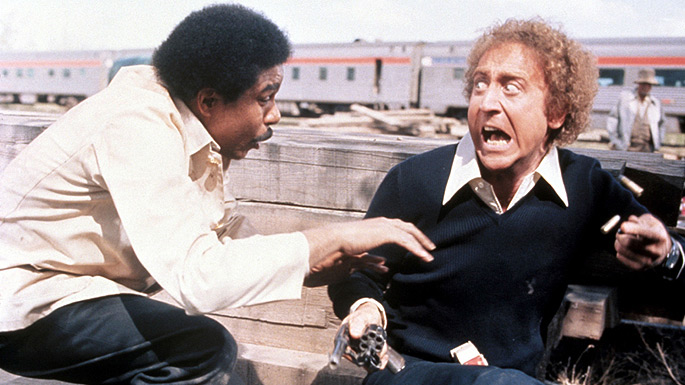
The Pryor/Wilder Quartet – Silver Streak

Silver Streak (1976, dir. Arthur Hiller)

Silver-Streak-Gene-Wilder-Richard-Pryor-gun-in-hand-or-glad-to-see-me

George Caldwell (Gene Wilder) is taking the Silver Streak train from Los Angeles to Chicago. While onboard he meets and spends the night with Hilly Burns (Jill Clayburgh), the secretary to a prominent art professor. George claims he saw the professor dead and thrown from the roof of the train and his investigation the next morning leads to him crossing paths with paid goons and being tossed from the train. A conspiracy behind the professor’s work is uncovered and George must team up with Grover Muldoon (Richard Pryor), a thief who ends up drug into the mess.

When Silver Streak was released, Gene Wilder was at his career peak. He’d come off of Blazing Saddles and Young Frankenstein. Previously, Wilder had struggled to find a breakout role. In retrospect, films like The Producers and Willy Wonka are spoken of fondly but at the time they were considered box offices failures whose love only came later with home video in the 1980s and 90s. Richard Pryor was as big a name and arguably bigger than Wilder at the time. By 1976, he’d had three comedy albums that went gold and hosted what became one of the great Saturday Night Live episodes. Before that, he’d cut his teeth as a writer on Sanford and Son as well as Blazing Saddles. He was set to play the co-lead with Wilder in Saddles but his volatile nature connected to his drug use caused studio heads to nix that idea.

The film was directed by Arthur Hiller, one of the big directors of the 1970s with features like Love Story, The Out of Towners, and The In-Laws. He worked frequently with playwright Neil Simon, however, Silver Streak was the work of Colin Higgins. Higgins was the screenwriter behind Harold and Maude and would go on to write and direct Foul Play, 9 to 5, and The Best Little Whorehouse in Texas.

The biggest thing you’ll notice while watching Silver Streak is that Pryor doesn’t appear onscreen until a full hour into the film. He’s billed third behind Jill Clayburgh and this appears to be because his roll was not meant to be as stand out. After reading the script, Wilder told the producers that the only way to keep elements in the film from becoming offensive would be to hire Pryor for the Grover role and allow him to bring his personality and point of view to the role. He was exactly right because, in scenes like the blackface disguise moment, Pryor is able to comment on white people and their exploitation of blackface in a way that most certainly came from his own mind. It’s very apparent to see why Pryor and Wilder would be teamed together for the next 15 years because they do have a wonderful chemistry together.

Speaking of chemistry, the relationship between Wilder and Clayburgh is one of the most convincing I’ve seen in a film. There was a certain type of naturalistic acting that worked its way into mainstream cinema in the 1970s that I think is present in the interaction between these two actors. It doesn’t hurt that both of them just have very magnetic, genuine, and charming personalities. You just can’t help but smile during their flirtation because it feels like you’re watching a real moment between two people who are attracted to each other.

The supporting cast is one of those great character actor showcases: Ned Beatty, Scatman Crothers, Patrick McGoohan, Ray Walston, Clifton James, and Richard Kiel. The roles are not that meaty on the page, but the actors bring dimensionality to the characters through their choices. The film is also very well-paced with Wilder’s series of ejections from the train marking the act breaks in a very clever manner. This will definitely be the strongest of the four Pryor/Wilder films in the series and serve as a benchmark to compare the subsequent pictures.