
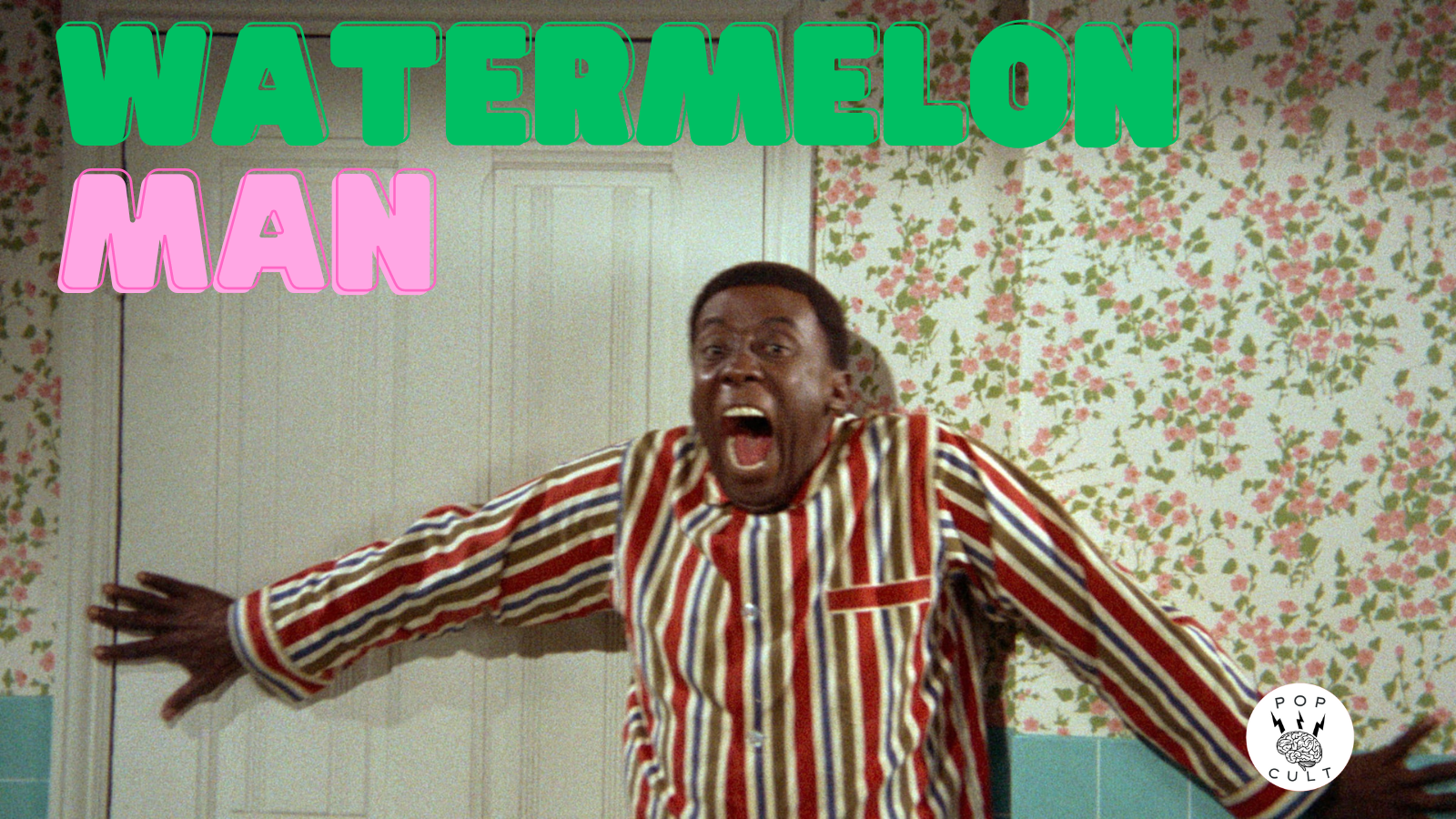
Watermelon Man (1970)
Written by Herman Raucher
Directed by Melvin Van Peebles
In 1965, Time Magazine published an article about the most prominent Black comedians of the era. The list was composed of names you’re likely familiar with, like Bill Cosby (what a disappointment), Dick Gregory, and Nipsey Russell. Also on that list was Godfrey Cambridge, and unless you are a comedy historian, I would guess that you have never heard of Cambridge before. He wasn’t so much a comedian as he was a highly experienced actor. Born to immigrants from British Guiana, Cambridge was schooled in Nova Scotia while living with his grandparents after his mother & father became dissatisfied with the options given to Black children in New York City. He dropped out of medical school after three years to pursue acting and held down various odd jobs in what we call today “the gig economy.”
In the late 1950s, his career began to take off with roles in Off-Broadway productions alongside James Earl Jones, Louis Gossett, Cicely Tyson, Maya Angelou, and more. This led to opportunities to take supporting roles in films. While acting, Cambridge would do stand-up comedy sets and, at one point in 1965, was making $4,000 a week from this side job. He even appeared on The Tonight Show when Black comics were not showing up on television much at all. Part of his comedic shtick was a balance between precise elocution and the looser slang speak you might find in Black communities.
Watermelon Man is a showcase for Cambridge’s distinct sarcastic comedic tone. He plays Jeff Gerber, a white suburban member of the professional class. While Jeff views himself as a fun-loving joker, the people around him find the man increasingly intolerable. His wife Althea (Estelle Parsons) has liberal views and gets upset by Jeff’s casual racism. Even his fellow workers on the daily commute encourage the bus driver to not pick Jeff up. One morning, our protagonist wakes up and finds he’s no longer. No matter what he does, Jeff cannot scrub the “Black” off of himself. He believes this results from spending too much time in his tanning bed but quickly realizes the world doesn’t see him as overly tanned. Instead, Jeff gets accused of theft, pushed around by the police, and used by his employer to secure a “larger market” for the life insurance policies they sell.
Watermelon Man came from the mind of writer Herman Raucher, a white man who began to note how many of his seemingly bleeding-heart liberal friends still held racist views only shared in private. After reading the script, Melvin Van Peebles, one of the most influential Black filmmakers of the 20th century, was chosen by Columbia Pictures. They knew they could not make the film with a white director, and Van Peebles had recently impressed the industry with his feature debut, The Story of a Three-Day Pass. Before Van Peebles brought in Godfrey Cambridge, the studio had planned to cast a known white actor as Jeff for the first 20 minutes of the movie, tossing out names like Jack Lemmon or Alan Arkin.
Van Peebles was more thoughtful than this and understood letting Cambridge play both roles had a tremendous impact, as it managed to comment on the proliferation of blackface performances in white entertainment that had been going on for a century. It was not a common sight to see a Black person mocking the behaviors of white people. This led to clashes with Raucher, who viewed the project as a satire of white liberals, while Van Peebles saw it as a story about Black power. This rift was so large that Raucher wrote a novelization of the film that ended with Jeff waking up white again, realizing it had all been a nightmare. Van Peebles was told to shoot both endings, but wouldn’t you know it, he “forgot” to shoot the one where Jeff becomes white again.
I prefer Van Peebles’ reading of the material because it makes Watermelon Man even more complex and fascinating. It can be inferred that Jeff is Black the whole time, but he was “white-passing,” made his way up the economic ladder, and hopes to remain there by disparaging the rest of the Black community. Yet, his racial identity is made more prominent through how he is treated to the point Jeff can no longer deny it. As a result, he starts to see how quickly some people turn on him while others embrace him more. However, some of those welcoming him have ulterior motives, and Jeff must learn to not trust white people without a deeper examination of their motivations.
One of the most stunning pieces in the film comes when Jeff is kicked out of his house by his once “tolerant” wife. He ends up sleeping with a Swedish secretary from his office who suddenly shows an interest in him when he becomes Black. Their exchange reveals a more profound message that stories of this type don’t often embrace. She has fetishized Jeff’s Blackness. What might appear to be openness is really an exploitation. Jeff is good to her because of the pleasure she can get from him, and his autonomy as a human being is erased from the equation.
If you browse any pornographic site these days, you are bound to come across the genre label “interracial,” where Black men are trotted out as sideshow freaks essentially. The sex they have is meant to serve as a spectacle, a perversion. The purpose of this subgenre of porn is not to serve as entertainment or arousal for non-white people but specifically for white people who have dehumanized Black bodies into objects of desire for themselves. The Black person’s thoughts and desires don’t even come into the picture. The fact that “interracial” exists as a label alongside specific sex acts or fantasy scenarios implies the Black person is not an object of reality but part of a pleasure playground for white people.
Van Peebles uses this extremely Kafkaesque story to explore how you begin to see the world when it is done through the eyes of a Black person. Where Raucher’s version keeps the Blackness as a gimmick, Van Peebles says, “No, Jeff is a Black person. He always has been. Now he is seeing the reality of the world.” This is smartly done as comedy to hide how radical its message was for the time and highlight the natural sarcastic delivery Godfrey Cambridge was so talented at.
The sensibilities of something like Jerry Lewis’s comedy are at work on the surface in the opening act. The longer Jeff lives as a Black man, the more subtle the humor becomes. This isn’t a slapstick farce but an unpacking of truths unsaid in white company. Van Peebles is just as interested in making us laugh as in asking us what we are laughing at. Is it the idea of a white man being “punished” by becoming Black? Because if that is the case, why do we think we’re so enlightened? This would be the director’s single foray into a Hollywood film for obvious reasons. When Jeff questions his wife (“What happened to the flaming liberal I was married to?”), she responds, “I’m still liberal but to a point.” I like to imagine this is essentially what happened between Van Peebles and Columbia Pictures.
Watermelon Man is a film that clearly influenced Black comedy in the following decades. Eddie Murphy and Dave Chapelle have done skits with them in whiteface that are extensions of what was done in this film. Godfrey Cambridge did not live to see his work’s effect on the later generations. While shooting a tv movie where he played Idi Amin, Cambridge had a heart attack that took his life. He was only 43 years old. The actor was part of the beginnings of the Blaxploitation film movement and served as a voice that challenged many of the stereotypes America posited about Black people. Watermelon Man remains a film that is as hilarious as it is angry, a truly honest satire of racism that says the often whispered things out loud and in your face.

 PopCult Reviews
I SAW this on TV in the late 1970s, in my teens, late at night, sound down so as not to wake anyone; but it still worked although I could hardly follow the story, a visual meditation (only B&W TV then, naturally); I thought then, “they won’t make many of these”; four decades later I had completely forgotten the film and Godfrey Cambridge’s name – then you did a review of it; thank you
That’s awesome! It is such a wild movie, definitely something I don’t think a studio would be willing make these days.