
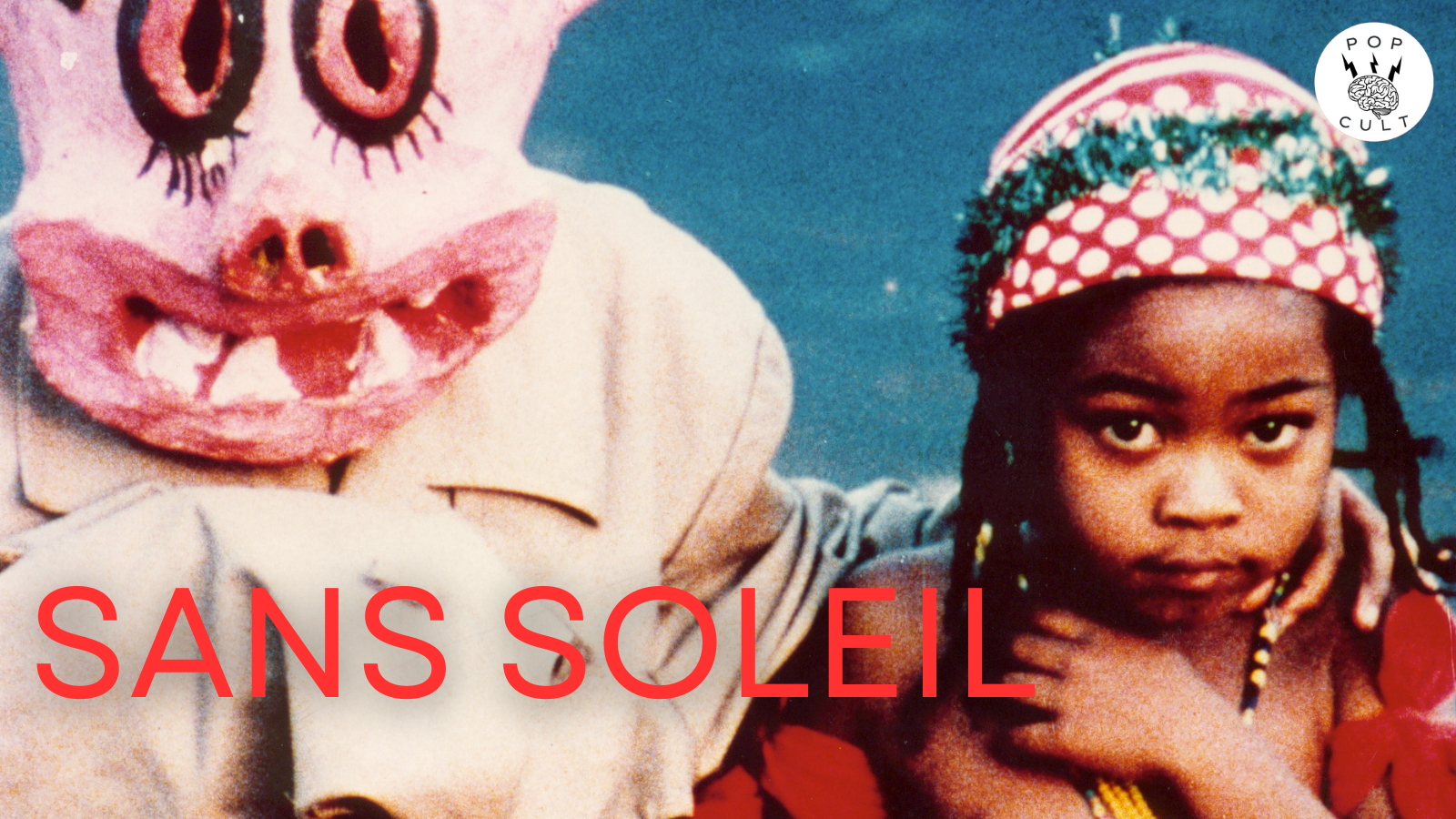
San Soleil (1983)
Written & Directed by Chris Marker
I can’t tell you much biographical information about filmmaker Chris Marker. I can tell you he directed one of the best short films ever made, La Jetée, and he is French. I like it that way. Holding Marker as an enigma does more to imbue his work with meaning than finding out where he was born, his upbringing, his beliefs, etc. I can extrapolate all of these things in generalities through his work. San Soleil (trans. Sunless) is a documentary & a video essay that tells us a lot about this often-forgotten figure in mid-late 20th-century cinema. Marker is concerned with things on the micro and macro levels; he finds connections between his complex inner world and the diverse external one he travels through, particularly in the people and their faces.
San Soleil spends most of its time concerned about people’s day-to-day survival in Japan and Guinea-Bissau. Why these places? They represent two different ways of living. Japan entering the 1980s, was a technological powerhouse, a nation fully committed to the capitalist death drive, manufacturing a new hyper-individualistic world but also caught in tradition. These two elements combine to create rigid hierarchies of power. I will go out on a limb here, and I assume most of you reading this don’t know much about Guinea-Bissau, even where it is geographically. It’s an African nation, one of many ravaged by centuries of European colonialism. By the time of this film’s release, there had been a coup of its first independent government as economic conditions deteriorated. The constitution was suspended, and a military council was put in charge, with the politician who led the coup being placed in charge (by himself, of course).
Chris Marker is an avowed Marxist; that’s another thing I know about him. As a Marxist, he is deeply concerned with historical analysis and looking at the complexity of the systems that people live within around the world. He worked as a journalist and was often sent to every corner of the globe, where he could take photographs, speak with people, and learn about how they saw the world. Marker has admittedly said he doesn’t always understand what compels him to film a specific moment or, while in the editing bay, place that moment next to other moments. There’s a deep intuitiveness to the work that can be felt. It’s not improv per se, but something connected to an indescribable feeling.
San Soleil is a film that digresses a lot! Look elsewhere if you want a movie with a succession of clear points building on each other. If you are in the mood for an experience that is semi-stream of consciousness while still being coherent, you’re in for a treat. The narration tells us they have “been around the world several times, and now only banality still interests me.” The film follows through with that, fixating on seemingly unimportant mundane moments but demanding we contemplate them to discover what is beautiful and profound about them.
The narration is another crucial piece of the film. It is written by Marker, read by a female voice performer, and the text is fictional letters sent to this unnamed woman from a globe-trotting cameraman named….Sandor Krasna. Krasna doesn’t exist, he’s a fiction made up by Marker, but he is speaking for the director. The film’s music is credited to Michel Krasna, Sandor’s brother, who also doesn’t exist and is another stand-in for the actual composer, Marker. Throughout the documentary, there’s an intense refusal to say “I,” a resistance to the first person in favor of these imaginary figures. They are still saying Marker’s words and expressing his thoughts, but creating a layer between himself and the film changes things. I think it allowed Marker to observe himself from as close to an objective point of view as a person can by distancing himself from his thoughts.
There’s an aside in San Francisco, where Sandor shares his obsessive thoughts on Hitchcock’s Vertigo with his female friend. A brief clip of three Icelandic children bookends the movie and holds extreme significance for Marker. The letters reflect how much this seemingly unimportant moment has come to symbolize happiness for the letter writer, both in its illusory intensity and brevity. I can relate to much of this as someone who lives in their own head most of the time. I sit and remember or meditate on moments from my life or images/stories I’ve glimpsed. It is the search for meaning in a world in which there is none, where meaning is derived by the one who thinks, not by anything naturally occurring in the landscape. Marker attempts to confess while remaining at a distance, and somehow, he pulls it off.
San Soleil is just as much about its structure and delivery as La Jetee. The composition of image and narration makes implications. These elements draw us closer, Marker offering us a seat at his table in a dimly lit cafe to talk about the trip he just returned from, how it affected him, and the thoughts lingering in his mind. Marker is interested in humanity’s advancement through communication technologies, a big part of the sequences set in Japan. However, he’s also returning to how we still manage to coexist and communicate without these innovations when we look at Guinea-Bissau. Do we need these pieces of technology to accomplish what we have, or do we use them to explain rather than dig deeper to understand how we have reached this place in our species’ history? There are no easy answers.

 PopCult Reviews
2 thoughts on “Movie Review – San Soleil”