
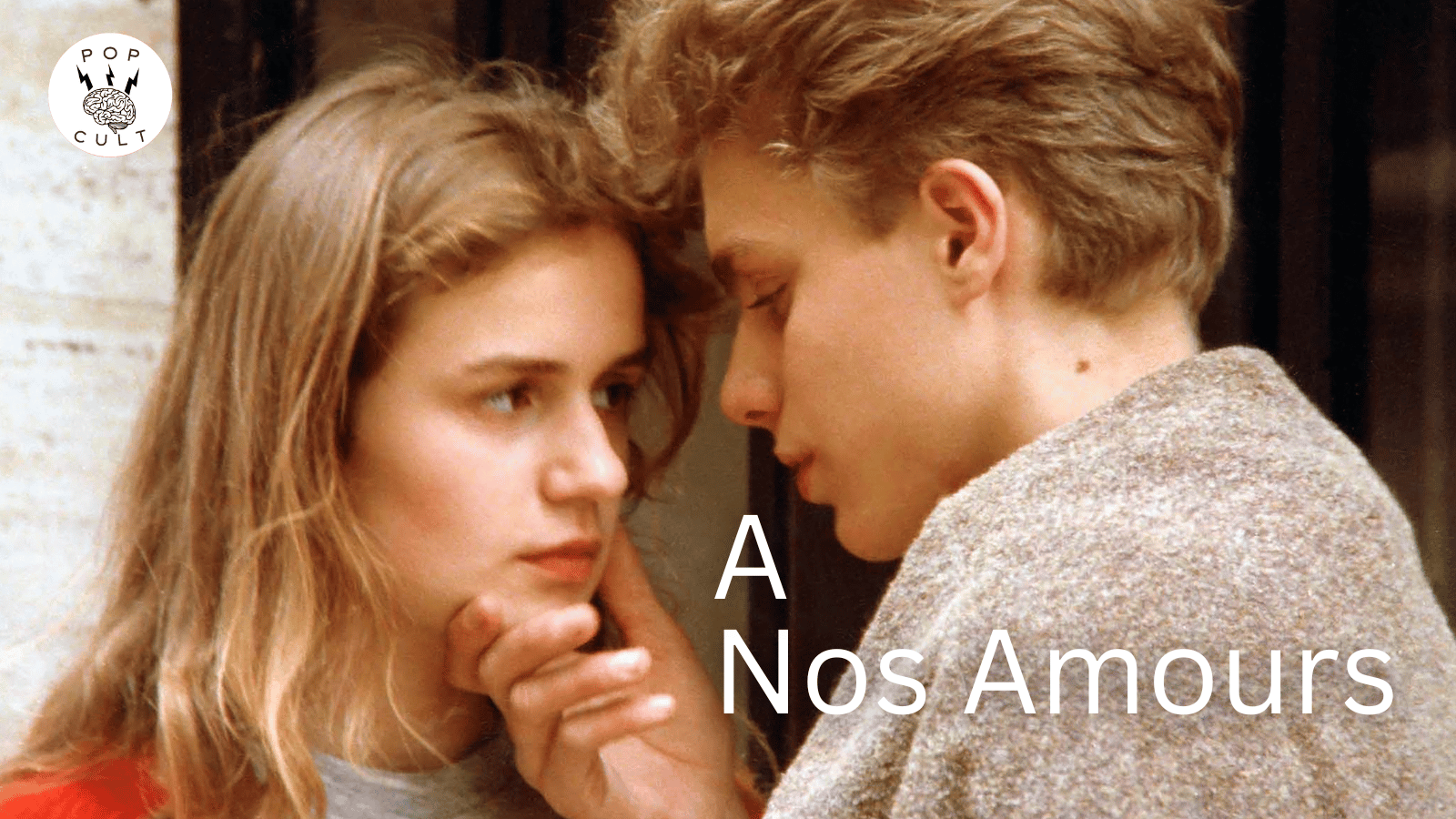
A Nos Amours (1983)
Written & Directed by Maurice Pialat
People often seem to forget that a vast ocean of thought exists within each person’s mind. Society does its best to halt our exploration of these complex inner worlds, but they remain a part of who we are, always waiting to be uncovered and mapped. You likely have noticed the same disturbing trend I have among mostly white conservative men, an aggressive push against women’s agency over their lives and bodies. They want the population to see women as nothing about vessels for men’s pleasure and laborers to provide men with their every need. But this denies that inner world, the complicated web of desires, needs, emotions, beliefs, and more that exists in women just as much as they do in men. A Nos Amours is a brief peek into that world, a film that also shaped the life of its star.
Suzanne (Sandrine Bonnaire) is a 15-year-old girl living in Paris. Her family is pretty dysfunctional, but she survives. She really likes Luc, a boy in her neighborhood, but her emotions are challenging to understand. Suzanne has a burgeoning sex drive and doesn’t want to just be with one person. She’s young and wants to experience different things before settling down, which is a normal desire. A brief tryst with an American tourist leaves the girl feeling both thrilled about the prospect of more sex but also bad that she was “unfaithful” to the boy she likes. Suzanne starts having casual sex with various young men she knows, which irritates her family. Her father secretly confides in his daughter late one night that he wants to leave the family and move in with his mistress. Eventually, he does, which sends the household into further disarray. Suzanne becomes the object of abuse by her mother and older brother. She makes desperate choices to save herself as best she can, leading to her departure from France altogether.
I absolutely loved A Nos Amours and think this is one of the best films ever. Director Maurice Pialat channels elements of John Cassavettes, resulting in a style that feels improvisational and authentic. This isn’t meant to be a purely literal story, though, as in the credits, Suzanne’s parents are billed as “The Father” and “The Mother.” There’s a larger metaphor at work. The subject of the “young girl awakening to her sexuality” is a pretty cliched French film trope at this point, but it is that very trope that Pialat is unpacking and examining. So often, the young girl’s sexual desires are linked in some Freudian way to her father, and the director thinks that’s a relatively dishonest summation of something far more complex.
It is evident that Sandrine Bonnaire had a lot of conversations with Pialat and did a lot of thinking before and during filming. In later interviews, she talked about being a virgin when they began shooting and how she had sex with a friend for the first time between shooting days. She and Suzanne were experiencing significant life events around the same time. Bonnaire has also spoken about Pialat as a father figure who became good friends with her father. In turn, she said her father was profoundly moved watching his daughter’s performance in this film, resulting in them talking to each other in a way they never had before. In essence, Bonnaire’s father was forced to see her not as just a girl or even “his” daughter but as an autonomous human being with the same flood of thoughts and confusion that everyone wrestles with.
Pialat has no time for films that try to be too pretty about life; he finds them dishonest, projecting a myth onto people’s minds. That means some scenes, especially in the latter half of this movie, get really uncomfortable. It is not easy to watch Suzanne become the frequent object of abuse by a mother and brother who can’t deal with the emotional turmoil in their lives. It’s nothing obscenely graphic but more emotionally raw. If you were ever abused by family members or spoken to with raw hate, these scenes will be a rough watch. But the director finds moments to counterbalance. Life is not all horrible things; profound moments of quiet beauty exist. My favorite moment like this is a scene where Suzanne comes home late; her father is the only one still awake. The way the camera floats, the father is barely glimpsed off to the side as Suzanne tries to slip in unnoticed. Then there’s their conversation, which you can only have around midnight when the house is silent and it feels safe to share your secrets and pain.
This moment conveys the father’s lament at his daughter moving into adulthood, not because he wants to control her but because he understands how much it can hurt to be a grown-up. We know this because he talks about coming to a point where he wants to walk away from the family and life he has built. He doesn’t feel concerned about his daughter’s sexuality because he wants her to be a possession; instead, he knows how complicated those emotions and relationships can be. Alas, he cannot stop her, though, and he knows that. Instead, he confides his own anxieties with her. He tries speaking to her like an adult in hopes she will understand. Bonnaire delivers such a genuine performance in this scene; she plays the moment effortlessly, projecting the childlike nature that remains coupled with what she has learned by coming into her own.
The themes of A Nos Amours are around discovering the limits of our lives. The film opens with Suzanne practicing and then performing in a play. She’s a girl playing a role, unsure how to deliver her lines but unable to step out of that strict space. Pialat shows an understanding of the nature of life and especially relationships. They are often fleeting and also fragmentary. So many people come in and out of our lives, and we rarely contemplate what it means to have them in it, even briefly. The great tragedy that Suzanne learns by the film’s end is that so much of her ability to escape confinement still lies in men. She gets a quickie marriage to escape her tyrannical family. She eventually heads off to the States with another man to get out of that mistake. Pialat never judges anyone in the film; he tries to document life’s emotions and ever-present heartache.
Many scenes in the film show Suzanne in isolation despite being with a group. Early in the movie, she stands on the bow of a yacht she and some friends have spent the day on. They are behind her, and the men, especially, are ogling, objectifying her. However, Suzanne is alone in her shot, back turned to them, looking out onto the horizon while they can’t seem much further than themselves. The film ends with Suzanne alone again, despite having a partner with her on the plane. She stares out the window, never betraying an emotion, looking down at the city she’s known her whole life, unsure if she will ever see it again, headed on to some strange new place. Life is uncertain, yet Suzanne knows she will have herself no matter what she encounters.

 PopCult Reviews
3 thoughts on “Movie Review – A Nos Amours”