
This special reward is available to Patreon patrons who pledge at the $10 or $20 monthly levels. Each month, those patrons will pick a film for me to review. If they choose, they also get to include some of their thoughts about the movie. This Pick comes from Bekah Lindstrom.
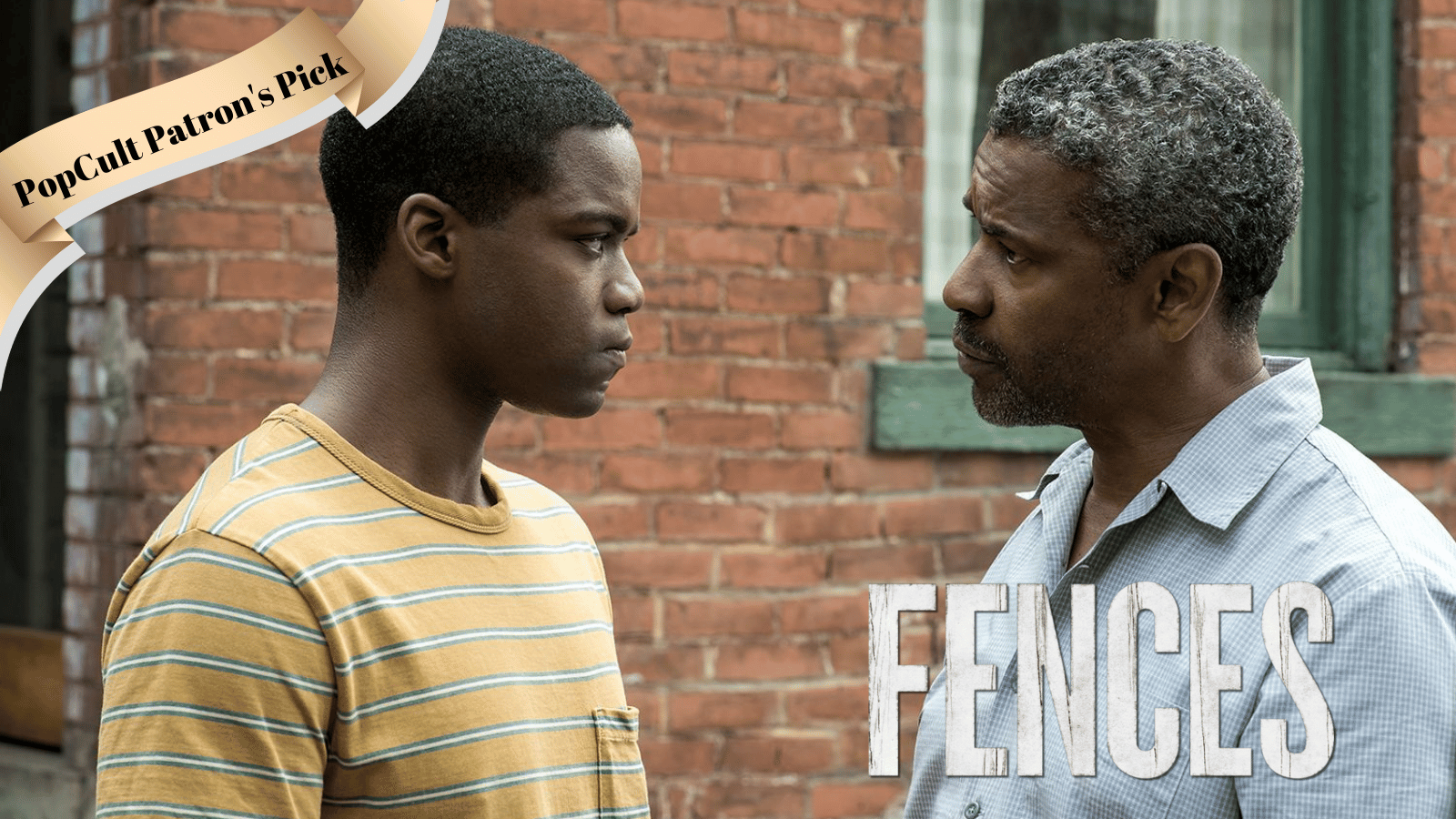
Fences (2016)
Written by August Wilson
Directed by Denzel Washington
There is no argument against the acting in this film. It is solid from top to bottom, with Viola Davis stealing the show from a strong Denzel Washington. The emotions feel real, lived in, and presented with authenticity. The film adheres rigidly close to the original stage play to the point that the deceased August Wilson has sole screenwriting credit. That may not be the best direction for a film based on the play rather than a recorded performance of the stage play. Director Washington does a decent job giving filmic qualities to the material, but not enough. The world feels constricted because we never leave the house while so much time passes. Additionally, some themes about masculinity and fatherhood feel muddled, and the ultimate message is troubling.
Set in Pittsburgh in the 1950s, the film centers on Troy Maxson (Washington), an aging trash collector who has managed to carve out a respectful existence in a neighborhood far nicer than where he grew up. His wife, Rose (Davis), has been loyal to him throughout their marriage, and they share a son, Cory (Jovan Adepo). Cory has aspirations of playing college football once he gets a spot on his college team. It may be his only viable path to get into college. This enraged Troy because Cory quit his job at a local supermarket due to the afternoon practices. There’s also Lyons (Russell Hornsby), an older son from a former now-deceased lover with a penchant for borrowing cash every payday. Rounding out the cast are Jim (Stephen McKinley Henderson), Troy’s best friend & co-worker, and Gabe (Mykelti Williamson), Troy’s younger brother who lives with a disabling head injury from serving in World War II.
I first encountered Fences when I read it for an English class in college. The play is very well-written, but there are some positions taken by the end of the film that I still have a lot of trouble with. Maybe it is because I grew up with a very unsympathetic father that I’m not as keen to listen to Rose’s statement to Cory in the final moments of the play about understanding how hard his dad’s life was and looking past the constant verbal & physical abuse. I’m not saying Troy had an easy life and didn’t work hard. But he is not a good man. He’s not someone we should admire. His story is a tragedy. The toxicity of the world around him poisoned the man, and he can never have a healthy relationship with any of his family members.
Rose is harmed time and time again by Troy. He has never considered her opinion or thoughts; he’s lived as a dictator in their shared home. Rose has raised his child, made every meal for the man, and kept his house in order. Viola Davis does get an incredible scene where she has finally had enough and unloads her frustrations on her husband. He cowers a bit, but I didn’t feel he absorbed what she had to say as he kept being an asshole. To make matters worse, he breaks the news that he’s impregnated another woman. That woman dies in childbirth, and Troy shows up with the newborn baby girl. He’s right in that the baby is innocent in all of this, and Rose never hesitates to take on the role of the child’s mother. She’s a good person.
I know we are supposed to see her ability to forgive Troy in the final act as a testament to her virtue, and I guess it could be read that way. I see it troubling, though, as this was written by a man, not a woman, and so a man writing a wife who courageously forgives her philandering, ogre-ish husband feels like someone trying to make an excuse for horrible men. Because we don’t see the large gap in time between when Cory leaves home and the final act, we can’t know if Troy changed at all. The last we see is a man threatening to kill his son for the boy’s attempt to push back against the toxic shit his dad has brought into all their lives. The pressure of “forgiveness & charity” through the lens of Christianity never seems to say we are obligated to give it to those who were vulnerable and made terrible choices; no, we are asked to hand it over to the worst, most abusive men who never seem to show an ounce of regret.
We compound this with the revelation that Troy stole Gabe’s disability checks and used them to buy and pay off his house. The whole time, he never offers a room to Gabe and ends up putting the poor man in a nursing home. His oldest son, Lyons, is constantly accused of borrowing money, never to pay it back. When he comes into the house not to take but to return, Troy refuses to take the money. Why would he do this? Well, how else could he continue to self-righteously look down on Lyons? So Lyons has to give the money to Rose, who gives it to Troy because her husband is fucking infant.
The way the conflict between Troy and his family is wrapped up felt way too easy & pat. There should be considerable lingering tension about the matter when the story concludes. Instead, what was a strong play until that point devolves into some sort of Tyler Perry-esque church play. Okay, it’s not that bad. It’s certainly better written from a technical perspective, but it carries the same toxic masculine notions throughout Perry’s catalog.
Where the film is more substantial is in how it addresses race. I don’t argue that Troy is wrong to try and remind his son that a career in athletics, even in the 1950s, was rife with racism. Cory dismisses this as his father’s residual hurt over being passed over for the majors, but later, some dialogue hints that the old man was already in his 40s when he tried to make a go for it. It could be argued that Troy uses racism as an excuse and then feels jealous that his son might make it and prove him wrong. Remember Lyons and the money? Troy has a nasty penchant for not wanting to be proven wrong by his sons when they are explicitly in the right. That is not an admirable quality.
There is no doubt about Washington’s passion for this work. He & Davis’s performances are the standouts of the picture naturally. He stuck too close to the play and failed to deliver a successful adaptation. Instead, we get a performance of the play with different camera angles and some bits of camerawork from time to time. I assume that Wilson wanted the play to create a conflicted feeling in his audience based on how the story unfolds. It certainly had that effect, and if that was the case, Wilson does an incredible job.

 PopCult Reviews
One thought on “Patron Pick – Fences”