
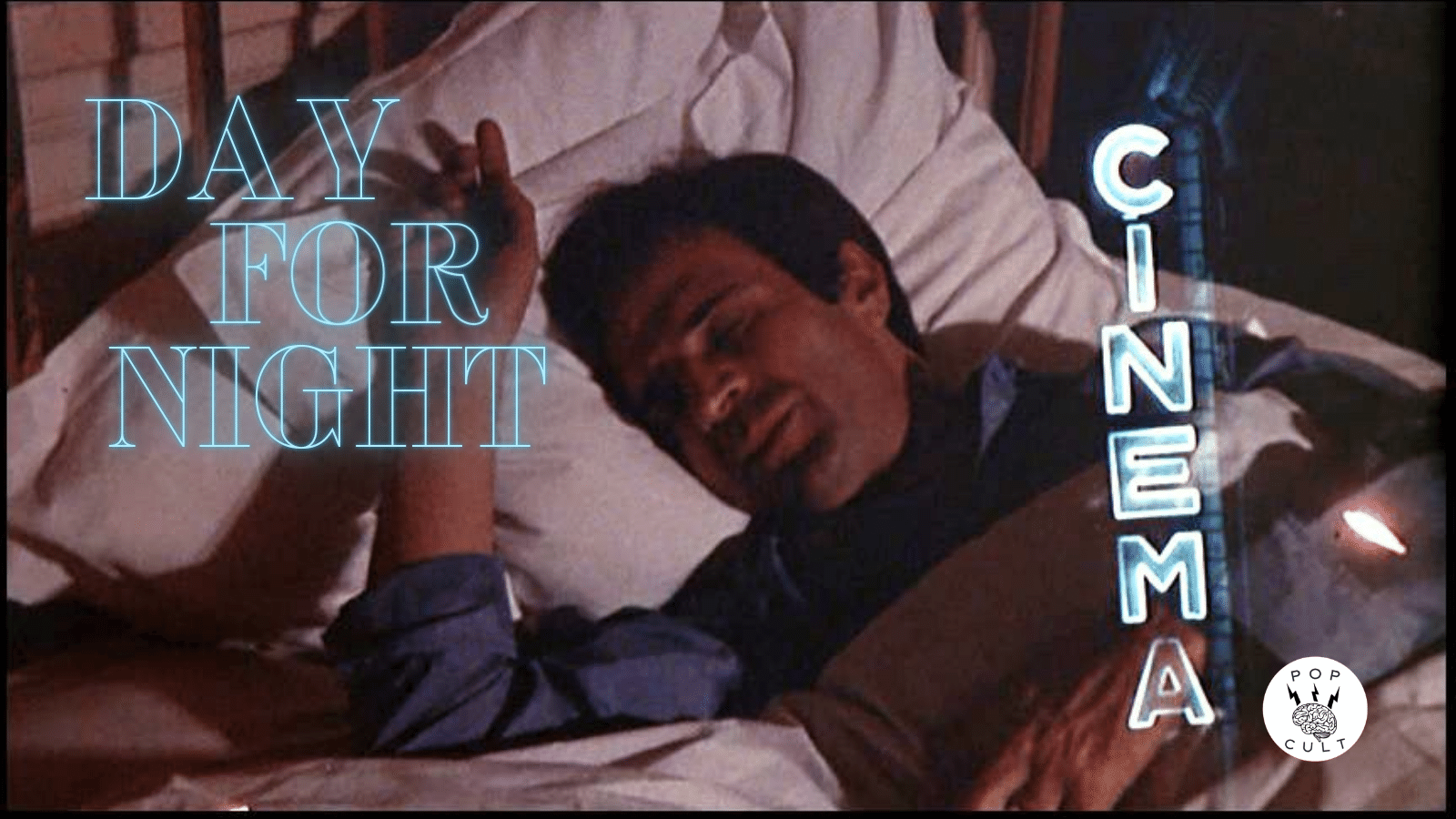
Day For Night (1973)
Written by François Truffaut, Jean-Louis Richard, and Suzanne Schiffman
Directed by François Truffaut
Like Jean-Luc Godard (Contempt), Francois Truffaut seemed like someone born in a movie theater. One of the French New Wave movement’s founders, Truffaut, felt cinema in a way few people do. They were certainly not the same and had a very contentious relationship as colleagues. Godard’s approach was to tear down norms, push back against expectations, and embrace a sometimes mechanistic view of the form. Truffaut was far more into the pathos of his work, wanting it to be relatable, often adopting a very sensual approach to his films. Day For Night was Truffaut’s self-reflexive movie, something for his longtime fans but also an exploration of why people make these pictures in the first place.
Ferrand (Truffaut) is directing a cliché melodrama, Je Vous Présente Paméla (Meet Pamela), about a young man introducing his new bride to his parents and the following travails. He’s brought in two aging stars, Alexandre (Jean-Pierre Aumont) and Severine (Valentina Cortese), as the parents. Alphonse (Jean-Pierre Léaud) plays the son, and British actress Julie Baker (Jacqueline Bisset) plays Pamela.
The film is told in a series of vignettes about cast and crew members as they encounter production problems like a “trained” cat that won’t go to its mark or planning a complicated car stunt. There are also a host of personal issues that arise. Severine is awaiting news of her terminally ill son’s passing and keeps forgetting her lines. Alphonse has brought his girlfriend to work as a script girl, but she’s starting to stray. One of the supporting actresses who is shooting now and then in a few months turns out to be pregnant, which creates a host of problems for film continuity.
There’s a sense of spontaneity throughout Day For Night, though that seeming effortlessness is part of Truffaut’s magic trick. Throughout, he addresses that feeling of illusion by showing that every moment in a movie takes a lot of planning, involves dozens of people, and is never right on the first take. Ferrand is constantly spinning plates, keeping all the disparate parts of this production in harmony and moving. Why does he do this despite the stress? At night, we see Ferrand’s dreams, how he returns to the time as a child when the cinema and all its films introduced him to a world of wonders and imagination. It inspired him to want to make them.
This awareness of artifice is part of the film’s playful nature. Casting Jean-Pierre Leaud as the lead, who played the lead for Truffaut in his breakout film The 400 Blows and many more to come, makes us pause. Is this a mockumentary? Is Truffaut poking fun at himself? There’s another layer with a behind-the-scenes film crew documenting the making of Meet Pamela, but they are part of the movie we are watching. A film within a film within a film within a film within… There are voiceovers, like snippets from an interview, where Ferrand comments on the state of the picture from time to time. It’s never made explicitly clear if these are part of that making of production or if Day For Night is allowing us to hear the thoughts of its director.
The lines between reality & the film are blurred even further with the casting of Jean-Pierre Aumont and Valentina Cortese, playing former lovers from long ago, now reunited on the set of this film. There’s no love story between them now, just camaraderie and acknowledgment of how time slips by so fast. They mention a brief stint in Hollywood, which the real-life actors experienced simultaneously in the 1940s. Severine’s repeated errors nailing her lines are met with a question about it all being fixed in the dubbing process like she’s done before in films. Severine mentions that’s what she did when she worked for “Federico,” another reality break as Cortese did work with Fellini on Juliet of the Spirits, where she dubbed her lines in post.
Truffaut had a penchant for using real life in his work, too. The story goes that after his parents saw The 400 Blows, they never spoke to him again, believing he had humiliated them publicly by lifting so much from his childhood. For the director, repurposing life for the sake of art is something he is compelled to do, yet he calls himself out on it within the film. Julie notices that a private conversation with Ferrand made its way into the daily rewrites. There’s no resolution to this moment, just an acknowledgment by the actress that she knows what he is doing. Day For Night isn’t a movie about conflicts and their resolutions but more about the process of this kind of work.
It’s crucial that the audience understands that Meet Pamela isn’t a great film. Most of the movies made are simply jobs that the people who work on them were able to get. Lighting crew, make-up artists, script supervisors, carpenters, etc. They don’t sign onto movies because they know they will change the world; they sign on to them because these people like making movies, but they also have bills to pay. Truffaut/Ferrand understands he’s in a privileged position compared to the rest of the people on set, and he doesn’t run things like a tyrant. There’s a genuine appreciation to even be here in this place making this thing. No problem is over so overwhelming that it makes people want to quit. When you love this medium like someone like Truffaut or Godard did, then you cannot help but want to be immersed in it, to live inside waking dreams.

 PopCult Reviews
One thought on “Movie Review – Day For Night”