
Intervista (1987)
Written by Federico Fellini and Gianfranco Angelucci
Directed by Federico Fellini
When you think of Federico Fellini and movies about movies, you probably think of 8 ½, and rightly so. It’s one of the best movies ever made and the best movie about a movie ever made. However, I already reviewed it when I did a series on the iconic Italian director in 2022. When I discovered this late-career picture, I put it in this series instead. Intervista was Fellini’s second to last film, and like most artists in old age, as they grappled with their mortality, he returned to his memories. This wasn’t new for Fellini; nostalgia has always played a significant role in his work. 8 ½‘s beautiful dream/memory sequences of Guido’s and the reflections of childhood presented in Amarcord are some of the strongest examples of this in his films. Intervista is a movie about falling in love with making movies, and Fellini goes back into his memories of this time.
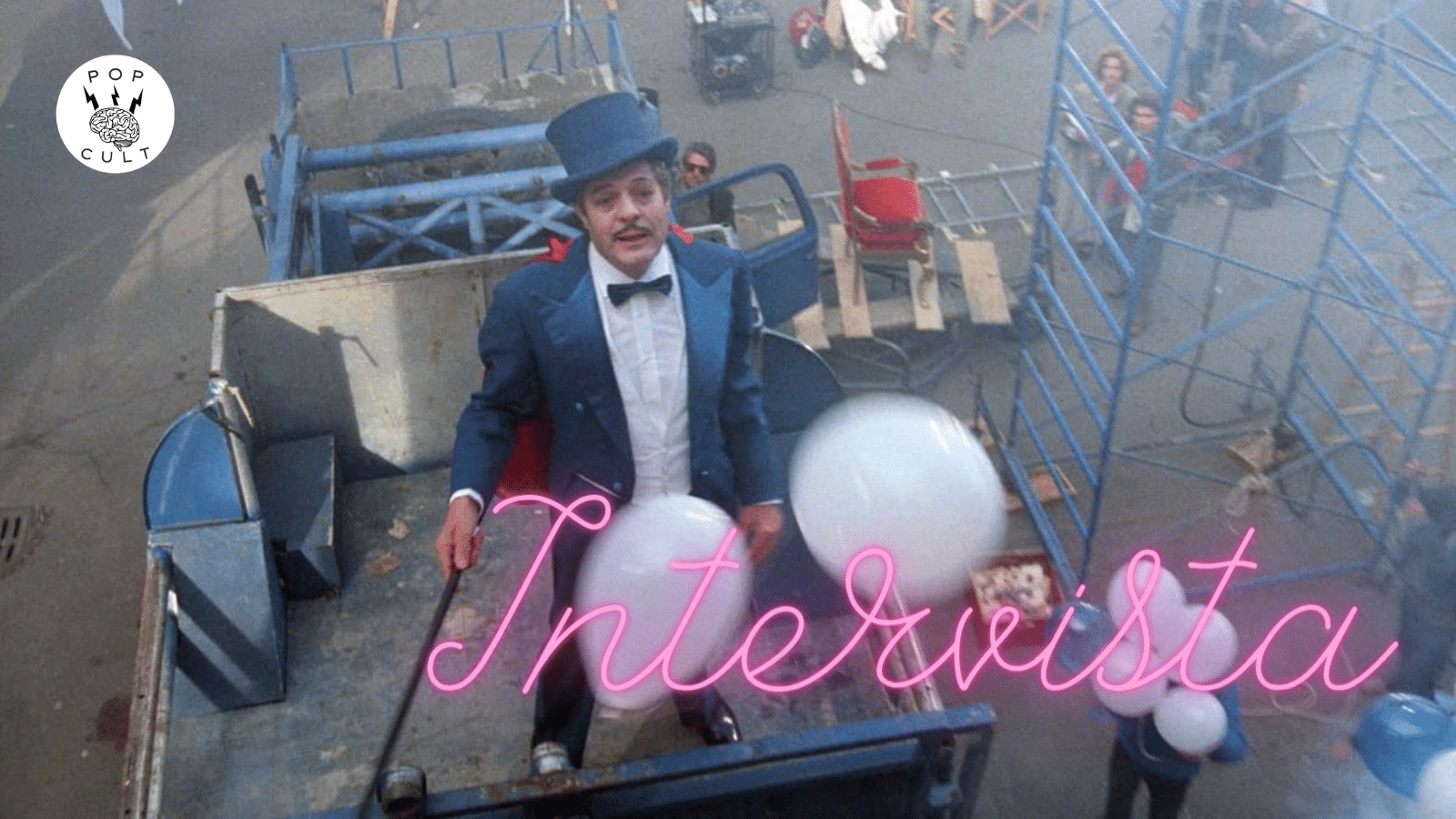
Framed as an extensive interview by a Japanese TV crew, Intervista sees Fellini taking the audience on a tour through a baroque & magical version of Cinecittà, Italy’s largest film studio and the largest in Europe. The interview leads Fellini to reminisce on the first time he traveled to the studio as a journalist in 1938 during the Fascist era. These memories are revealed in a film he’s directing about the experience with young actor Sergio Rubini, playing himself, playing young Fellini in the movie-within-a-movie.
As young Fellini tours the studio, he becomes engrossed in the films being shot there, with the audience being taken into those stories. The layers of fiction increase. Eventually, Intervista bounces back and forth between Fellini’s memories and the present-day work he’s trying to accomplish. Ultimately, the two blend together in a chaotically beautiful cacophony, with Fellini unsure where this ends and simply having to say the movie stops.
Intervista does an excellent job of reproducing the feeling of memory bleeding into the present and vice versa. Fellini has always been a magician, able to pull his audience into a place & time and cause the world to disappear. He does that again here, showcasing that while he was nearing the end of his life & career, the filmmaker still had a grasp of cinema few ever do.
As young Fellini sits aboard a train on his way to Cinecittà, the elder in voiceover talks about the strange things he has half-memories of seeing on that journey. He points out elephants wandering through Italian fields and spying a roving band of indigenous American warriors on the hunt. Given his location, These are nonsensical things, but when we arrive at Cinecittà, we eventually see young Fellini come across sound stages where these appear. The implication is that he was misremembering the train ride, letting the productions he saw bleed across those memories.
Two important people are encountered on that train ride. The first is a beautiful young woman whom he wordlessly flirts with. Upon arriving at Cinecittà, young Fellini learns she is there for a screen test, and a fiance suddenly appears from the ether, squashing any chance of further romantic connection. After parting ways, the young reporter enters Cinecittà and comes across a film set where a melodrama is shot. The story revolves around a beautiful young woman and her fiance, and suddenly, the audience begins to question what happened on the train, if it was even real.
Fellini underscores this by pulling back and showing the artifice. The train is just a set somewhere in Rome, a rebuild of a type of transit that has been updated since. This is the magician showing you how he does the trick, both with the train ride and the projections of the human experience of love that has drawn so many into movie houses worldwide.
The second person Fellini encounters is a Fascist on his way to meet with his colleagues who work at the studio. Cinecittà was built by order of Mussolini, who understood the power of the media in shaping his people’s thoughts. While Fellini was often politically ambivalent, he did comment on the destructive nature of fascism to the community he grew up in through Amarcord and its depiction of the locals who pushed this horrible ideology.
Young Fellini is not as conscious of how bad all this is, and he doesn’t interact with the older Fascist gentleman with any disdain. It is important to note that the Fascist is played by one of Fellini’s longtime collaborators who, when introduced in this film, is reading a Communist newspaper, which the director notes out loud. This, in turn, is another one of cinema’s tricks revealed: the people who you see on screen are rarely who those performers are in real life.
Flipping this on its head, Fellini eventually brings two stars from La Dolce Vita into the film as themselves: Marcello Mastroianni and Anita Ekberg. Their famous dance in The Trevi Fountain in Rome is played on a screen in Ekberg’s living room with both stars looking on wistfully, tears coming to their eyes. Fellini presents Ekberg in all her glory, wearing nothing but a towel when they come to visit. However, she has aged quite a bit since she appeared in his film. She’s also gained weight. However, Fellini doesn’t present her in a manner that seeks to undercut the same palpable sexuality conveyed on screen in La Dolce Vita. He has Mastroianni play this sequence with smoldering & reverent eyes for this sex symbol.
Fellini embraces the passage of time. These two cinematic figures are old now; their youth is long behind them. This doesn’t mean they are less beautiful; they now exude a beauty reserved only for the aged. It is a beauty that comes with respect. Fellini understands how we see these people, and he presents them to us with a mix of reality & illusion. But isn’t that his entire career? If we are honest, life is not beautiful without the painter’s brush adding an accent here or there. It takes the imposition of a person to make this existence something beautiful; it simply will not happen on its own.
Intervista is not one of Fellini’s best pieces. It is messy, scattered, and meanders a bit too much, if we are being honest. Yet even an okay Fellini picture is a masterwork compared to most contemporary films. He was such a rare animal, making the medium his own, practically inventing new ways of telling stories with movies, and he kept doing it until he was no longer physically capable. Intervista stands as an imperfect but still beautiful reflection of a career in making magic come to life.

 PopCult Reviews
One thought on “Movie Review – Intervista”