
Hyperion by Dan Simmons
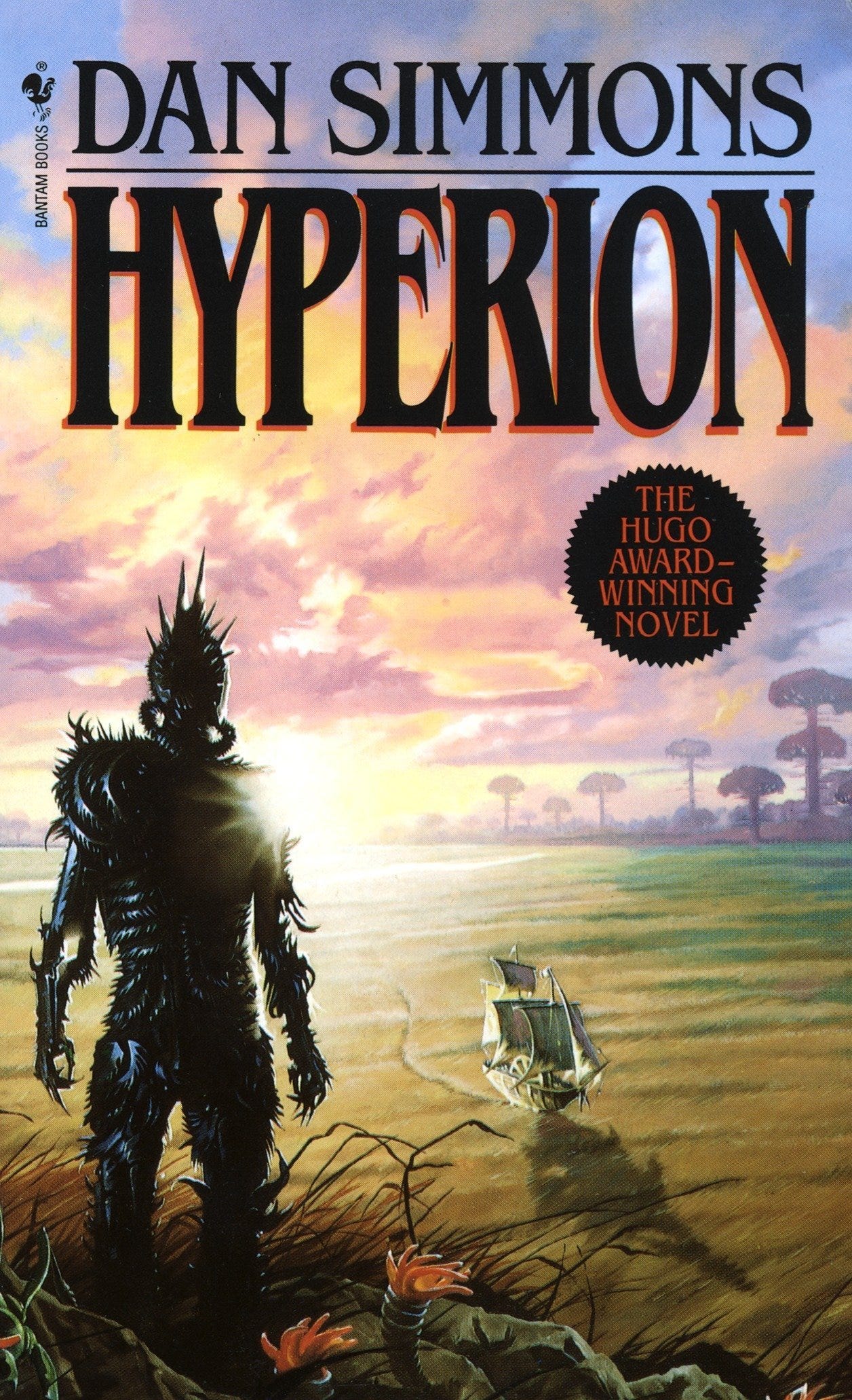
As a teenager, I came across this book in the now-defunct Wizard Magazine. I am trying to remember the context in which it was brought up, but I do remember the striking cover. Years later, when I took Chaucer & Medieval Literature in college, someone told me Hyperion was a retelling of The Canterbury Tales. Only at the end of 2023, at 42, I picked up Dan Simmons’ acclaimed science fiction epic to read. Wow. What an incredible treat to enjoy.
Through the framework of pilgrims telling their stories on a journey to an important religious site, Simmons showcases some of the most enthralling worldbuilding I’ve ever encountered. The Hegemony of Man rules most of known space, apart from the Ouster (separatist humans that rebelled and have been hiding in the dark corners of space), the TechnoCore (AI existing in a parallel universe of data), and the mysterious planet Hyperion. The Time Tombs are located on Hyperion, immense structures moving backward in time and beginning to open. No one knows what happens when they are, so the Hegemony has organized a final pilgrimage before the planet falls into a long, brutal war.
Among the pilgrims are The Consul, The Priest, The Soldier, The Poet, The Scholar, and The Detective. It takes quite a while to journey from their landing spot on Hyperion to the Tombs, and so to pass the time, the pilgrims tell the stories of what led them to this odyssey. As the details unfold, we learn copious amounts of information about this universe and how their individual stories reveal a shared link with the Tombs and Hyperion’s enigmatic cyborg predator, The Shrike.
I am not a big consumer of science fiction, but this has me wanting to search out similar titles. I know there is a Hyperion series, but I have not heard positive things beyond the second book. What I appreciated about Hyperion is that it is a complete story. Yes, it continues into the next book, but even if I never picked that one up, I was treated to a beautifully written piece of literature. You don’t need any background knowledge of The Canterbury Tales to appreciate the novel, but having that does bring another layer to the story.
One aspect I’ll take away from this is for my solo tabletop roleplaying. The details of this world make it unique compared to other science fiction universes. There are some essential elements that it shares with others, but how Simmons personalizes everything to this reality and the rich history that comes before the first pages of the text elevates it. Every element from the Ouster to the TechnoCore to the Shrike gets a spotlight with enough information revealed without giving away the mystery. If you are a science fiction fan, this feels like a must-read.
Corpsemouth and Other Autobiographies by John Langan

I’ve read four Langan short story collections and his novel The Fisherman, so I am a fan. However, I felt very cold about this latest collection, with only a few stories standing out. I don’t know why; perhaps my mind wasn’t in a suitable headspace to enjoy the book, but I never felt very excited while reading.
“Kore,” the opening story, was a nice short spooky reading presented as the memory of a man about one Halloween when his family made their basement into a scary stop for the trick-or-treaters. It was ambiguous and creepy.
“The Open Mouth of Charybdis” was an excellent Twilight Zone-esque story of our protagonist remembering an alternate history no one else in their family seems to recall and of a family member who has been lost in a reality shift.
“Shadow and Thirst” has a compelling central idea; I simply didn’t find the overall presentation enjoyable.
“What Is Lost, What Is Given Away” is probably my favorite of the eleven stories. The narrator attends his ten-year high school reunion and discovers a teacher who had been scandalized by an affair with a student in attendance. At an event later in the weekend, he runs into the teacher again in the bathroom, where he learns about what happened to the older man over the last decade and, even more shocking, how exactly he came to be at this reunion.
Overall, it’s a fine collection; Langan is an excellent writer; some stories went in the direction of types of horror I wasn’t really interested in.
The Wretched of the Earth by Frantz Fanon

The Wretched of the Earth is a book I’ve wanted to read for years now, and with the genocide happening in Gaza, it felt like the right time. I’m so glad I did. Frantz Fanon was born and raised on the French island colony of Martinique; the descendants of African slaves forcibly moved there. Vichy French forces were blockaded on Martinique after France fell to the Nazis, so they implemented an oppressive regime while stuck on the island. During this time, Fanon saw colonial horrors up close and began articulating his view of why such a system must be destroyed.
The Wretched of the Earth was published in 1961 when Fanon died from leukemia. In the text, Fanon embarks on a psychoanalysis of how colonialism dehumanizes its victims in ways that can last for multiple generations. The first section of the book, “On Violence,” details how violence is used by colonialist forces to impose their will & structures onto indigenous communities. He also describes how violence must be used to rid these regions of their colonizers. He explains how settlers rarely see indigenous people as human beings; in most instances, they are equated with local fauna that are pests.
Even more insightful is Fanon’s observation that the local population gets divided into roughly three groups: There is the proletarian worker in aid of the colonizer, the “colonized intellectual” who is often made into a spokesperson for the colonizer, and finally, the lumpenproletariat – the poorest class, usually living in ways labeled as “primitive,” the peasants who have little. Fanon makes a very pointed critique of Marxist thought by reminding us that this group is often ignored when the proletarians rise up as they focus on industrialized centers. However, Fanon shows how the peasants are the first to understand the role of violence in dethroning their oppressors.
In the essay “On National Culture,” Fanon looks at how the decolonized society can often fall prey to ideological traps that remain due to having been occupied. Part of this is how colonizing forces rewrite the precolonial history as a time of barbarism and savagery. The colonized intellectuals will often try to return to a past they have idealized in a way that is unfair to their ancestors as a violent rejection of colonization. The result is frequently a cliched parody of these traditions, which romanticize the past in the same unconstructive way as their oppressors did their own.
Fanon concludes that the way forward is to move past outdated ideas of nationalism towards a global consciousness. Building a national culture is only a means to reach a greater goal: international solidarity. It is through this struggle to see a society not as something insular from the world but as a part of a larger mosaic that humanity can achieve its highest form of culture. Through this transformation of the consciousness of the entire species, we might end the oppressive movements that have erased so many. But like any Marxist, Fanon also understands this is a multi-generational struggle, the fruits of which he would never see, and neither will I. Simply because I will not be alive to witness a transformation for the better does not mean I can shrug off my responsibility to the work needed to be done to reach that day.
Solo Game Master’s Guide by Geek Gamers

On a completely different note was this really informative book by Geek Gamers. I have been enjoying her YouTube channel as she presents & reviews various games either made for solo play or using adaptations to achieve that goal. The book is partially a collection of tools and Geek Gamers’ ideas about approaching solo roleplay to ensure you don’t hit a creative wall. Just like writing, you might have a good hook, but if you cannot sustain it and develop an initial thought into more ideas, you’ll find yourself stalled out.
One of the most important “rules” to remember here is that “Everything is Play.” This means reading over a sourcebook or watching a film is part of play because you engage with your imagination. Character creation is another act of play as you are sorting numbers and assets to tell the story of a person. Worldbuilding can be play without every rolling dice as you determine the history and factions that populate your universe.
She also pushes us to get away from focusing on mechanics and towards emotion. Good stories are connected with strong emotions: romance, betrayal, revenge, survival – these all bring up complementary and conflicting emotions that drive narratives forward. If your character is not emotionally invested in the world, you won’t know where they should go next.
I loved a section where Geek Gamers talked about how important setting is and that we should often start with setting instead of characters. That contradicts the layout of most roleplay books as character creation is presented early on, with lore and worldbuilding coming in later chapters. By finding points of interest in the world, you imply the existence of certain characters. If you have a chain of islands ravaged by a dragon, you immediately imply people who would hunt the beast & people attempting to live despite such a monster. A destructive dragon might have carved away at the ground and revealed secrets to the people that live on these islands, other monsters, or unique artifacts that might be used in their fight. Starting from the world makes creating a character invested in something much more straightforward.
Because Geek Gamers approaches solo RPGs from a more literary, academic mindset, she provides a fresh perspective from someone whose sole engagement with the hobby has been playing D&D since they were a kid. One of her most helpful sections is categorizing the resources you will need as a solo player, which fall into four categories: generative (random tables), suggestive (components from non-RPG sources), restrictive (percentile oracles), and rubrics (RPG rulesets). It’s a combination of these four things that results in fruitfully creative solo play.
If you are curious about getting into tabletop roleplay of any kind, this is a valuable resource to think about how emergent narratives can be entertaining & build your strengths as a storyteller.

 PopCult Reviews
One thought on “Book Update – January/February 2024”