
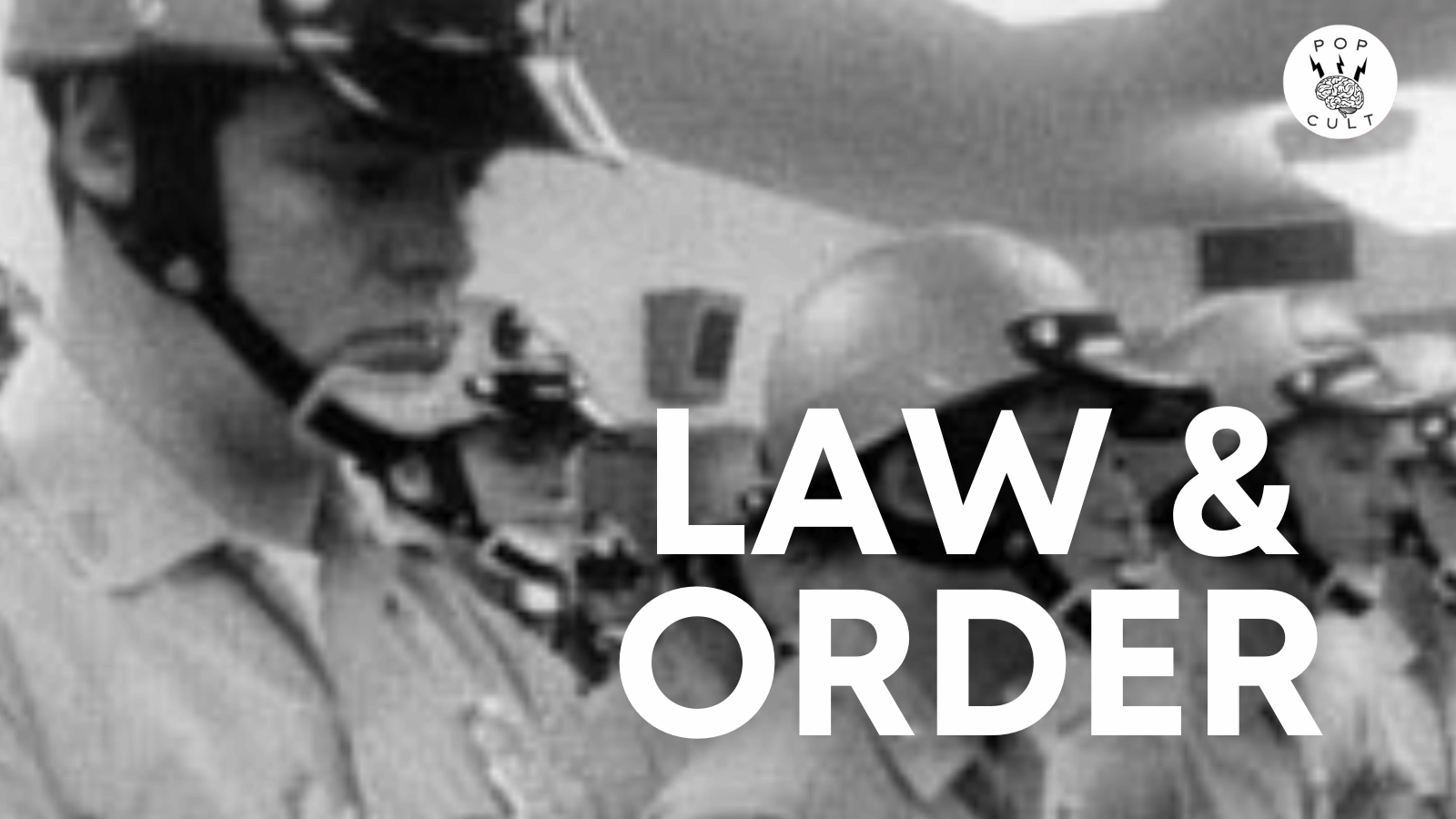
Law and Order (1969)
Directed by Frederick Wiseman
The police are not your friends. They are, in fact, an occupying force planted by those in positions of power who have tremendous wealth. The police are actually state-sponsored gangs, as you can see from their origins and the ongoing criminal money-making schemes so many of them have going on the side. Many articles on the Los Angeles County Sheriff’s Department’s deputy gangs and their activities can be found if you want to know more. This is standard practice when you give a select group of people in a society permission to commit nearly unaccountable acts of violence under the guise of “protect and serve.” In 2005, the U.S. Supreme Court ruled the police have no obligation to protect any person from harm. The police exist solely to protect the interests & investments of the ruling class. They would easily kill any one of us in service to that duty.
For his third documentary feature, Frederick Wiseman followed members of the Kansas City Police Department around the city for over two weeks. Throughout this time, he recorded police handling calls ranging from armed robbery to a domestic dispute between a landlady and her tenants to a lost child. Throughout each encounter, Wiseman is concerned mainly with the interaction between the police and the civilian. How does the officer speak to this person? How does this person react to the presence and authority of an officer? What we come to see is how little policing has changed in nearly sixty years, that these men given badges and guns seem to view the public with an intense level of disdain, especially Black people. And here, in black and white, we see mirror images of the violence that is all too common today.
Wiseman would later state that he went in with a very negative opinion of police but came out with a far more nuanced take. I don’t know how much I believe that statement because of what he chooses to show us. He may have said that because this was a production made for NET, the predecessor of PBS, broadcasted on television in 1968. My takeaway from the film is how inept the police handle any problems they get dispatched for. There’s a man blackout drunk on the sidewalk. The cops show up and stand around. A neighborhood woman explains that she knows the man. They wake the guy up and toss him into the truck headed for the drunk tank. Did anything happen here that will lead to this man recovering from alcoholism? Doesn’t seem like it.
Throughout the film, Wiseman juxtaposes the banal with the intensely violent. Two cops chat through their driver’s side windows as they’re parked, shooting the shit about salaries and promotions. Then we cut to a sudden chase through a building, a door is busted down, and a black woman in a nightgown is pulled out of her hiding place. This woman is choked so severely that her tongue literally hangs from her mouth as she gasps for air. We get snippets of conversation but enter the scene after the primary events happened. The woman is a sex worker operating out of a motel, the building we are in. Something happened between her and an officer. She claims he undressed and told her to service him or she’d be hauled in. Of course, that gets her verbally harangued by the white officer, forcing her back to her room. Had Wiseman’s camera and lights not been there, would she have made it out alive?
While Wiseman may have developed empathy for police in some part, my take from this footage is twofold. The police are both laughable jackasses but also drooling to inflict violence on anyone they can. Brutality seems to be the only thing the police excel at. There’s the Black woman mentioned above who is nearly suffocated unconscious on film. There’s also a Black teenager who attempted to steal a neighbor’s car. There are two or three Black civilians that help in catching the young man, but once he’s in the station being booked, you can see the cops barely holding back their grins. One of the officers promises he’ll make sure the teenager ends up in a terrible institution. Later, we see the same officer calling to confirm this has happened. Even later, he warns one of his colleagues there for the arrest that the young man is out and they should watch their backs.
The scenes of domestic conflict are where the police suddenly feel out of place. A young couple, the man likely cheating on his young wife who has just had a baby, got into a violent spat, and now their landlady doesn’t want them in her house where they rent a room. The police don’t have any tools to work through this, just broad threats that they better stop or the cops will be back. The film ends with another domestic conflict – an estranged husband and wife are arguing over custody of their child. The father has had his visitation cut back farther and farther. The attending officer gives the verbal equivalent of a shrug, leading to the picture’s final image of the husband running down the sidewalk. The police solved nothing, and from our present position, we can see all they do is create a looming threat of violence in any situation they enter.
This film was made shortly after the 1968 Democratic Convention in Chicago, which Wiseman attended. This event is notorious for the gross police violence caught on film against Vietnam War protests. The police were entirely in their element, then carrying out violence in the name of the fascist state. And in Wiseman’s doc, we see them entertaining another one of their pastimes – the infantilization of Black communities through police violence. Black people are treated like children, incapable of understanding what is happening to them. It’s evident through the tone and language used.
Wiseman excels in finding moments of near hyperreality. If you saw people speak and behave like this in a film, you would accuse them of overacting, but everything we see here is real. This leads to an odd sensation of the surreal; the people on screen become larger than life in our subconscious mind. Seeing a single moment in a person’s life this close-up and raw makes it feel more profound than that. We’re seeing a universal truth lived out by a human being. The next thing you realize is how these moments happen all around us; we just aren’t there to see them or have been distracted from noticing. More than anything, Wiseman’s work reminds us of the stories behind every human life. And looming in the background of all these narratives is an oppressive state force that wants to determine the direction of each life.

 PopCult Reviews
2 thoughts on “Movie Review – Law and Order”