
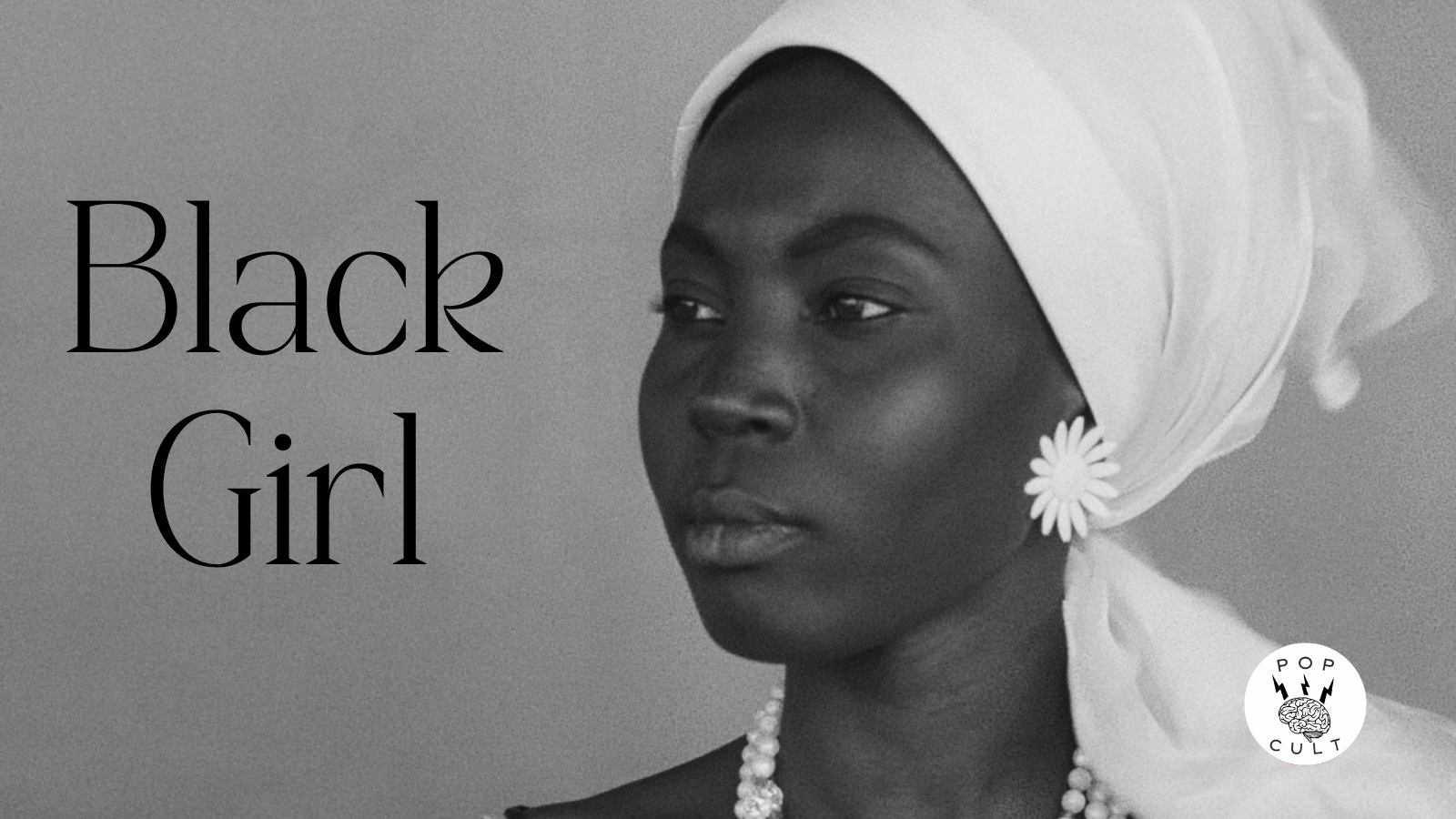
Black Girl (1966)
Written and directed by Ousmane Sembène
I had never heard of this film until a few years ago. I didn’t learn the name of its writer-director, Ousmane Sembène (pronounced Oos-man Sem-ben), until last year. I have to ask why that is. Why do I know the names and filmographies of a whole host of directors, but if I were to be asked about African cinema, I would draw a blank? At most, I probably could have come with Neill Blomkamp, a white South African. But no indigenous African filmmakers? I should have known who Sembène was long ago; he’s considered the “father of African cinema” and has been named one of the greatest authors of that continent. The reason I didn’t know this person was because the society I grew up in is profoundly racist, and so someone like Sembène is seen as unworthy of attention.
Sembène was a Senegalese artist born to a fisherman and his wife who lived along the Casamance River in the southern part of the country. Living under French colonial rule, he ended up speaking three languages fluently: French, Arabic, and his mother tongue, Wolof. His spiritual life was a mix of Islam (he attended a madrassa) and Serer, an indigenous religion that believes in a very active realm of spirits when humans pass into death. As a young adult, he served as part of the ironically named French Free Forces, infantry rustled up from colonized African people during World War II. After the war, Sembène became serious about his writing and became a labor activist. He stowed away to France, where he worked at a Citroën factory in Paris. The more Sembène saw of the French Empire, the less impressed he was, and the more he came to understand his people’s role in the systems of oppression, which led him to become a Communist.
Black Girl is the first Sub-Saharan African film to receive international acclaim, but it was not Sembène’s first. The plot is nonlinear, showing moments in the life of Senegalese woman Diouana as she lives and works in France as a domestic servant & her previous life back home. Promises have been made to Diouana by her employers that when she moves from Dakar to Antibes to continue working as their nanny she will have a cosmopolitan life the likes of which she can’t even imagine. The lure of Western consumption proves too much, and she departs only to discover the promises are hollow.
Diouana becomes overwhelmed with the increased workload, from caring for the family’s children to cooking and cleaning all day. It gets to the point where they won’t even let her leave the house because otherwise, they might have to do some domestic labor. The young woman decides that she can at least look “sophisticated” and dons a fancy dress and heels as she cleans, which earns her the wife’s admonition, not to forget she’s just a maid. During a dinner party, the couple’s friends view Diouana as an exotic novelty, one of the men kissing her on the cheek in the French style and remarking with glee how he’s never kissed a black girl.
Sembène uses this story to address the exploitation of African people by colonial forces. Throughout the film, we’re shown a wooden African face mask. Diouana purchases the mask from a boy in her community and gives it to her French employers while they are still living in Dakar. It joins a collection of similar artifacts they have amassed on their walls. When the move to Antibes occurs, the only mask on the wall in the new house is this black mask against a stark wall of white. The mask & Diouana are meant to parallel each other. Before, she was surrounded by others like her, but now she is alone.
There’s significant meaning to the mask for Sembène as these objects were a substantial part of his Serer religious upbringing. Masks contain the spirits of the dead. They can remind the descendants that their ancestors are still watching over them, but they can also haunt the colonists who take them as decoration for their homes. Diouana is a similar ornament for the French family, a means to impress their friend with how “traveled” and “cultured” they are. However, the French family abdicates their humanity by consigning another human being to such a role.
Diouana is hired out of a group of women who stand on the side of the street waiting for opportunities from the French who live in Dakar. She’s picked explicitly because she’s not “pushy” like the other women. She and these other Senegalese women all want the same thing, though – to escape life under colonialism and live in the utopia of France. This is a common belief throughout the colonized world, reinforced by the occupying force. The European homeland is what the indigenous should pledge allegiance to, a fantasy world they have never seen or know much about.
As extraction economies take over the colonized land, life becomes more brutal, and labor is extracted at minimal cost because the humanity of the African people is devalued. Any rational colonized person would want to go to the “promised land” because those from that place seem to have an easier life. Yet, in almost every instance, the colonized will discover they are relegated to even less than second-class status in the homeland. They are ironically seen as invaders despite growing up being told they are part of this empire. Diouana is not seen as a human being with inherent dignity and deserving of love & care. She’s a curiosity to be gawked at and posed.
Ousmane Sembène would spend his career making pointed critiques of the French empire, colonialism, and even his countrymen’s desire to emulate their oppressors. As we continue on our journey, a survey of selected films, we will see all the ways European colonizers inhibited the culture, the people, and the progress of the African continent and even made them turn against each other.

 PopCult Reviews
One thought on “Movie Review – Black Girl”