
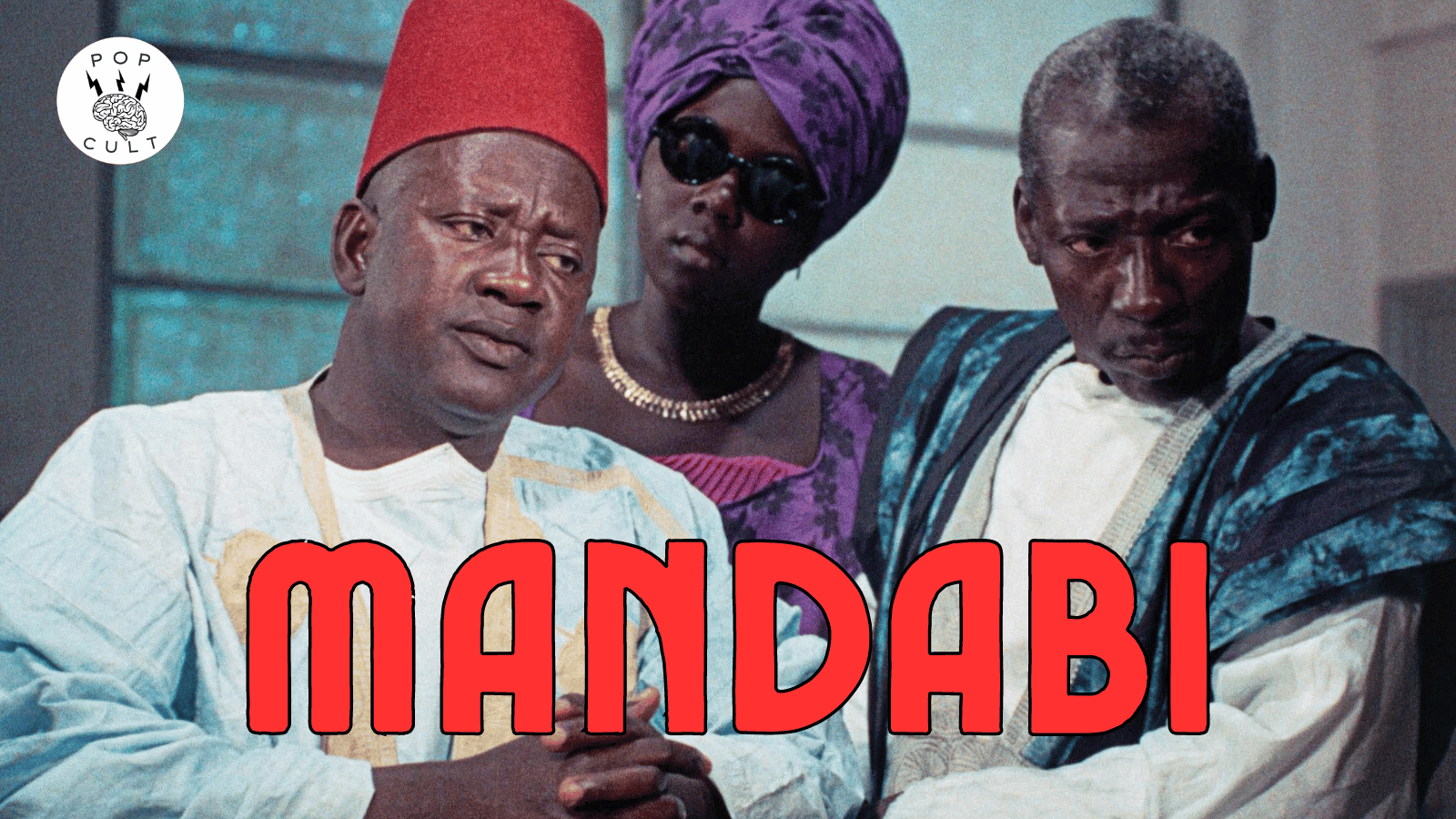
Mandabi (1968)
Written and directed by Ousmane Sembène
Despite the brutal French colonial presence in Senegal, most Senegalese do not understand or speak French. This led Ousmane Sembène to want to make a film entirely in the indigenous tongue of Wolof. Like most of Sembène’s work, it was almost lost to us. Film prints were locked away in vaults in France. Sembène’s son, Alain, and filmmaker Martin Scorsese worked together, slogging through bureaucratic hell to get the films in their hands for restoration.
(On a side note, it disheartens me how for a portion of the American populace, it has become in vogue to shit on Martin Scorsese. This comes from two places: film bros who don’t understand his work and cause others to shy away from it based on their incorrect readings & a population lacking significant media literacy. When Scorsese passes away, his more substantial legacy will be the prolific world cinema preservation he has done using his clout in the industry. I don’t think many directors love films at the Scorsese level.)
Ibrahima Dieng is an unemployed Senegalese man living with his two wives and their children in Dakar. One day, they receive a money order from his nephew, who lives & works in Paris. The amount of the order is 25,000 francs. Ibrahima is to keep most of the money and give a portion to his sister, the nephew’s mother. There’s a problem when Ibrahima goes to cash it at the bank. He has no identification. To get an I.D., he must get photos. However, the photos cost money he doesn’t have. To get that money, he has to go into debt. Meanwhile, neighbors have heard about the money order and keep popping by to remind Ibrahima how much they’ve always respected him. Mbaye, another of Ibrahima’s nephews, has offers from a French businessman to buy his uncle’s property and sees this current situation as something he can leverage to his advantage.
It was serendipitous that I would watch this film after recently reading Frantz Fanon’s The Wretched of the Earth. I can see Sembène was developing those same post-colonial ideas through themes in the picture. While what happens to Ibrahima is done by his fellow citizens, it is a direct outgrowth of generations of French control. Fanon explained in his writings how the colonized often take on the traits of their former occupiers in a way that only keeps them under the thumb of a foreign power. The bureaucracy maintains French as its central language, so Ibrahima must seek out translators to help him accomplish even the smallest of tasks. French is seen as the language of “serious people,” while the native Wolof is considered the tongue of “backward people.”
The central idea of Mandabi is that African people cannot take European money without a high cost. It’s a metaphor for the various “development funds” that former colonial empires now offer to extend their hold on extraction economies. The money is not given in good faith, but with strings attached that almost always results in the receiving country ending up worse off than when they started. Capitalism is allowed to fester, so only a handful of native people, typically of the formally educated class, end up profiting while the majority suffer.
Sembène isn’t just critiquing the continued effects of French colonialism; he also speaks to his fellow Senegalese about where they are not moving forward. In Fanon’s work, he wrote about the instinct of many colonized people to want to turn their indigenous history into a mythologized Golden Age. Fanon and Sembène both argue that pretending that native societies were flawless before colonization is something the colonizers do. Look at how America turns its history into a whitewashed fairy tale or similar behaviors in Europe and other empires. Sembène would argue that religion impedes progress because it stokes people’s fear of change. Skepticism is good, but irrational fear gets us nowhere.
Mandabi is a beautifully shot film with such a well-developed story. The colors are exceptionally bold & vibrant, and Sembène reminds us that Black directors know how to film Black people better than others. He can get the perfect lighting and angles to make a spectrum of skin tones visible in ways Western cinema fails. Barry Jenkins has spoken numerous times about how Black people were so poorly lit & shot throughout most of film’s history, something he has made a focus of his work. Sembène pulls that off wonderfully.
Mandabi is also a hilarious satire. I found the Ibrahima character to be a Senegalese version of a role W.C. Fields might have played. He’s a not-too-bright guy who likes to puff up his chest and wear ludicrously ostentatious clothing to play up a wealth he does not have. The interactions between Ibrahima and his wives reads just like Fields’ scenes with his movie wives, especially in his feature The Bank Dick. The parade of vultures that stop by for a chat adds to the comedy because they are so transparently only interested in a portion of that money. The best comedy comes from the moments when they realize they aren’t getting any, and suddenly, all that goodwill crumbles away.
There’s often an assumption that the further you get from Hollywood, the more “inaccessible” a movie is to Western audiences. Mandabi is a movie Western audiences can easily comprehend. It touches on anxieties that are universal while also illuminating the experience of Senegalese people and how colonialism has warped their relationships with each other. Money is an essential part of life under the systems imposed on us, yet it always exacerbates problems. As a communist, Sembène wants us to be honest about this fact, if nothing else. He also highlights that the purpose of most Western bureaucracy is to impede people, not to help them in any meaningful way. This will certainly not be Sembène’s final word on capitalism, but it is one of his finest.

 PopCult Reviews
2 thoughts on “Movie Review – Mandabi”