

A Touch of Jen by Beth Morgan
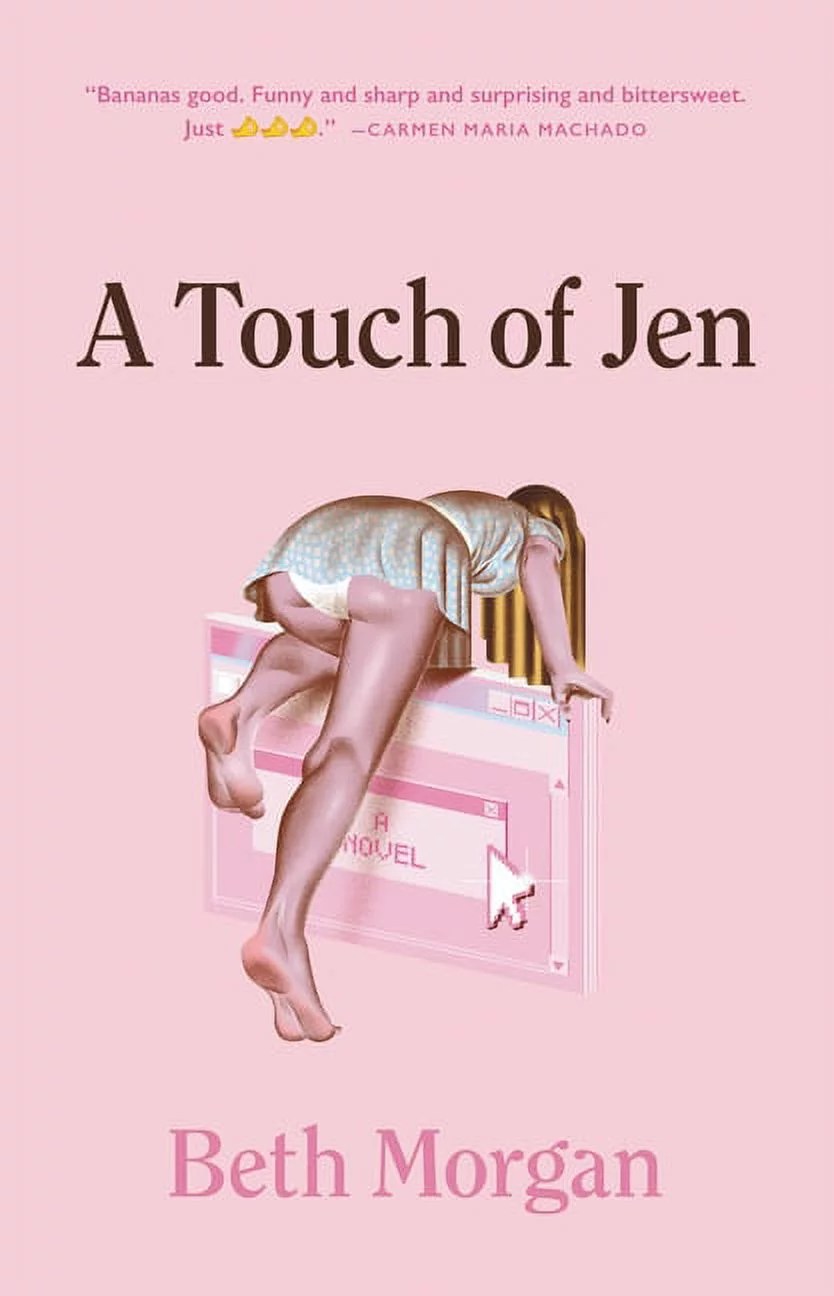
What a strange book. Remy and Alicia are an odd couple. One of their favorite pastimes is to scroll through Jen’s social media profiles and make fun of her. Jen’s a former co-worker of Remy’s from when he was a waiter. Alicia clearly has insecurities because Remy has the hots for Jen but pretends he thinks she’s a pretentious basic bitch. Things have evolved into a weird sexual roleplay where Alicia will pretend to be Jen while Remy pretends he doesn’t like it. That’s not where the strangeness ends. Alicia insists strange noises are coming from the kitchen in their apartment at night. Remy says it’s probably just their roommate.
The book’s first half or so is its best part. That portion explores parasocial relationships and the sick depths many people go to while fostering these artificial, toxic connections. I loved how Remy and Alicia were saying and doing very sick things while not reacting to them in that way. Their casualness about their weird habits is what makes it so unsettling. Things get even more bizarre when they run into Jen and get invited to a weekend at her boyfriend’s beach house. The book still had me through that section. Then, we get to the final act and the twist.
In an unexpected turn (though I can see small ways the author is setting it up beforehand), we dive headfirst into zany psychedelic horror that I’m not sure hits quite right. The multiverse is brought into the conversation at one point, and that is when much of my love for the book started to go. It’s not the worst thing I’ve ever read, but it doesn’t feel like it stuck the landing that was being set up at the start. I saw some people online making comparisons to Darryl by Jackie Ess (a book I loved!), and if Jen hadn’t taken that wild left turn, it might have been up there for me, too.
Dune by Frank Herbert

So, I only read a little in March/April because this one took up almost all of my April. I’ve wanted to read Dune for a while now, and after seeing the second part of the recent film adaptation, I decided to finally do it. Part 2 provided enough new details I wasn’t aware were in the story that got me curious. I still think Hyperion by Dan Simmons is my favorite science fiction novel; Dune has some incredible world-building from start to finish.
You know the story. Paul Atreides watches as his family’s House falls at the hands of the treacherous Baron Harkonnen and the Emperor. It all happens on Arrakis, a desert world which produces the Spice, a substance that enables all sorts of advancements in humanity. Paul comes to believe he is the prophesied messiah that will liberate Arrakis from the control of the Houses. By the end, Paul does become *a* messiah, but it doesn’t seem like things will get better, just worse in a different way.
One observation I made about Dune was that most of the first section is about a person in a room, and another person comes into the room and talks about something that happened a long time ago or between chapters. I don’t know why, but I found that so funny as it happened chapter after chapter. Paul comes into a room where the Bene Gesserit Reverend Mother is sitting. Paul is in his room, and Doctor Yeuh comes in to talk. It’s not the most creative structure to deliver exposition, but it is very readable.
Things get more interesting once the coup occurs, and Paul and his mother, Jessica, end up joining the Freman. The amount of terminology in the book is awe-inspiring. Seeing multiple film adaptations helped in contextualizing everything for me. I remember trying to read this when I was around thirteen and getting lost very quickly. It may have just been that I was so young, and a few years later, it would have been a cinch. However, understanding the various names of the messiah made it less confusing when I was reading through bits where people were throwing around terms like Lisan al-Gaib and Kwisatz Haderach like crazy.
I felt the book showed me how much influence this story had on something like Game of Thrones. People make the Star Wars connection, but that’s a very thin connection at most. The courtly intrigue being preferred over action set pieces makes that obvious. I’ve always found well-written dialogue between people attempting to exert control over the other more enjoyable than pages of physical combat being described.
The book also cemented Lady Jessica as one of the most complex villains I’ve ever seen. Harkonnen is an easy villain because he’s so disgusting, and the same goes for Feyd Al-Rautha because of his murderous tendencies. Jessica is a perfect zealot villain in that she is convinced what she is doing is right while ignoring that part of this mission is driven by her ego and resentment of the Sisterhood. There’s also the revelation of her parentage and how that drives her down this path. When I call Lady Jessica a villain, what I mean is she is an excellent example of a person who has convinced themselves that what they do is righteous while ignoring the underlying personal hate that is driving it. It is the central aspect of potential villainy that lives within us all and that we must watch over.
I also loved how abruptly the book ended. There isn’t closure, which makes it resonate for longer. We have this crescendo moment where Paul has defeated his enemies, and Chani sees the edge they’ve come to. The final line is Lady Jessica’s, and it underlines a big reason why things have descended into madness, why the Freman are now going about to commit nuclear genocide on a large swath of the known universe. Jessica tries to comfort Chani by telling her they, the concubines, will be remembered in history as wives. It’s chilling. I agree that Jessica should not have been limited in her relationship with Duke Leto, but the extremes she goes to by the end of this novel are wild. What a fantastic character with such complexity and relatable but terrifying motivation. I definitely plan on reading Dune Messiah sometime in the near future.
Having and Being Had by Eula Biss

I am not a big reader of memoirs. I don’t find the genre all that appealing. However, I heard good things about this one and decided to pick it up. My conclusion was that I am still not a big fan of memoirs. Eula Biss is a professor who lives in Chicago, and when the book opens, she and her husband have just purchased a house in a predominantly Black, low-income area of the city that is being gentrified. The book is about Biss reflecting on the role of money, consumption, and capitalism in her life while wrestling with her mixed feelings about buying this house.
I didn’t encounter any ideas I hadn’t read in other places and had better developed. I became annoyed with the author at a certain point because her central message seemed to be, “It’s difficult living with so much privilege in our modern world.” She is genuinely sympathetic towards her neighbors who feel they are being pushed out and casts a judgemental eye towards her peers who waltz through life, never seeming to think about the plight of these people.
However, she just sounds like another white U.S. liberal trying to be part of the destructive consumption while feeling sad about it. Don’t buy the house if you don’t want to participate in gentrification. I already hear the excuse: “But if I didn’t, somebody else would have.” Okay, then let them. You still won’t have to bear the guilt. The reality is Biss loves her new house, and the guilt of imposing herself along with other monied white people into this neighborhood isn’t bad enough that she wouldn’t do it. I just don’t get who this is for. I don’t think there is a dearth of rich white people’s voices in the conversation on class and privilege at the moment.
Having and Being Had forever floated on the surface of the ideas it wanted to bring up. Biss uses a lot of academic quotations and references many sources to lead into her meditations on privileges. I personally found them to be a method of distancing me from her. There’s minimal questioning about the machine Biss exists within, and even less action is being taken to counter her supposed guilt. Like most white U.S. Liberals, she’s terrified of forms of Leftism that would actually solve these problems, so she just laments about how bad things are and how sad it all is.

 PopCult Reviews
One thought on “Book Update – March/April 2024”