
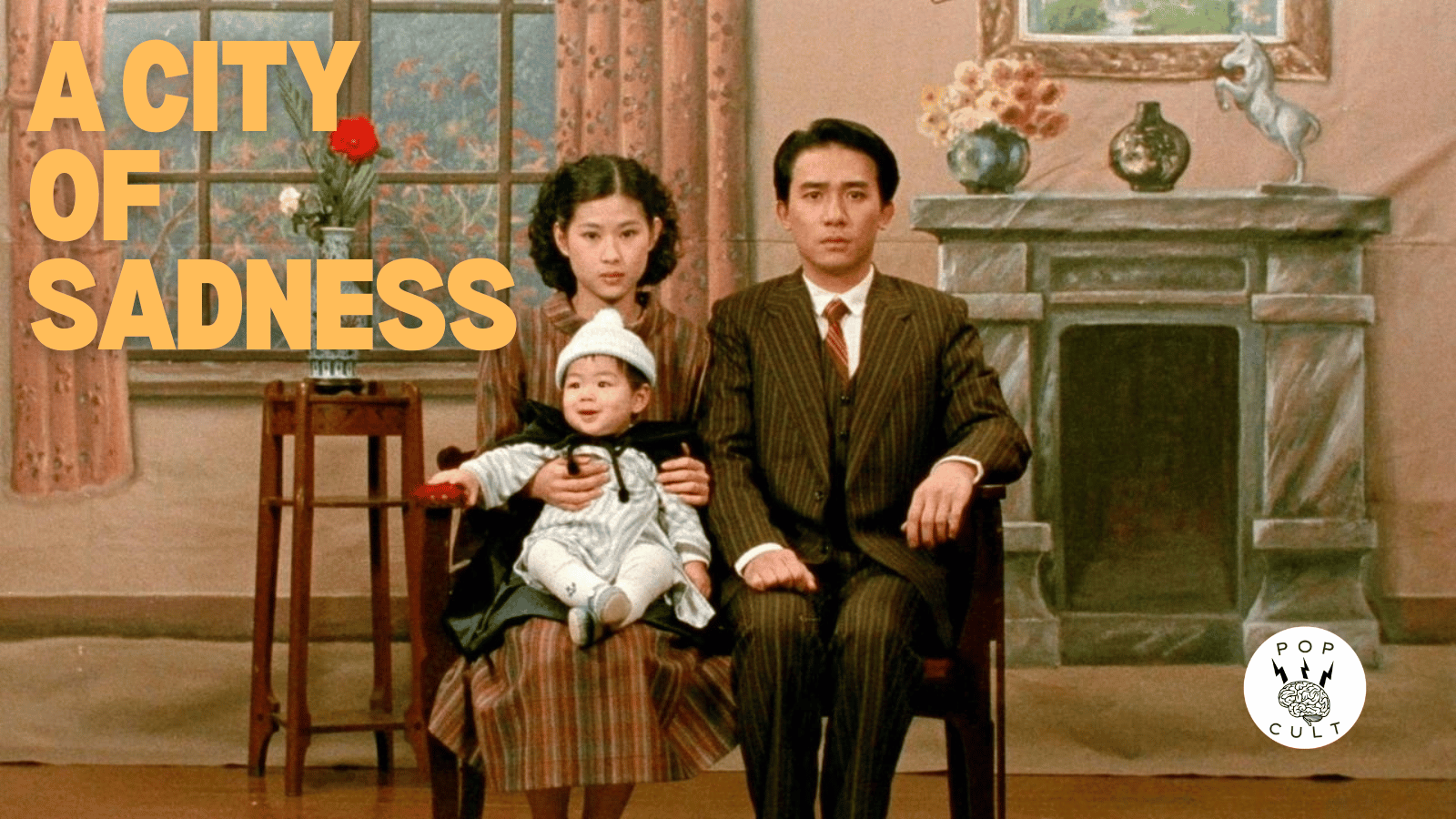
A City of Sadness (1989)
Written by Chu T’ien-wen and Wu Nien-jen
Directed by Hou Hsiao-hsien
I have to admit I do not know as much about Chinese history as I would like to. I’m going to guess that most people reading this, if they live outside of China, probably fall into that category, too. The relationship between mainland China and the island of Chinese Taipei is complex and has not been made any easier due to Western interference. The political group that fled from the mainland to Chinese Taipei was the Kuomintang, a nationalist organization that pushed far right-wing ideology. Hence, they were driven out by the Communists after the still-dominant party attempted to work the Kuomintang. Modeled after many Western fascist parties, Kuomintang brought their particular twisted worldview to Chinese Taipei, which is what this film is about.
The Lin family lives on the coast near Taipei. The Japanese have ended their fifty-year colonial rule of Chinese Taipei following World War II. The film begins with Emperor Hirohito announcing his surrender, and the Lin family is elated. Finally, after so long, the tyranny ended. This causes a flood of people from the mainland, among them Kuomintang, gangsters, and communists. The four brothers that make up the Lin family are experiencing a variety of things during this period of turmoil. The eldest, Wen-hsiung, runs a bar and is expecting his first child. The youngest, Wen-ching (Tony Leung), is a doctor and photographer who became deaf after a childhood accident. He also has strong Leftist beliefs and sees terrible things on the horizon.
The second eldest brother disappeared in the Philippines during the war. The third brother, Wen-liang, worked as an interpreter for the Japanese in Shanghai. With the Japanese withdrawing, he is taken prisoner by the Kuomintang, who torture him so severely that he has to be committed to a mental hospital. He recovers to an extent but gets involved in criminal activity, which worries his brothers. Wen-ching has problems as well. He is close friends with Hiroe, a Japanese woman whose family has made Chinese Taipei their home. It all leads up to the February 28 Incident when the Kuomintang began a brutal crackdown and slaughter of anyone who opposed their rule.
Because A City of Sadness follows one family, we see the events through the fragmentation of the brothers. Each of them feels broken, adrift in a world reshaping itself into something far from the freedom the people have hoped for following the Japanese withdrawal. These are people who have lost a sense of identity. They have become a parcel of land passed around by those with imperialist notions, so it makes sense that such a strong sense of disconnect penetrates the film. The act that triggered the February 28 massacre was over someone illegally selling cigarettes; something so minor is allowed to become a powder keg that devastated society.
Films like this serve as a reminder of how chaotic periods of change are. I appreciated that the film provides no resolution for what unfolds. It is history, and so it continues on when the movie ends. People’s lives are upended. If they survive, they try to put the pieces back together, but things will never be like they were before. There are moments of such profound melancholy here, where you can watch characters slowly become jaded to the immiseration inflicted upon them. Some characters make it to the end. Others are killed. Some survive, but not in one piece, stumbling around like ghosts.
Director Hou Hsiao-hsien doesn’t spend much time unpacking the politics here. He understands you have the history books for that. Instead, he uses the Lin family to explore how people got through these times. Tony Leung, as Wen-ching, is incredibly strong and gives a wordless performance. His pensive face always seems to be anticipating something that will devastate the direction of his life. The decline of things is so gradual, like the ground crumbling out from beneath its characters’ feet. We see it coming, but it’s happening so slowly that it doesn’t seem too bad. Then it arrives.
We often think about wars as neatly contained in compartments of a few years. Colonialism upends that idea; it is a war against people that goes on and on and on. As one ruler recedes, another takes its place. Persecution is a daily event. Those with designs on power have to keep the masses broken. If we could muster together an iota of solidarity, these rulers would be in trouble. So, you divide people and sow seeds of chaos. Nationalism, in particular, is an insidious dogma that works to plant the national identity as the primary marker over family, friends, and even humanity. Hou Hsiao-hsien delivers something so achingly honest in this film. I am curious to learn more details of the history to better understand what the filmmaker was trying to say.

 PopCult Reviews
One thought on “Movie Review – A City of Sadness”