
While the hit Netflix series Stranger Things was inspired by classic games of Dungeons & Dragons, it seems like a no-brainer that someone would develop a tabletop RPG system to make playing the show possible. That’s the basic premise of Kids on Bikes, a game where players are the inhabitants of a small town where mystery and horror are bubbling to the service. Despite the title, PCs can be kids, teens, or adults and use pre-made archetypes to quickly take on a role you would expect to find in such a story. A unique powered character is shared narratively between all the players, a la Eleven or E.T.
Kids on Bikes handles its world-building as a session-zero collaborative task. During this activity, players will determine the name of their town, its biggest industry, what it is both famous & infamous for, notable organizations & landmarks, and rumors. The GM will use these elements to construct the core mystery the characters will investigate. I personally think collaborative world-building is the default way of running a campaign. Some may prefer a GM who slowly unfolds a world of their construction, but part of the fun of playing a game for me is creating that setting with everyone else at the table.
Character creation is made simple through the use of Tropes. These are character types you might expect to find in this kind of story. Tropes include the likes of Brilliant Mathlete, Funny Sidekick, Popular Kid and more. Some are labeled as Kid/Teen, Teen/Adult, Adult, or Any. Each Trope includes stat dice, your suggested bike, Strengths, Flaws, and two questions to help further develop the characters.
Stats are Brains, Brawn, Fight, Flight, Charm, and Grit. It’s these stats where the game adopts a unique system. Instead of assigning scores, you assign die types from d4 up to d20. The higher the die, the stronger your character is in that stat. A d4 reflects something the character is terrible at; a d10 is just above average, while a d20 is a sign your character is highly skilled in that area. Based on what age range you choose to play yo,u get a small bonus of +1 to two of the stats. Adults get a +1 to Brains and Grit simply based on life experience, while Kids get a +1 to Flight and Charm.
Characters also have a Knack, which allows you to get an automatic 10 result once per session. This is something your character has a particular skill for. This involves taking a general skill – “competitive gymnast,” for example – and using that in a situation that might be outside the standard setting for that skill. A gymnast would be good at landing on their feet or balancing as they walk the edge of a roof.
You’ll also have a Fear that the GM can use, Obligations that create story complications, and items you carry in your Backpack (Trunk if you are an adult character and don’t want a backpack). The items in a Backpack can also be figurative. If your character is a kid with a secret hideout treehouse that can be included, or if you are an adult who grew up poor, you might always be good at finding things for cheap or free.
Your bike also brings abilities with it through its color and accessory. A Blue bike adds a +1 to Charm checks, while a Rusty bike gives +1 to Grit checks. A Banana Seat on your bike lets you carry an extra person while Trading Cards in the spokes add +1 when attempting to distract others. By the time you finish character creation, you’ll have a strong sense of who this person is and a list of special abilities they can perform.
Failure in the game is rewarded through Adversity tokens. These can be used to 1 to a check per token, to activate your character’s Strength, or to ignore a Fear when the GM brings into the scene as an obstacle. Failure should narratively hinder the character, but the Adversity token means that at some later point the character should be able to achieve something. Players start with 3 Adversity tokens when the game begins and are expected to be spent and given out reasonably frequently.
Kids on Bikes also has its version of the Exploding Dice mechanic called Lucky Breaks. If you roll the highest value on a die, you roll again and add both results to get your total. If you keep rolling the maximum amount, you keep rolling again until you no longer hit that top number. In the narrative, the characters are achieving something beyond what they usually could, so this should be reflected in how it happens. What is causing this sudden surge of success? External supernatural elements? A boost in confidence? It could be something that helps or something with a cost that arises later.
Stat checks are separated into two types: Planned Actions and Snap Decisions. Planned Actions are things the characters would have time to discuss and develop strategies over. Think of Kevin in Home Alone. He has a day to set up traps around his house to hinder the Wet Bandits and plan an entire escape route through his home. Snap Decisions must be made under pressure or in dire circumstances. The game includes a handy flowchart that guides players through deciding which type is happening and how to roll accordingly.
When the GM uses a character’s Fear, it changes how the player can respond in several ways. First, they are rolling as a Snap Decision, so there is no planning or time to think. Secondly, you cannot share your Adversity tokens to help a friend; you only use them for yourself. Lastly, depending on how severe the Fear is, the player may end up rolling with a -3. If the GM allows, a player can spend an Adversity token to ignore their Fear, but that decision has to be made before any stat check rolls.
I will explore the mechanics of the Powered Character more when they appear in our story. I will also use Jeansen Vaar’s Plot and Scene Unfolding Machines in play and discuss them further in the next session when we start to play through the story.
As I was trying to decide what sort of character I should play in a solo version of Kids on Bikes, I came up with something inspired by some recent viewing. These types of movies seem like the same thing you’d find in an Ernest film—Ernest Scared Stupid specifically. So, I decided to create a knock-off of Ernest, who will be my player character.
First, I had to create my Town, which I have detailed below, using the template provided by the game
- Our adventure takes place in Westgrove, USA – the crossroads of many other big cities
- The industry our town is best known for is copper mining
- Our town is famous for its high school football team, which has won the state championships for the last 12 years
- Our town is infamous for the moonshine produced there during Prohibition
- Economically, our town is starting to stagnate, and one effect of that is…
- Notable local organizations are
Concerned Moms for Decency – conservative censorship group
The Westgrove Historical Society – preserving local history
Oak Fortress Global – a corporation that wants to turn the woods into a new land development - Notable local landmarks are
The Westgrove High Football Arena
Paolo’s Ice Creamery
Gordon-McClain Library
Winslow Heights – the old affluent neighborhood - Our school’s mascot is The Fightin’ Geese
- The town closest to us is named Estry Lake, and our relationship with that town is caught up in a healthy sports rivalry
As for Rumors, I rolled on an oracle and developed the words I was given into something more substantial:
vanishing villagers – children from Westgrove started disappearing two months ago; it’s up to four now, and the town believes something sinister is out in those woods
cursed statue—Abel Schmitt, the sculptor of the statue of Enoch Varney, the founder of Westgrove, is said to have been an occultist who imbued his own blood into the metal. Kids say the statue of Enoch moves around at night and is responsible for strange incidents discovered in the morning.
forbidden magic – Sally Gilliam is a strange old lady living in the woods outside of Westgrove. The Kids call her the Wood Witch and say any child caught on her property will be cooked and eaten by her.
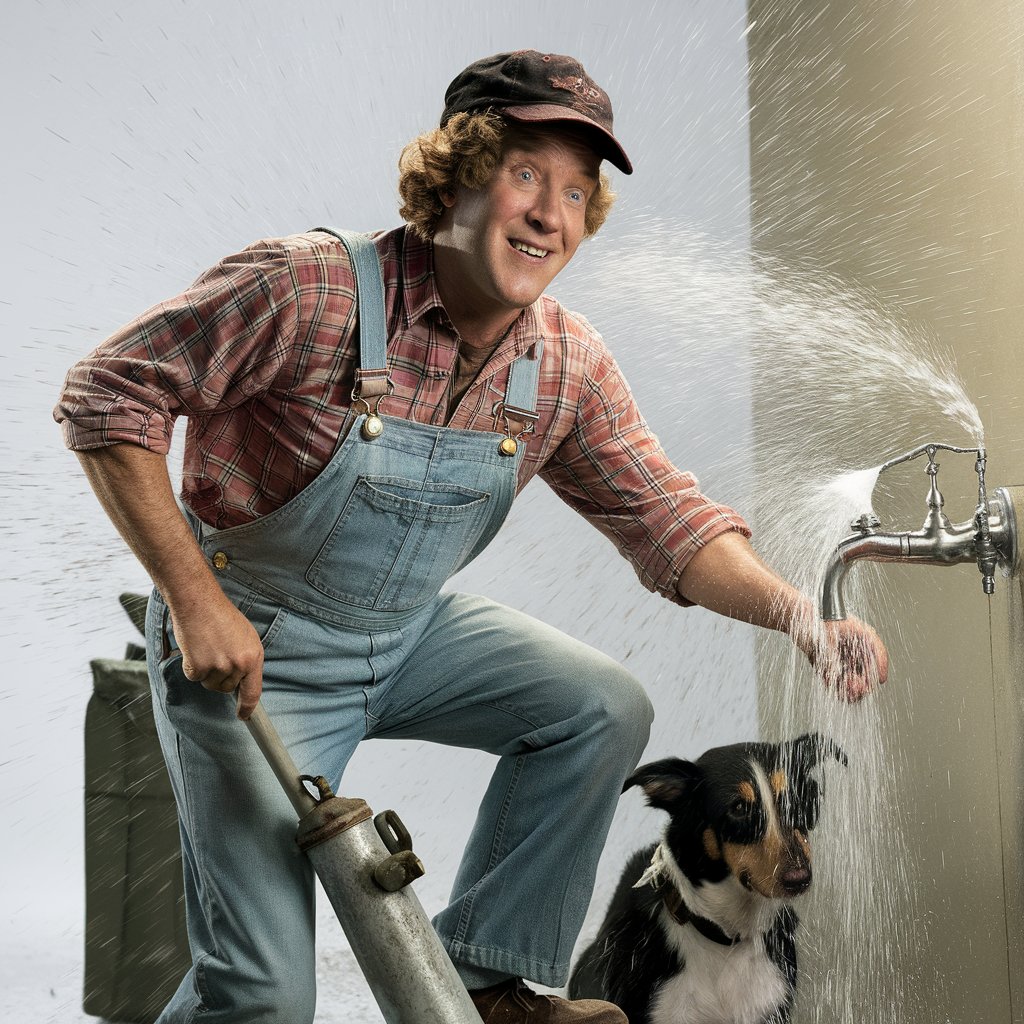
Our player character will be Waldo T. Holman, the custodian at Westgrove High. He’s a know-it-all type but always gets injured in ludicrous ways due to overlooking apparent dangers. He wears a trucker’s cap, blue jean overalls, and plaid shirts. Waldo’s regularly used catchphrase in response to almost everything is “Ain’t that sumthin’?”
For Waldo’s Trope, I chose Freakazoid. While the book lists this as a Kid or Teen Trope, I felt that a character like Ernest is extremely childlike, so it worked for an Adult, too. Appropriately, I got a d20 in Flight (running away) and a d4 in Brains. For a Strength, I chose Lucky, which lets me spend 2 Adversity tokens to reroll one stat check. For a Flaw, Absent-Minded seemed perfect, reflecting my character’s simple way of thinking and missing details.
For Fear, Waldo grew up hearing ghost stories about Westgrove and surrounding woods, which has terrified him at even the implication that any of it is real. Waldo’s Knack is “accidentally stumbling across a clue,” which should help progress the plot at least once per session. As for his bike, Waldo rides a Purple one, which lets him treat Snap Decisions as Planned Actions. That bike holds a Basket that, once per day, can be reached into and one mundane object of my choice will be there.


2 thoughts on “Solo Tabletop RPG Review & Actual Play – Kids on Bikes Solo Part One”