
You can purchase The Location Crafter here.
Read my brainstorming session in our first part here.
The Location Crafter is another solo play tool created by Tana Pigeon, designer of the Mythic GM Emulator. This module is intended to solve a problem of solo play – how to keep the fun of being surprised during exploration in a way that mimics traditional tabletop roleplay rather than Choose Your Own Adventure. In this way, you can have a framework but not feel like the story is on rails.
The remedy for this is implementing a variation on Mythic’s Lists. Some find Mythic to be a lot of paperwork, which I can understand, but folding in each piece one at a time helps ease the sense of feeling overwhelmed with procedures. Starting with something standalone like The Location Crafter is an excellent way to integrate these systems.
You begin with a Region, the place where the characters will explore. It can be any size and style. What the Crafter will be doing is creating an abstraction of that space to explore. You can make a concrete map using this, or it can be a looser idea of narrative exploration. Each Region is composed of three elements: Location, Encounters, and Objects. The player will make a list under these headings through dice rolls. Randomized combinations will be created that generate scenes to explore.
Locations are the physical areas in the Region. The torture chamber of a dungeon would be a region. The medbay on a starship. The hidden room in a large mansion. Encounters are typically people or creatures that the player can interact with. These are the active parts of the Region, the things that do stuff and can change the course of the narrative. An Encounter could be a guard, a rat, or the Big Bad Evil Guy himself. Finally, the character can run across Objects that play an essential role in the story. They could be as general as a chest or key. They can also be more specific, like the Infinity Gauntlet or the Holy Grail.
In crafting a location, you are encouraged to generalize things for the first six items. When exploring the Location, the player will roll a d6 up to three times, combining the Location, Encounter, and Object into a scene. You track a Progress Score for each Category, one point for each discovery. The next time you roll on that Category, you add the score to the d6, which “unlocks” more items further down on the list. If you ever roll over the number of items on a list, you treat the scene as Expected – i.e., the place, the encounter, and/or the object are completely what they should be based on the story’s momentum.
An item of Complete on a list represents that the specific Category has been exhausted, and the character has explored it fully. None means whatever that Location is won’t have an encounter attached. A few items on these lists should be marked with a U for Unique. Once a Unique item is encountered, it is crossed off the list, representing how it was a one-off encounter.
The biggest challenge with this is shifting from a concrete linear way of thinking about narrative & locations and leaning into the emergent narrative of solo play systems. The Region you create here will be a pool of narrative elements that will be used to create combinations that should inspire a direction for the scene based on previously established moments. The non-unique elements mean a character may revisit one of the three elements, and based on what has happened up to this point, that element will change from the last time you encountered it.
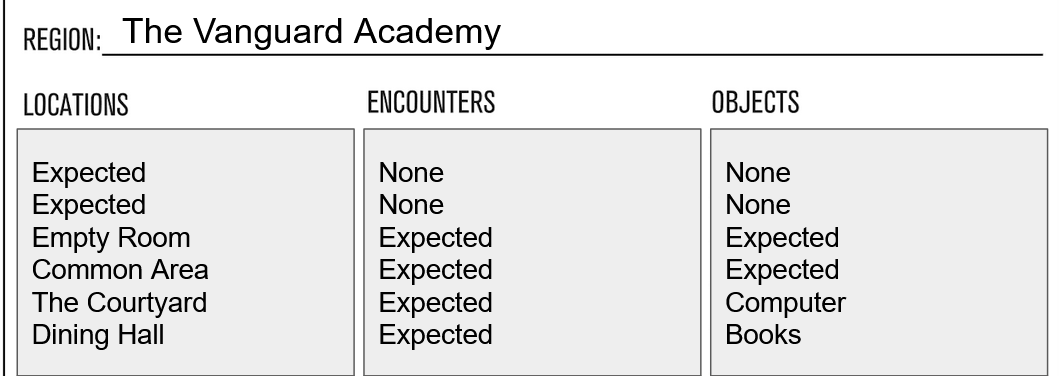
My Region will be The Vanguard Academy. I also want those first six slots for Locations, Encounters, and Objects to be reasonably generic but setting-specific to allow room for scenes in this Region to unfold close to the comic book tropes at play. This means I am using a lot of Expected and None tags to ensure that. You can see the top six below.
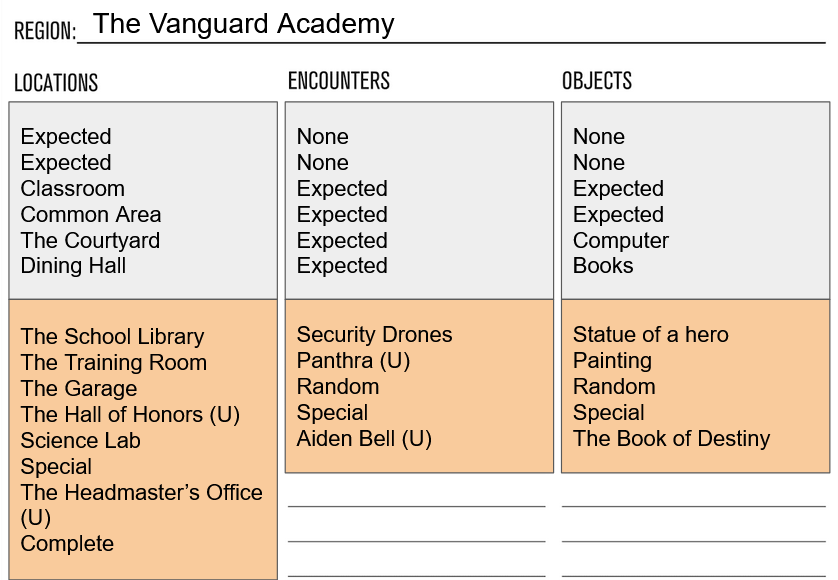
Then, I started filling out the more specific parts of the list. I definitely wanted an encounter with Aiden Bell, the headmaster. Such an old, storied superhero school would have a museum, hence the Hall of Honors Location. The only unique Object I could think of was The Book of Destiny. The thing about these lists is that they are not final. You can always revise once you start playing as new things come up. You can even put items after a Complete tag, which means there could be things on the list the character never discovers. I look forward to seeing how this works out when we play with our system (still to be determined). See the complete list below.
Next, in our solo world building series – we play solo Microscope using the Signal Light superhero expansion.

 PopCult Reviews
3 thoughts on “Solo Tabletop RPG – Worldbuilding: The Location Crafter Part Two”