
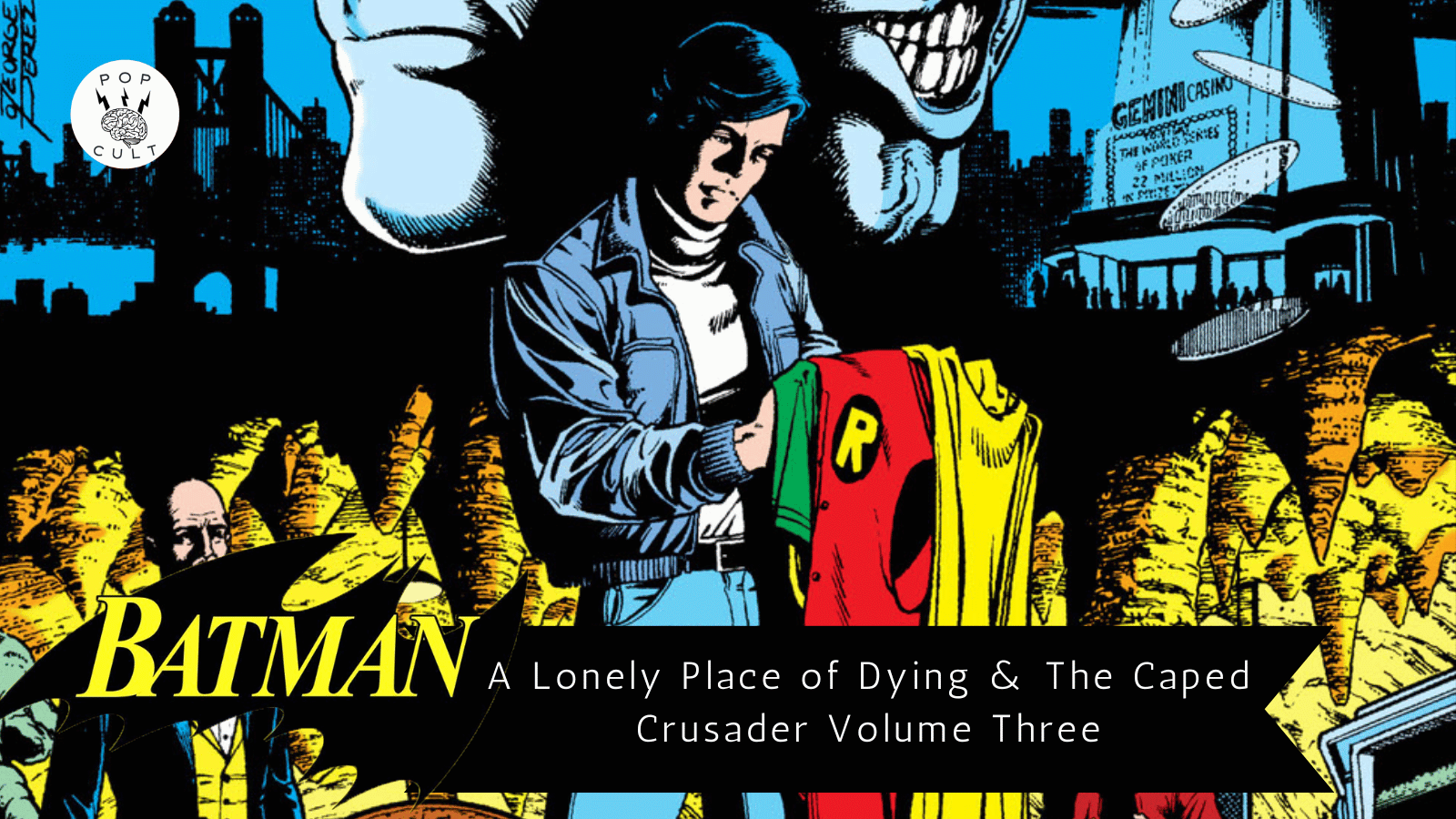
Batman: A Death in the Family (2011) – “A Lonely Place of Dying”
Reprints Batman #440-442 and New Titans #60-61
Written by Marv Wolfman
Art by Jim Aparo, George Perez, and Tom Grummet
Batman: The Caped Crusader Volume Three (2019)
Reprints Batman #445-454, Detective Comics #615, and Batman Annual #14
Written by Marv Wolfman, Alan Grant, Andrew Helfer, and Peter Milligan
Art by Jim Aparo, Norm Breyfogle, M.D. Bright, Chris Sprouse, and Kieron Dwyer
In November 1988, Jason Todd, the second young person to hold the title of Robin, was murdered by the Joker in the pages of Batman. In March of that same year, The Joker shot & paralyzed Barbara Gordon (Batgirl) and kidnapped & tortured her father in the one-shot graphic novel The Killing Joke. Things had taken a dark turn for Batman. Tim Burton’s 1989 feature film furthered that with a Gothic, haunting version of the character and his world.
Since Jason had been killed (by fan vote, no less; how macabre is that?), D.C. editorial had been discussing how to introduce a new Robin who readers would like much more. In the pages of Detective Comics, Alan Grant & Norm Breyfogle had thought their new creation of Anarky, aka teenager Lonnie Machlin, could be a good candidate, providing a very different version of the classic sidekick. The bosses said nope and opted for Marv Wolfman’s creation, Tim Drake. A Lonely Place of Dying introduces Drake to the Batman mythos, leading to a more extended development before he dons the costume.
For months after Jason was killed, Batman’s mood has been shifting. He showed signs of this in Wolfman’s Batman: Year Three story arc, but now it’s full-blown. The hero pushes himself harder, leading to worse injuries than usual. Alfred is worried and reaches out to Nightwing/Dick Grayson, the first Robin. Two-Face is apparently back in town, and Batman is on the hunt.
Meanwhile, Dick ends up back at Haly’s Circus, where his journey as a hero began. Tim crosses paths with him, and Dick realizes this boy was in the audience the night his acrobat parents died. Tim has also deduced Batman’s true identity by making the connection between Bruce Wayne adopting Dick and the debut of Robin alongside Batman shortly after.
I wish I liked this comic more, but the more I read of Marv Wolfman, the less impressed I am. His writing feels very standard. I would much rather read Grant & Breyfogle’s work in Detective than this. By the end of the story, Tim is accepted as a protege of Batman, but he insists that the kid cannot become Robin. Tim agrees with this and acts more like the guy in the van trope from pulp/crime stories. He is typically at the computers in the Bat-Cave after this, feeding Batman info regarding the case he is on. It wouldn’t be until Batman #457 (Dec 1990) that Tim officially took up the Robin mantle.
Wolfman delivers a three-part sequel to Jim Starlin’s “Ten Nights of the Beast,” pitting Batman against the Soviet super soldier KGBeast. In this story, Batman ends up in Moscow, where he takes on Gregor Dosynski, the NKVDemon, the protege of KGBeast. Vicki Vale is tossed into the mix. After her appearance in the 1989 film, Wolfman tried to bring her back, but it never worked. Batman has never had a consistent love interest that works other than Catwoman.
As for the NKVDemon, it just wasn’t my thing. I am not a fan of the globe-trotting Batman stories, but I am a much bigger fan of the Gotham/Arkham/Rogues Gallery stories. Wolfman seems to like involving his characters in international affairs – The Titans and Zandia, Superman and Quarac. I always like characters in their home base far more than sending them to another locale. Aparo’s art is excellent, though; there’s a reason he was such a regular on the Bat titles for so many decades.
There’s a three-part crossover with Grant & Breyfogle’s Detective titled “The Penguin Affair.” Right away, we are introduced to Harold, a mute hunchback discovered by the Penguin and his henchwoman Lark one night. Harold is walking along a highway outside of town, assaulted by thugs and seemingly unsure of where to go. This isn’t Harold’s first appearance, which was a revelation to me. He first appeared in Denny O’Neill’s The Question. The Penguin nurses him back to health and uses the man’s technological prowess to create chaos in Gotham.
Batman eventually discovers the Penguin’s scheme and takes him out, while Harold remains hidden. Eventually, the character meets Batman and is brought into the fold, working as a tech expert and developing new gadgets and vehicles for the Dark Knight. When Bruce Wayne lost the use of his legs in Knightfall, Jean-Paul Valley briefly replaced him, and Harold was roped in to help create a more brutal, violent armor suit for this dark version of Batman. “The Penguin Affair” is a decent story, but it is better because Wolfman collaborates with Grant.
This is followed by a two-parter that sees The Joker returning while someone else calling themself “The Joker” is committing a series of crimes. The real deal dons his Red Hood suit at one point, but that triggers some horrible memories from his past. Wolfman is clearly trying to evoke some of the mood of A Death in the Family and The Killing Joke, but he’s nowhere near the level of Jim Starlin or Alan Moore. There’s a reason why you’ve heard of those story arcs but never this two-parter. Tim gets some moments helping from the Bat-Cave, which continues his progress towards becoming Robin.
We get Batman Annual #14, which features one of my all-time favorites, “The Eye of the Beholder”. This fits into the Year One niche of Batman, retelling the origin of Two-Face. I think this has been made moot by Jeph Loeb & Tim Sale’s The Long Halloween. It’s still fantastic to add some more mature bits to the story. One of these is the inclusion of Rudolph Klemper, a serial killer who targets the elderly. Klemper is exceptionally well-versed in the law and confronts District Attorney Harvey Dent about how he can’t be caught for the crime. Klemper insists it was another identity inside him that committed the killings. The criminal gets acquitted but is killed in a mysterious explosion days later.
Then we get into the standard origin arc with Boss Moroni and the acid on Harvey’s face. Added to the story here is Harvey’s relationship with his abusive father, who used a double-headed coin to beat his child. Harvey was unaware that the coin didn’t have a tail side and, while drunk, his father would taunt the boy, saying that if he flipped it and it came up heads, the child would be spared. Moroni scars Harvey’s face during a trial, and Two-Face is born. I’d initially read this when I bought a supermarket grab bag of three random comics, and it stuck with me. It still holds up and is my favorite take on Two-Face.
The collection closes with Dark Knight, Dark City by Peter Milligan & Kieron Dwyer. This would be a very influential story in Grant Morrison’s Batman run. Starting in 1765, Thomas Jefferson and other members of a secret cabal perform a ceremony that summons the bat-demon Barbatos. The Riddler discovers one member’s writing of this event while stealing antiques. It leads the villain to perform the ritual and attempt to put Barbatos’s essence in Batman. This leads to a series of riddles, with Batman rushing across Gotham to save innocent lives while unknowingly fulfilling the ritual steps.
Batman in occult stories is another of the story types that come up in his near century-long history. I find them hit & miss, with this one being one of the better entries. Incorporating The Riddler makes it more interesting. He had been floating around post-Crisis without much to do. I would argue he’s still a very underutilized Batman villain even today. Sometimes, he’s made to be a foil to the Joker while having multiple short-lived arcs where he goes straight. Having him become obsessed with the occult is an interesting angle, and folding in his riddles with the steps of the ceremony is very clever.
Batman was finding a new direction post-feature film success. You can see the writers thinking about incorporating more of the ideas from that picture but still staying the course with their own. Wolfman feels like a bad choice to put on the book, but we still have more from him to come. Grant & Breyfogle continue their Detective run with a stint on Batman soon. That’s reason enough to keep reading, as, in my opinion, they created my version of Batman in this era.

 PopCult Reviews
2 thoughts on “Comic Book Review – Batman: A Lonely Place of Dying & The Caped Crusader Volume Three”