
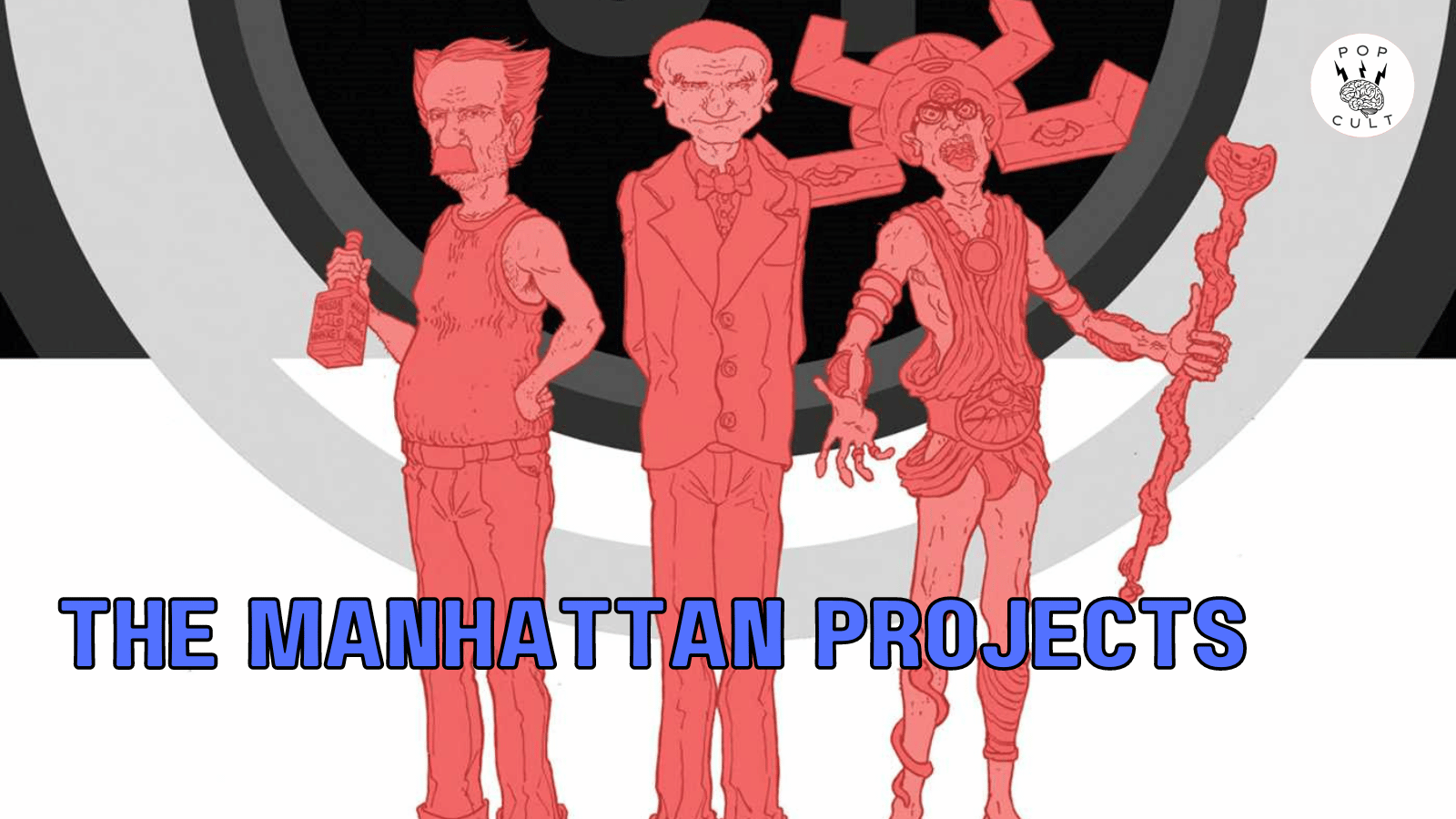
The Manhattan Projects Deluxe Book One (2014)
Reprints The Manhattan Projects #1-10
Written by Jonathan Hickman
Art by Nick Pitarra and Ryan Browne
The basic premise of Jonathan HIckman’s The Manhattan Projects is “What if the research and development department created to produce the first atomic bomb was a front for a series of other, more unusual, programs?” From this seed of an idea, Hickman and artistic collaborator Nick Pitarra developed alternate history versions of many well-known scientific figures of the mid-20th century. The names are familiar, but what they do and who they are in the context of this comic is a wild trip of discovery, comedy, and horror. At first glance, the books have a graphic design philosophy similar to Hickman’s Krakoa-era X-Men work, making them like artifacts from an alternate reality.
The series uses Robert Oppenheimer’s hiring as our introduction to this strange world. The first wrinkle the book introduces is that Robert has a twin brother, Joseph. General Leslie Groves, the military man in charge of The Manhattan Project, is aware that Joseph is a Communist and wants to make sure Robert doesn’t share those sentiments. Robert gets taken on a tour of the facility. We glimpse Albert Einstein sitting in a locked room, staring intensely at a strange block of stone.
The facility is invaded by the Japanese via a Red Torii gate Zen-powered by Death Buddhists, a shadow war happening while the more significant global conflict plays out. All the while, we get color-coded flashbacks to Robert and Joseph’s lives, the former red and the latter blue. By the end of this first issue, we know the truth about Robert and get a hint at the complex civil war happening within his own mind. It’s a very bold introduction to a strange and fascinating comic book.
As the series continues, each issue spotlights a different famous scientist while further developing the experiments in the facility. Eventually, the spotlight ends, and the book becomes a proper ensemble. Werner von Braun joins when he becomes aware of Operation Paperclip & murders his colleagues so the U.S. forces only have him to take back to the States. Enrico Fermi is a strange, almost goblin-like figure whose eponymous paradox plays a role in the arc his character experiences. Richard Feynman is portrayed as slightly narcissistic, yet he is about as close to being a “good guy” as we will get.
Even the Presidents play a part in this story. Franklin D. Roosevelt dies early in the series, but his consciousness is uploaded into a computer mainframe. He lives on as a complex artificial intelligence runs much of the Projects’ facility. Harry Truman is a Freemason cultist whose introduction in the comic is him acting as a high priest over a human sacrifice that resembles the iconography of Mayan culture.
The dropping of the atomic bomb in Japan results in alien intelligence reaching out to humanity for the first time and is the real engine driving the comic. Once these scientists realize how strong their firepower is versus these outsiders and what they could steal from the aliens, it becomes undeniable what they will do next. The Manhattan Project is even willing to join forces with their Soviet counterparts in the science metropolis of Star City. Dmitriy Ustinov, the real-life Soviet Minister of Defence, has ended up as a brain in a jar operating a mechanical body and serves as the Russian liaison to the Americans. He brings along cosmonaut Yuri Gagarin and iconic Russian space pooch Laika, who is super-intelligent and can speak.
The violence on display is pretty graphic, but not the worst I’ve seen in comics. The various scientists don’t seem to have much of a problem dissecting any and everyone they come across if it furthers their personal agendas. Oppenheimer has developed a means of absorbing knowledge by eating other people, which leads to a host of conflicting personalities becoming involved in his internal psychic war. Einstein proves to be a ruthless motherfucker, too, but that gets a reasonable explanation tied to the strange monolith he watches day and night.
This first volume takes place over more than a decade, and by the final chapter, John F. Kennedy is delivering his famous moon speech. One element confused me here, especially in the next volume: the timeline. Because the main characters use such advanced tech and rarely leave their underground science facility, it becomes hard to know precisely when we are. The presidents who appear make that a little better, giving us a range of times when each issue occurs.
The art by Nick Pitarra may not be what you expect, but it is just the perfect amount of detail & grotesque. His pencils play a significant role in giving The Manhattan Project its weird, unique tone. Characters’ faces will be marked with scars, wrinkles, double chins, etc. Von Braun, in particular, gets put through the meat grinder in this first volume and ends up as a head, torso, and right arm. The rest is replaced with primitive cybernetics forced onto his body and clearly not always fitting perfectly.
By the end of this first volume, the scientists working on the Project have realized they are in a position to do whatever they want, and the U.S. & Soviet governments simply don’t have the knowledge to stop them. The alien threat is still looming and will come into play in the second book. Oppenheimer remains the team’s most dangerous part; the final chapter here is inside his head. It’s a surreal odyssey akin to Being John Malkovich, where everyone is some variation on the host body. Hickman seems to posit that the type of mind that could develop something as horrific as the atomic bomb would be a place of pure nightmare. I don’t think he’s too far off.

 PopCult Reviews
One thought on “Comic Book Review – The Manhattan Projects Deluxe Book One”