
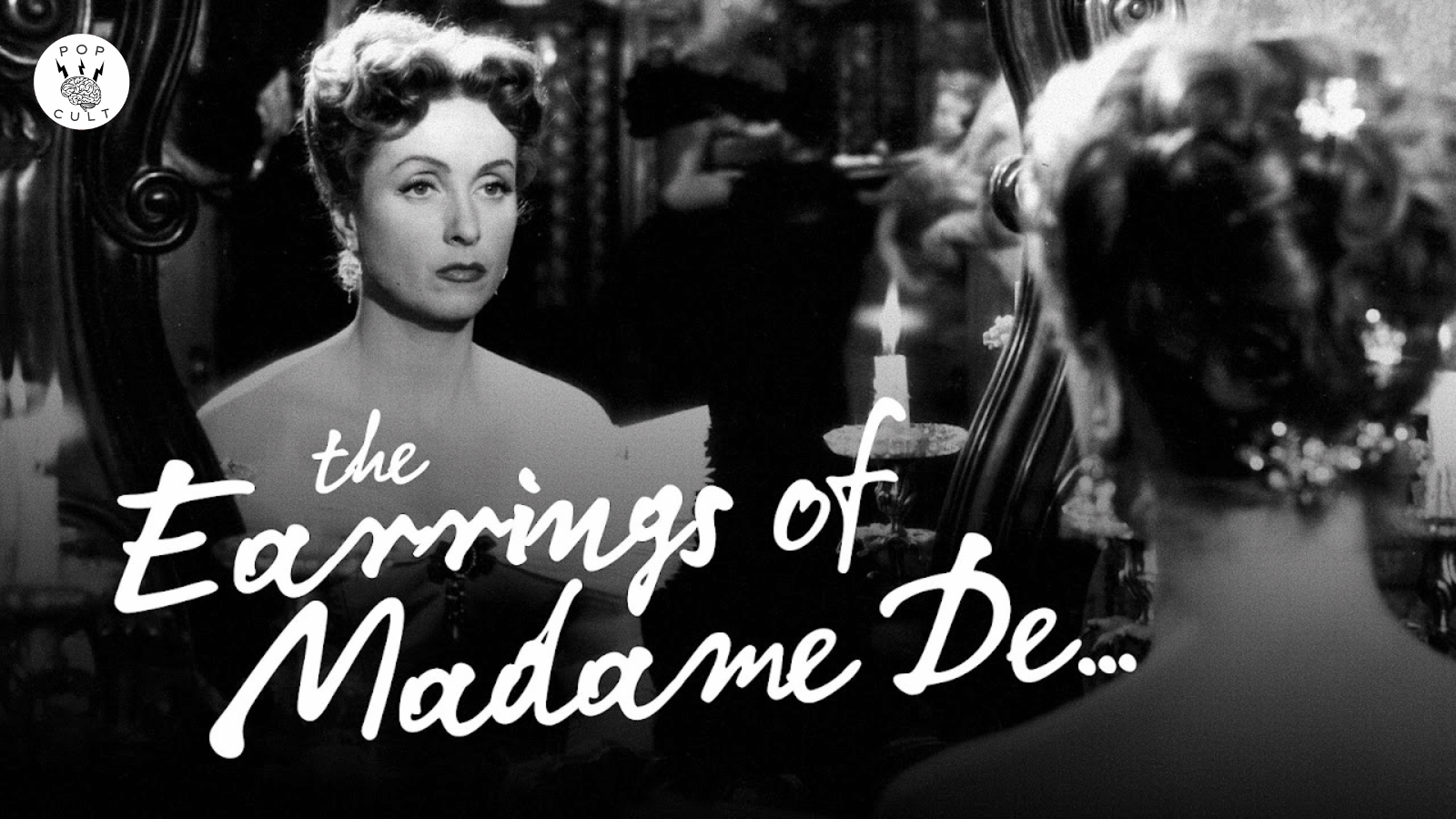
The Earrings of Madame De… (1953)
Written by Max Ophüls, Annette Wademant, and Marcel Achard
Directed by Max Ophüls
As with so many artists in Europe during the 1930s, Max Ophüls could see the rise of the Nazis and fled to France following the Reichstag Fire. He would continue his odyssey across the continent, attempting to stay ahead of the Nazis, making films along the way before reaching Portugal and heading to the United States. Ophüls would settle down in Hollywood for a few years, where he continued making movies, and once the war was over, he returned to Europe in 1950. It’s this period he’s become most known for, when he made his most acclaimed feature film, The Earrings of Madame De…
Shortly before World War I breaks out, we meet Louise (Danielle Darrieux), an aristocrat married to Andre (Charles Boyer), a count and general in the French Army. They are kind to each other, but it would be hard to argue that the same passion we can assume inflamed them at the start of their marriage still burned. They have no children and sleep in separate rooms in their large home. Because of Louise’s wealthy lifestyle, she has also amassed a lot of debt. To pay those off, she secretly sells a pair of heart-shaped diamond earrings Andre gave her for their wedding. While selling them to the same jeweler Andre purchased them from, she tries to disguise them, but he recognizes the items without letting Lousie know. Later, she concocts a ruse at the opera to convince Andre they have suddenly gone missing.
The earrings end up back in her possession when the jeweler speaks to Andre. Louise’s husband pretends he has bought her a replacement pair just before she departs on a holiday to Constantinople. After a losing streak in a casino, Louise sells the rings to a local jeweler. Baron Donati (Vittorio De Sica), an Italian diplomat living in the city, purchases them. Louise and Donati meet in Paris, and they fall madly in love. They attempt to carry on an affair while keeping Andre oblivious. But it’s only a matter of time until Louise’s secrets surface, and her life will be forever transformed.
Ophüls interest in the source novel came from the way the story revolved around the earrings, with them appearing to exit Louise’s life only to emerge again, often in unexpected ways. The earrings represent all the unspoken things between her and her husband, the admissions about their marriage, and how love has faded from it. It’s reported that Ophüls would speak with Darrieux between takes, and their conversations were often about the emptiness inside Louise and how that could be conveyed on screen. She possesses no culture, just a desire to spend money and have frivolous things, which her husband encourages. This shallow existence centered on consumption has left Louise completely hollowed out.
The two men Louise ends up torn between come to represent the struggling dualities within her. They are both men of privilege, but they view her very differently. Donati is the awakening of her desire, her connection to what love and passion actually feel like. Andre, a military man, represents death and comes to be the cause of multiple characters’ deaths, some directly and others inadvertently. While Andre exudes masculine energy, Donati has a slightly feminine persona. You can see it in how these men sit across each other: Donati leans back, a cigarette hanging from his mouth. Andre sits up straight, the medals on his ever-present military uniform catching the light. Pleasure versus control. The film goes back and forth from Louise’s perspective, letting us see both paths’ positives and negatives.
The film takes on an even grander existential pondering if we dig deeper. What happens when we mistakenly attribute destiny to things that happen by chance or manipulation. The earrings highlight these themes as Louise and Andre keep pretending to have found them when they passively aggressively test each other. Things become even more complicated when the earrings become a gift from Donati, causing Louise and us to question their significance now. Has their emotional connection to Andre been severed, or does it still linger? When death comes, the meaning of the earrings changes once again. Like Schrodinger’s Cat, they are now locked into one suitor. Ophüls cleverly obscures who that is, which is what makes the finale hit with such strong emotion. There was freedom in the limbo, but now, a choice has been made.
Ophüls employs camera techniques here that would become standards for other artists in future decades. The camera is a fluid creature, moving around very freely. It’s not quite a Steadicam, but you can see the push to get the device to function in that manner. Ophüls plays with time by piecing together a montage of a series of ballroom dances. Through Louise and Donati’s dances over weeks (seen by the audience in a matter of minutes), the development of their relationship is clearly communicated. These dances are captured in mirrors, fragmenting the bodies and their movements. With their circular movements, the waltzes feel like the passage of time in these people’s lives – constantly in motion but going nowhere.
There’s a sophistication to The Earrings of Madame De… that I think is hard to find in the cinema of our own era. These are characters in a melodrama living lavish lives, but there’s nothing aspirational about them. Melancholy hangs over them with only brief moments of relief when a passion overtakes someone, only to return to the stark reality of life. Ophüls has no interest in ensuring that his protagonist has a happy ending. That would be dishonest and cruel to her. The director wants to provide finality; he wants Louise to have answers no matter how much it hurts.
It should be noted that during the women’s liberation movement of the 1960s and 70s, Ophüls’s work was significantly reevaluated in the same manner Douglas Sirk’s work was. In their time, they were seen as directors of “women’s pictures, ” thus not creating “significant” art. However, when the perspective shifted, audiences & critics began to realize how wrong they had been to overlook the stunning complexity of a woman’s life and the tragedy of it all.

 PopCult Reviews
One thought on “Movie Review – The Earrings of Madame De…”