
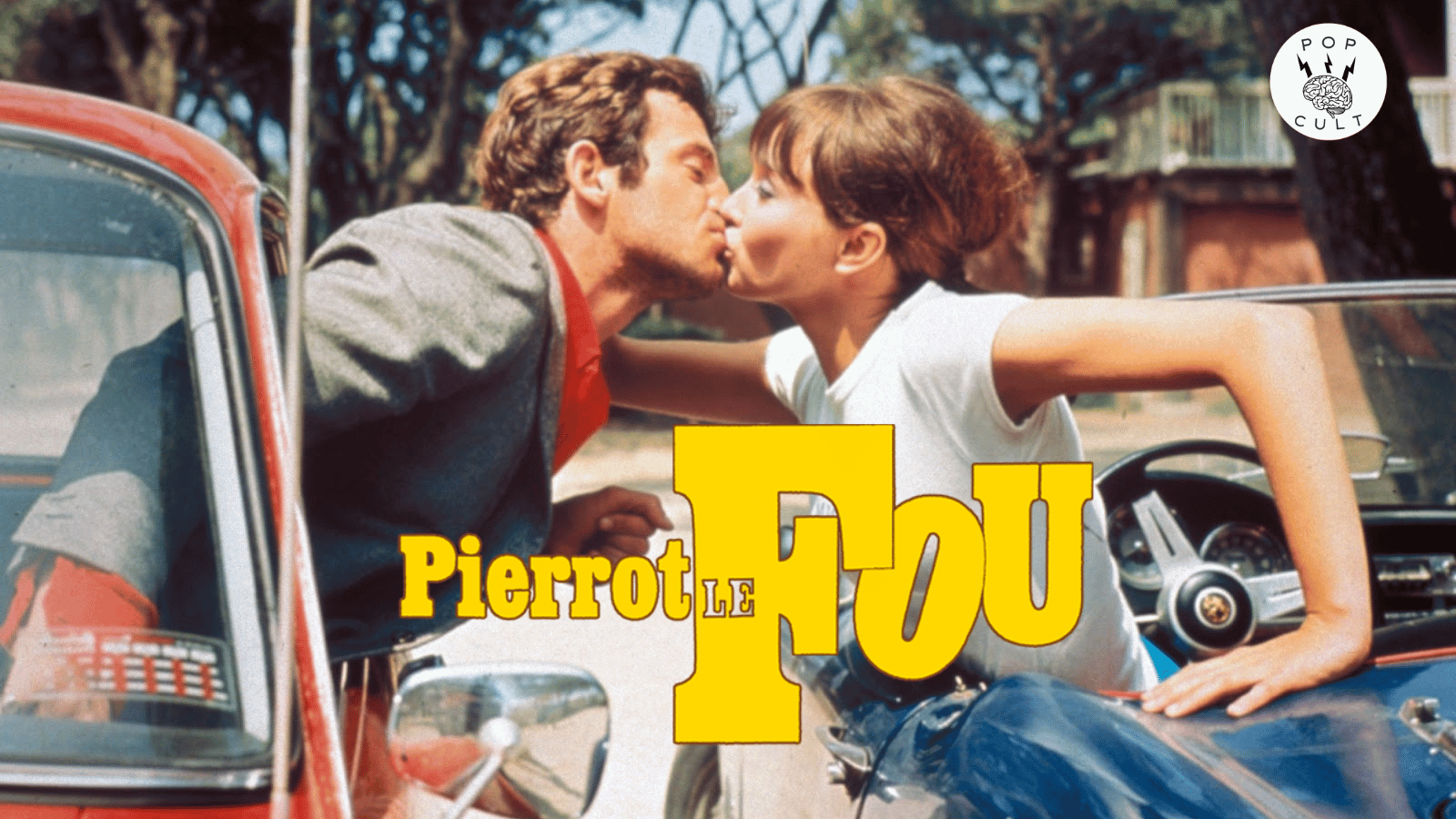
Pierrot Le Fou (1965)
Written and directed by Jean-Luc Godard
Will I ever watch all of Godard’s films? I’m not sure. Since my college days, I’ve watched them sporadically and never chronologically. Breathless. Masculin Feminin. Alphaville. Week-end. Contempt. Some I absolutely love, others I’m just confused by and probably need to revisit or read up on. This picture, made in the middle of Godard’s most productive period, was an adaptation of a recent crime novel, Obsession. Godard described the book as “the story of a guy who leaves his family to follow a girl much younger than he is. She is in cahoots with slightly shady people, and it leads to a series of adventures.” Casting ended up reuniting Godard with Jean-Paul Belmondo, his star from Breathless, and Godard’s wife at the time, Anna Karina, who took the lead female role.
Ferdinand (Belmondo) is an unhappily married family man recently fired from his job at a TV station. He goes to a party with his wife, and everyone’s conversations revolve around their recently bought products. They speak like they’re reading ad copy. Ferdinand returns home, where it is revealed the babysitter, Marianne (Karina), is secretly his ex-girlfriend, and he decides to run away with her. It’s soon revealed that Marianna is on the run from a far-right paramilitary group. She nicknames Ferdinand “Pierrot,” which means “sad clown,” reflecting what she sees this man as. They eventually find a respite on a deserted island in the Mediterranean, but their peace won’t last long.
Godard isn’t going to present us with a standard narrative; the French New Wave was all about breaking and playing with expectations and structures. Throughout the film, characters break the fourth wall, look directly at the camera, and comment on the situation while the other characters seem oblivious. Godard also continues playing with jump cuts and the juxtaposition of images. A cake is thrown at a woman’s face at the party. Just as it hits, he cuts to fireworks exploding in the sky. He also uses a technique where he cuts from one image to another, but in between is a third image seemingly unrelated to what is happening. There’s a moment in the film that clearly references the pop art movement with its distorted camera angles and vibrantly bold colors.
Godard pursues lofty philosophy through all his films, mainly the question, “How can we move film past characters and objects on the screen to complex ideas communicated through images?” I think the confusion the director’s work continues to elicit in audiences shows that he didn’t necessarily nail that. He is, however, like a social scientist combined with an artist, experimenting with the medium to see what reactions emerge and if what was in his mind is picked up by an open, willing audience. Terence Malick’s Badlands features similar Bonnie & Clyde-style characters, and like Godard’s protagonist, they retreat into nature to escape the law and society.
Godard’s marriage to Karina fell apart during this time. She was ten years younger than him and had left her partner in 1961 to be with the director. She appeared in eight of his films throughout their five-year marriage. She would later compare the relationship to the scenario of Pygmalion, with Karina as Eliza Doolittle, letting Godard mentor and shape her to his whims. I think it can be argued that the Godard/Karina collaborations were some of the most influential pieces of cinema in the art form’s history. Maybe that’s why they were doomed as a couple. Creative relationships like that can’t last for long. They are too volatile.
Their personal life was fraught with tumult, leading Karina to attempt suicide and be hospitalized in a mental institution at one point. Godard was insanely jealous but then suddenly absent from Karina’s life, only to return like nothing had happened. His film Contempt, not starring Karina, explores their relationship where Godard acknowledges he is in the wrong but seems unwilling or incapable of doing anything about it.
Pierrot le Fou has a rhythm to it. Sometimes it is a movie. Sometimes, it is the director’s canvas to play with an idea or express an opinion. This dichotomy could be daunting for someone familiar with traditional narrative cinema. Godard knew movies backward and forward, so he was adamant about upending our expectations. He gives himself room to voice dissent about the Vietnam War, how capitalism corrupted language, and whatever he was thinking about on his way to the set that morning. This means what the film lacks in a cohesive linear narrative, it makes up for in an overflow of ideas. I was surprised at how much comedy Godard employed. While humor is present in his other films, this one felt like he was putting in more of an effort in that regard.
At its core, this is an ironic tragedy. As Godard’s marriage to Karina was falling apart in real life, his film characters are a couple completely out of sync. Marianne is a dreamer, focused on the political aspects of the world and what effect, if any, she can have on them. Ferdinand is a horny middle-class dude that is turned on by the idea of running away and shirking responsibility. These are not static traits; as the film unfolds, they shift & change. The throughline, though, is one of fatalism. No matter this couple’s choices, they are doomed, romantically and in life.

 PopCult Reviews
Your analysis makes me want to re-watch this film and perhaps dive back into some of the other Godard films I’ve seen, with a fresh perspective. Thanks for sharing your insights!