
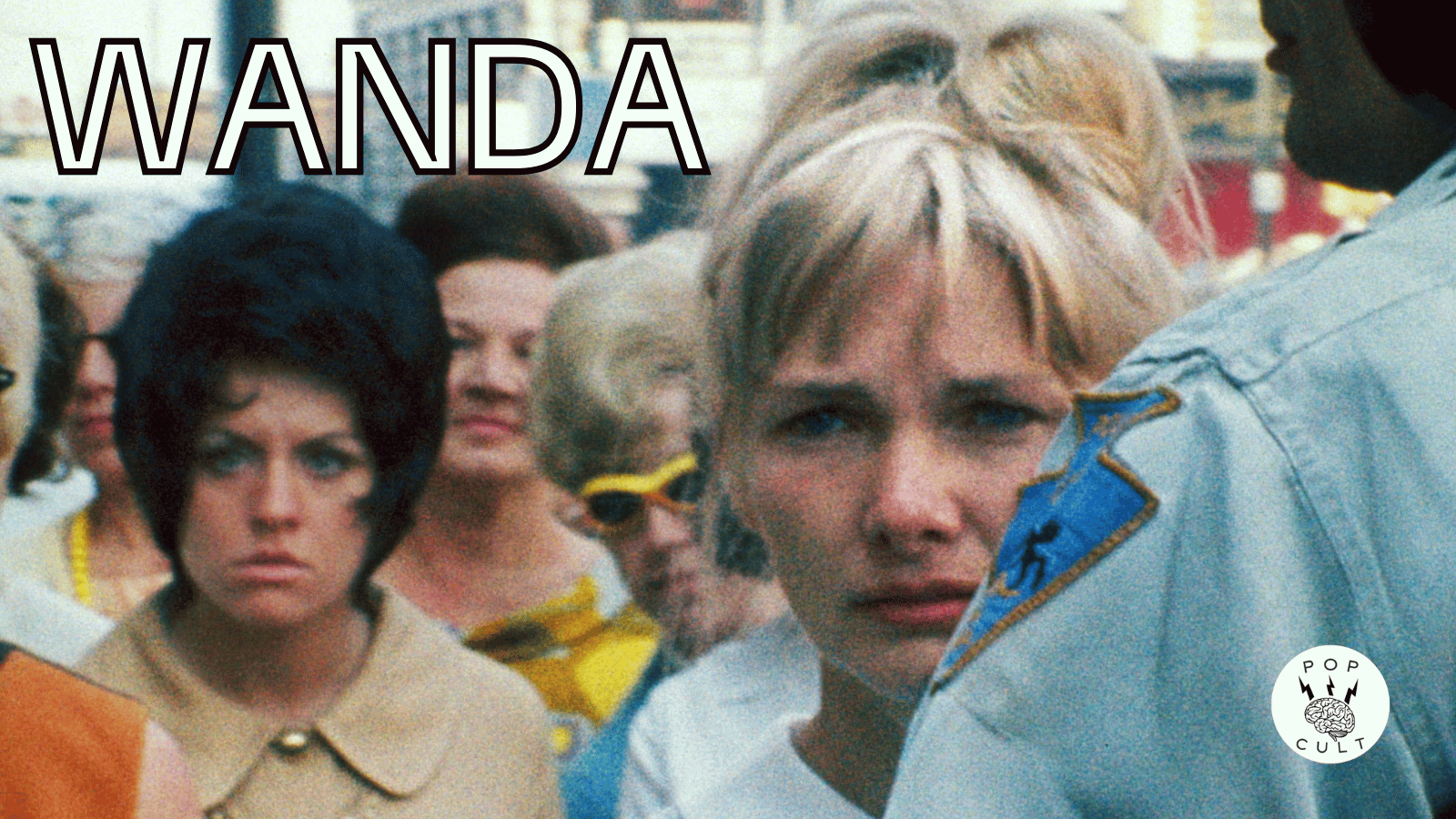
Wanda (1970)
Written and directed by Barbara Loden
The Actors Studio was founded in 1948 by Elia Kazan and his associates. The building in Hell’s Kitchen, New York, became a training ground for many of the mid-century’s greatest American actors, with Marilyn Monroe and Marlon Brando as two of the most notable. There are a host of character actors that developed their craft here as well. The most prevalent style of American acting from the late 1940s through 1980 directly resulted from what happened in this place. Barbara Loden was one of those people to hone their skills in the Studio. She would make a name for herself on the Broadway stage, winning a Tony Award for her performance in Arthur Miller’s After the Fall. In 1970, she wrote, directed, and starred in Wanda, an independent feature that earned her the description of “female counterpart to John Cassavetes” by the New Yorker.
Wanda (Loden) wakes up on her sister’s couch and rushes across the coal field that dominates her small town to arrive at divorce court. She relinquishes all her rights to her children, giving them to her husband and his new girlfriend. From there, she gets fired from her sewing factory job and decides to run away with a man with whom she has a one-night stand. He ditches her on the side of the road and enters a bar that’s being robbed. She’s unaware and thinks the man behind the counter is the bartender. Even after learning Mr. Dennis is a robber pursued by the police, Wanda doesn’t bat an eye. She goes on the run with him.
While the film was inspired by a newspaper report of a woman thanking a judge for sentencing her to 20 years for bank robbery, the character of Wanda is a version of Loden. On the matter, the filmmaker said, “It was sort of based on my own personality…A sort of passive, wandering around, passing from one person to another, no direction—I spent many years of my life that way and I felt that… well, I think that a lot of people are that way. And not just women, but men too. They don’t know why they exist.” Loden had grown up in the Appalachian Mountains of North Carolina, calling herself a “hillbilly’s daughter.” Her family apparently had a deep void of affection and emotion, so Loden became a shy, soft-spoken loner, yet something in her was restless. She understood the passivity being conditioned into her by society, but it didn’t sit well with her.
At the time of its release, Wanda didn’t garner much attention. Film critics reviewed it, but most people didn’t even know it existed. Everything about the film is very much in line with the popular cinematic aesthetics of the time. Films like Easy Rider opened the door for New Hollywood, an era where young filmmakers were able to make studio-financed pictures about their angst and ennui living in the decadent, capitalistic American society. Yet those films were dominated by masculinity, exploring men’s inner turmoil and often continuing to sideline women as sex objects. As the decade proceeded, men were still rising to the surface, particularly from UCLA’s film program with people like Coppola, Spielberg, Lucas, De Palma, Scorsese, and more. Elaine May (The Heartbreak Kid, Mikey & Nicky) was probably the most well-known female director during this period, and even then, her work has been criminally underrated and mostly forgotten by general audiences.
The character of Wanda is passive to a nearly absurd degree, but that’s part of the point Loden is trying to make. From the start, the emphasis is put on how messy this person is, undermining a lot of the social training Loden would have experienced in her youth. Arriving at court late would be considered an extremely unladylike, rebellious act. The judge might think this woman was disrespecting him as, in his eyes, she was subservient to him. Wanda commits another blasphemy by giving up her custody to her husband without a second thought. But aren’t all women ingrained with maternal programming to the point they will wither up and die if they can’t take care of children? No. Women are people, and like all people, some find fulfillment in child-rearing while others do not.
Contemporary American cinema has adopted a grating quality when it comes to women needing to portray them as physically tough girl bosses all the time. The comically absurd masculinity of men is applied to women, and we’re all supposed to think that’s some form of progress rather than the transposing of a flawed ideology onto women. Wanda is a tremendously flawed person, weak & clingy. But that’s a far more interesting character than some unrealistic uber person. The overpowered version of a woman is just as unrealistic a standard as the one for men. There’s far more to gain from a piece of art when it reflects the reality of life as we live it, as humans actually are with all their flaws.
Loden can capture the crushing, aimless despair of modernity, which is on full display in the opening sequence as a wide shot captures the speck of Wanda making her way across seemingly endless coal fields. This is a desolate place, but people live in it. It leads us to wonder what sort of people would such a place produce? If this is how they see the world their whole childhood and adulthood, what must their worldview be? A place like Los Angeles must be as real to them as Atlantis, with their geographic and economic distance from it.
Wanda’s overarching theme is about the hell of life as a woman in the United States. It’s not delivered like a sermon, shot almost entirely with a handheld camera, which gives the events urgency. William Friedkin spoke about applying documentary techniques to narrative cinema through The French Connection and The Exorcist. By not letting the camera operator know where the action is going, the picture suddenly takes on a spontaneous reality. In Wanda, it feels like we’re with a camera crew following this woman as she meanders from one place to the next. Wherever she goes, she’s met with exploitation or intense coldness. Barely any of these men see her as a fully realized person.
It’s not a feel-good movie, but it oozes with reality. When you reach the end, you’ll believe that Wanda’s life continues. It doesn’t seem like it will get markedly better, but that’s how life is for many people in the real world. You keep living until you die. Depending on who you are when you’re born or where that birth occurs, life will be a struggle. Wanda shares connective tissue with Dreyer’s The Passion of Joan of Arc in many ways. Where Joan is a devout religious fanatic whose torture elicits our sympathy, Wanda is a defiantly passive figure, but just like Joan, she’s seen as nothing by the men around her. Joan is the easier protagonist to empathize with; Wanda challenges our ability to see humanity in someone. Can a mother who abandons her children be someone worthy of dignity? The answer is yes because simplicity is not a virtue, and complexity is not a sin.

 PopCult Reviews
One thought on “Movie Review – Wanda”