
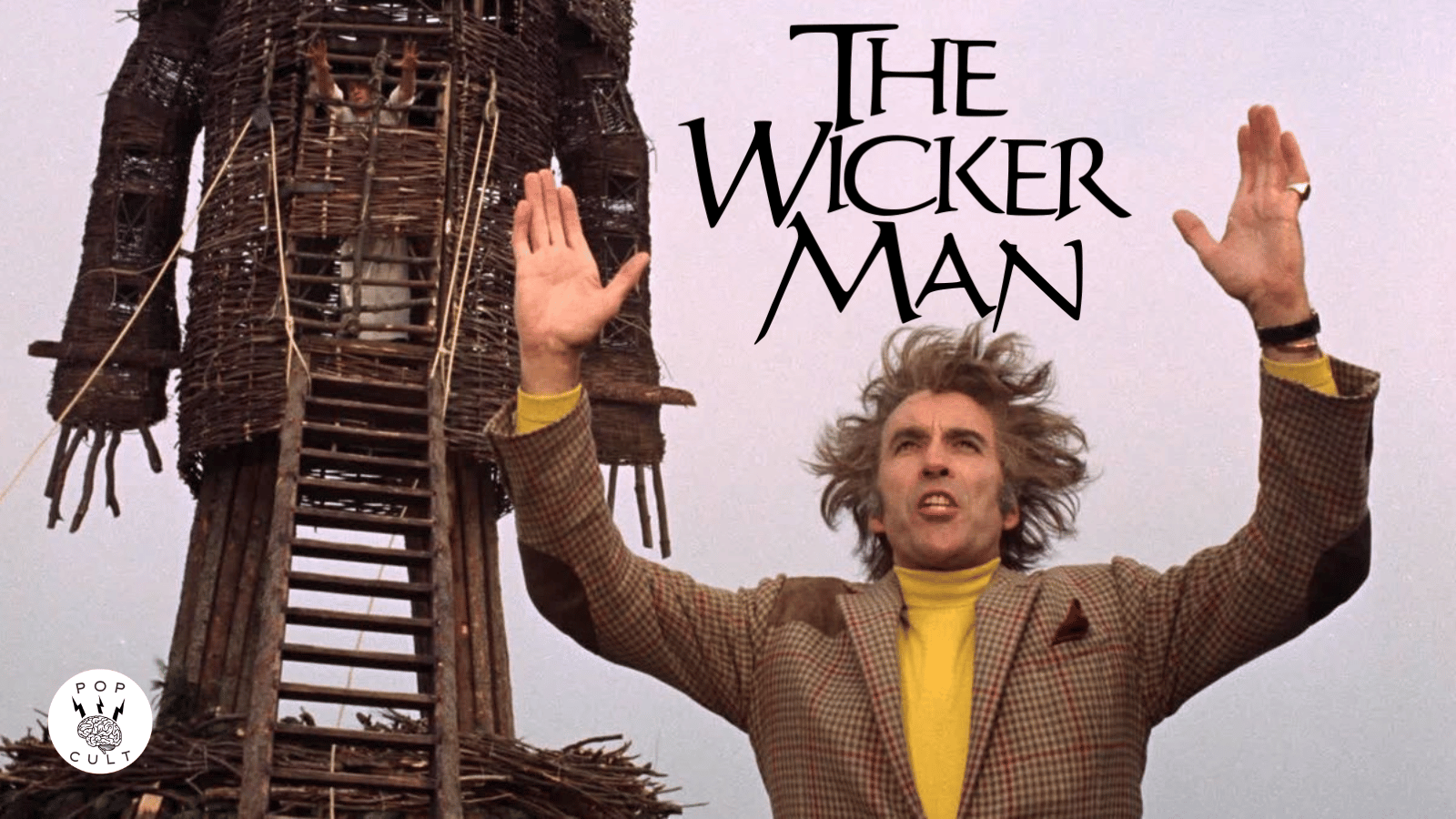
The Wicker Man (1973)
Written by Anthony Shaffer
Directed by Robin Hardy
I had seen the Nicolas Cage-led sequel in all its wild, camp glory but had never watched the film that inspired it. With it being October – the spooky month – I decided to kick off my Horrorpalloza 2024 with The Wicker Man. Before I even watched the film, I knew of the ending decades ago thanks to a Bravo series about the scariest movie moments. I wondered what knowing the protagonist’s fate would do with my thoughts on the film, but thankfully, there was so much of this movie I didn’t know about that I never felt deprived of surprises. It’s a movie that clearly inspired so many more films in the folk horror genre and still holds up after fifty-one years.
Sergeant Neil Howie (Edward Woodard) flies his seaplane into the harbor of Summerisle, a remote island in the Hebrides off the Scottish coast. He received an anonymous letter postmarked from the island about a missing girl, Rowan Morrison. However, the townsfolk cheerily insist they’ve never heard of the girl, though there is a Mrs. Morrison who runs the candy shop. The more Howie explores, the more he becomes disturbed by the island’s vibrant pagan roots, where acts of sex happen publicly in the fields at night, and young people dance naked to prepare for the upcoming harvest festival. The locals seem to delight in Howie’s apoplectic reactions, even taunting him. He meets with the island’s leader, Lord Summerisle (Christopher Lee), who invites him to investigate and even exhume a body from the cemetery.
But alas, all is not what it seems, and Howie doesn’t know he’s traveling deeper down a spiraling path that will ultimately destroy him. The irony is he’s given several opportunities to make a choice and invalidate this fate. Part of this is tied to Howie’s deeply held Protestant beliefs. Through hallucinatory flashbacks, we see Howie remembering his own communion when confronted with the sexual temptations offered by Summerisle. He’s also aggressively dismissive of the local customs, outright deriding the people as godless pagans who should abandon their traditions instead of the ones he deems correct. It’s actually pretty hard to root for this dogmatic prick.
That’s what makes the movie so fun. Howie is a complete shithead, and when he gets his final “reward,” I didn’t feel too bad about it. What I liked more was the ambiguity around the supernatural aspects. The Wicker Man could be read as literally being about a cult that worships slumbering old gods. Or is this a declining community whose current leader has made an outsider into a sacrificial lamb with promises that his death will reverse the declining trajectory of each year’s harvest? The look on Lord Summerisle’s face near the end shows a bit of apprehension as Howie yells from his cage that this won’t do anything and that the community will face worse problems next year. This aspect of the picture is perfectly crafted and leaves us wondering.
I was surprised with how close this movie comes to being a musical. Several folk songs are given a lot of production value – scored soundtrack, costumes, dancing – that may be a folk horror musical. It’s the most campy aspect of the film, dating it as something very much of its time. I would have liked this part toned down more and allowed for more weird horror instead of just odd. There’s lots of strange cavorting intended to lure Howie, like Alice, down the rabbit hole, but I can’t say I ever felt unnerved by it. Maybe that was because so much of the film takes place in bright daylight, but so did Midsommar, and I found that picture very unnerving.
I do wonder how the film would work with a different score. Think of Mark Korven’s work on The Witch, which evoked an eerie wilderness that unsettled its visitors at every turn. Music like this would be far more unsettling, even with the campy, silly visuals. Additions like Britt Eklund as the innkeeper’s daughter don’t do much for the film. The casting overall is fine, but there’s a minimal pool of character types. Multiple beautiful blondes and lots of leering creepy old men. If there was one change I would make in a remake, it would be to add some more unique personalities that would help Summerisle be even weirder.
Despite knowing Sergeant Howie’s final fate, I was still engaged and entertained by the picture. Christopher Lee as Lord Summerisle is perfect, a constantly grinning and confident leader who can exposit the history of the island without it feeling infodumpy. I wish we had a little more of this character because Lee is such a great actor and keeps us guessing what the Lord truly thinks of his island home’s situation. The script does an excellent job of slowly eking out information without revealing too much. That cheeky, creepy vibe makes me think this would pair well with Willy Wonka and the Chocolate Factory.
One more classic horror check off the list.

 PopCult Reviews
I appreciate the way you discuss the ambiguity between the supernatural and the rational, which highlights the film’s balance between folk horror and psychological suspense. Your observation about Sergeant Howie’s character is spot on: his dogmatic rigidity makes it hard to sympathize with him, which is an interesting dynamic for a horror film protagonist. Great review!
The ambiguous nature of supernatural elements can be even scarier when we think about it for the horror genre. Just as the unseen may unsettle us most of all, whatever actual supernatural force in The Wicker man might have existed is best left to our freedom to imagine. Indeed seeing humans acting more visually as the dangerous force can be even more haunting in The Wicker Man’s case.
When it comes to the building up of a human sacrifice in a horror film, no other film and certainly not the disreputable remake with Nicolas Cage can come close to what The Wicker Man achieved. Particularly in 1973 when horror films made good headway thanks to The Exorcist, Don’t Look Now and The Legend Of Hell House. Even with a dislikeable victim like Howie, it’s enough to make us pray that such a gruesome fate never happens to us. It’s what I remember Edward Woodward best for alongside The Equalizer and even more so one of my best memories of Christopher Lee. Thank you for your review.