
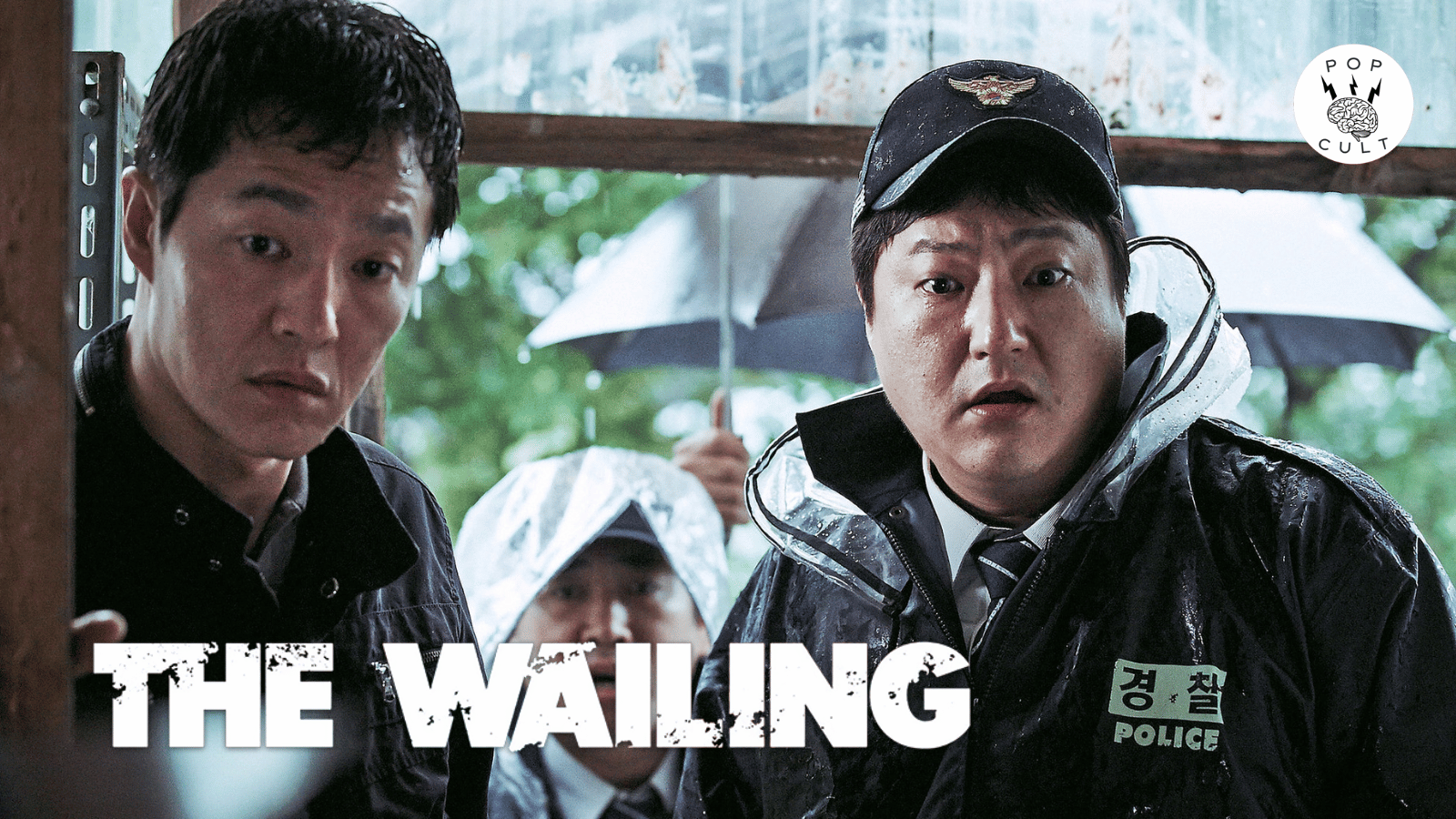
The Wailing (2016)
Written and directed by Na Hong-jin
I can’t say I fully understand the lore behind this film. I was also amazed by the tone, the tightrope between possession horror & Edgar Wright’s self-aware humor. It ends with a much heavier conclusion than a Wright film ever would, though. Scatterbrained is a good word to use when discussing this film, not as a pejorative but as an accurate descriptor. Filmmaker Na Hong-jin clearly has a lot to say about several topics, which is why the film clocks in at two and a half hours. Again, I can’t say I fully digested every piece of commentary, much of it because it’s clearly linked to Korean culture, and I do not have the background I should have on that.
A strange infection occurs in the village of Gokseong, tucked away in the mountains in the southern tip of South Korea. Those infected become increasingly deranged and violent, and their families suffer the worst of it. Officer Jong-goo is baffled by the crime scene he comes upon one day; the only survivor is a man covered in a red rash with strange eyes and unable to coherently communicate.
It becomes more personal for the investigator when he discovers his daughter Hyo-jin has become one of the infected. The root of this problem leads Jong-goo to a mysterious Japanese man living on the outskirts of town. An illegal investigation of the stranger’s home reveals a shrine with images and belongings of all those murdered. But this case is about to prove far more complicated than the officer believes.
Jong-goo is an unlikely protagonist, an oafish figure who acts impulsively and emotionally. He’s not the cool, calm, collected detective we expect from these stories. That’s one of many elements that makes this investigative horror so special. It’s an interesting conceit to have our main character taking actions that will cause the audience to groan or shake their heads.
This works partly because filmmaker Na Hong-jin cuts away all the fat; nothing that happens in this film is a side plot or unimportant. Every character and every scene is part of a larger whole. I was reminded several times of Luca Guadagnino’s Suspiria remake, my personal favorite horror film of the 2010s, which is dense like a novel but where every element ties together in the finale.
The first hour will lull the viewer into a false sense of safety. This is where most of the dark humor emerges, focused on Jong-goo. He’s out of his depth, growing increasingly overwhelmed as he comes to understand just how bad the situation in Gokseong is becoming.
This is not a case like the others he’s ever faced, his community doesn’t have brutal murders happening in it regularly. Now, he has a cabin full of photos of the dead, ravens showing up as omens of the doom to come, and haunting dreams he can’t escape. It would be easy to think this will be a silly mess watching that first hour, but it will flip you on your head in the second hour.
This is such a small community that Jong-goo has no supervisor. The mistakes he makes aren’t being called out by anyone. The audience is helpless, forced to watch as the officer pokes around, messes with things he shouldn’t, and the way he lets his anger ruin a situation.
Other characters behave in ways that don’t help either, and eventually, you start to feel the authenticity of this. When you look around, don’t you find that most people seem to lack the skills to handle a life-altering crisis? (see COVID-19) Especially when confronted with someone beyond their understanding of how the world works.
There is a loud & intense exorcism sequence near the end of the film that is a spectacle to be seen. It’s such a wave of energy that I felt myself oppressed by the intended effect. This is not just a song & dance; it invokes an evil spirit to bring it out of a human host and banish it. That should never be a tame, docile event.
The filmmaker manages to imbue every scene with importance, and by the end, you will feel as exhausted and drained as Jong-goo. Your brain will try to figure things out the whole time; no clear answer will ever be given by the end. Life has descended into horror, and Jong-goo must accept his new reality.

 PopCult Reviews
One thought on “Movie Review – The Wailing”